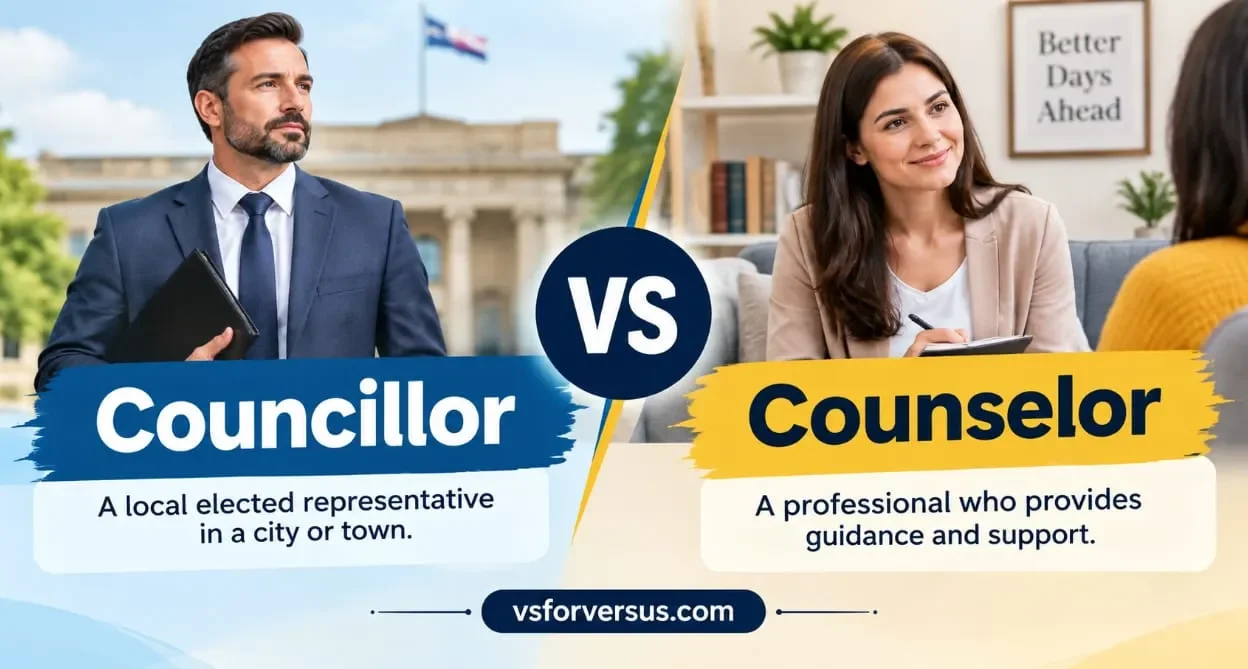
Councillor vs Counselor these two words sound almost identical when spoken but have entirely different meanings and uses. Many people get confused when writing, unsure which word fits which context, which can lead to incorrect spelling or a wrong message.
A Councillor refers to an elected or appointed member who serves on a local government body, council, or committee, taking part in policy making and administrative decisions. A Counselor, on the other hand, is someone who provides advice, guidance, or professional support, whether related to mental health, career choices, or legal matters.
In this article, we’ll break down the detailed differences between these two terms, their correct usage, and real life examples so you never mix them up again.
Quick Answer
A councillor is a person elected or appointed to serve on a local government council, such as a city or town council. A counselor is a person who gives advice, guidance, or therapy, such as a school counselor or mental health counselor. The two words are pronounced identically, which is why the councillor vs counsellor mix up happens so often, but they describe completely different jobs, and British English spells the second word “counsellor.”
Councillor vs Counselor at a Glance
Before diving into full definitions, here’s the councillor vs counselor comparison in one scannable table.
| Word | Part of Speech | Meaning | Example |
| Councillor | Noun | A member of a local government council | “She was elected as a city councillor last spring.” |
| Counselor | Noun | A person who gives advice, guidance, or therapy | “He met with a school counselor about his college options.” |
| Councilor (US spelling) | Noun | Same as councillor, American spelling variant | “The councilor proposed a new zoning law at Tuesday’s meeting.” |
| Counsellor (UK spelling) | Noun | Same as counselor, British spelling variant | “She’s training to become a marriage counsellor in Leeds.” |
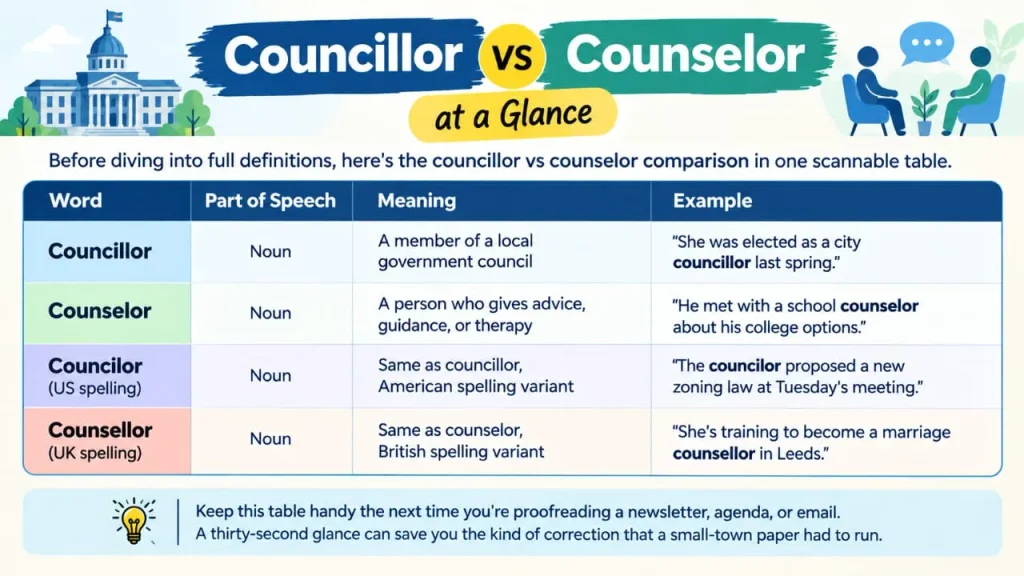
Keep this table handy the next time you’re proofreading a newsletter, agenda, or email. A thirty second glance can save you the kind of correction that a small town paper had to run.
What Does “Councillor” Mean?
A councillor is someone who serves as an elected or appointed member of a governing council, most often a city, town, or borough council. Councillors debate local policy, vote on budgets, approve zoning changes, and represent the concerns of the residents who elected them.
It’s fundamentally a civic role: the word describes membership in a governing body, not any kind of advisory or emotional support function.
In American English, the word is usually spelled “councilor,” with one L. In British, Canadian, and Australian English, it’s “councillor,” with two Ls. Both refer to the same role; the spelling simply follows regional convention, the same way “color” and “colour” do.
You’ll see this word most often in local government contexts, civic newsletters, meeting minutes, and election coverage:
- “The councillor voted against the proposed parking fee increase at Monday’s session.”
- “Our ward’s new councillor promised to fix the potholes on Elm Street by spring.”
- “As a first term councillor, she’s still learning how the budget approval process works.”
- “The town council welcomed three new councillors after last month’s election.”
If you’re writing about anyone who sits on a governing body, student council, city council, tribal council, or an advisory board, councillor is almost certainly the word you want. A quick test: if the sentence involves voting, policy, or a seat on a council, you’re in councillor territory.
What Does “Counselor” Mean?
Counselor works differently. Rather than a government seat, it describes someone who gives advice, guidance, or professional support. This is a broad umbrella term that covers school counselors, mental health counselors, career counselors, camp counselors, HR counselors, and even lawyers, who are sometimes formally addressed as “counselor” in a courtroom setting. The word signals expertise in advising or supporting people, not membership in any governing body.
The American spelling is “counselor,” with one L. The British spelling adds a second L, becoming “counsellor,” following the same pattern as councillor and councilor.
Here’s how the word shows up in everyday writing:
- “My daughter’s guidance counselor helped her narrow down her college applications.”
- “I finally started seeing a counselor after the stress at work became unmanageable.”
- “The camp counselor kept twenty kids entertained through a rainstorm without a single meltdown.”
- “Please loop in HR’s employee relations counselor before you send that email to the whole team.”
Notice that none of these examples involve government, elections, or public policy. That contrast is the fastest way to sense-check which word you actually need in a given sentence.
Key difference between Councillor vs Counselor
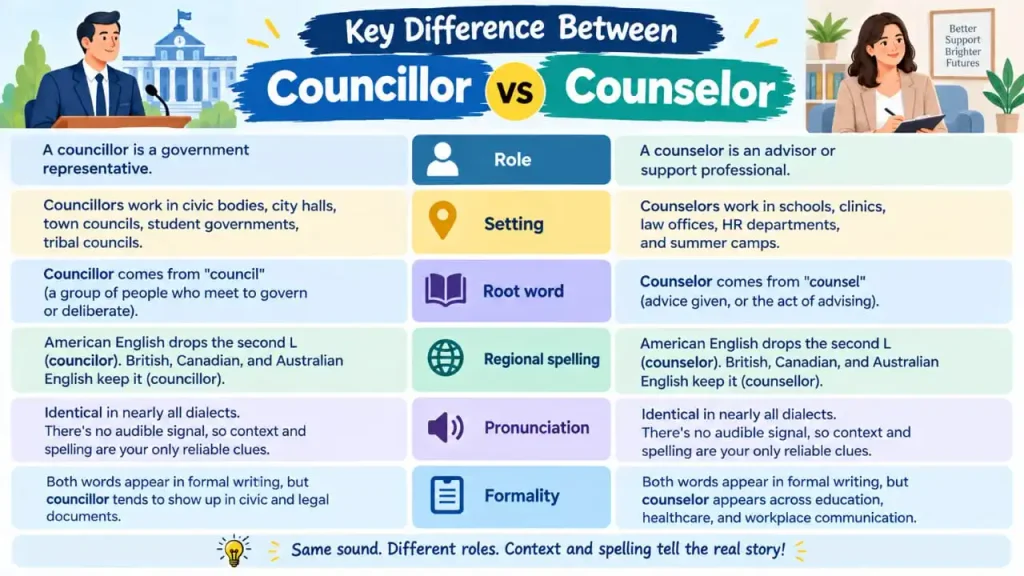
Once you strip away the identical pronunciation, the difference between these two words comes down to a few clear, memorable rules:
- Role: A councillor is a government representative; a counselor is an advisor or support professional.
- Setting: Councillors work in civic bodies, city halls, town councils, student governments, tribal councils. Counselors work in schools, clinics, law offices, HR departments, and summer camps.
- Root word: Councillor comes from “council” (a group of people who meet to govern or deliberate). Counselor comes from “counsel” (advice given, or the act of advising).
- Regional spelling: American English drops the second L in both words (councilor, counselor). British, Canadian, and Australian English keep it (councillor, counsellor).
- Pronunciation: Identical in nearly all dialects. There’s no audible signal, so context and spelling are your only reliable clues.
- Formality: Both words appear in formal writing, but councillor tends to show up in civic and legal documents, while counselor appears across education, healthcare, and workplace communication.
The Third Word People Confuse: Therapist
The councillor vs counselor confusion often pulls in a third word: therapist. It’s a licensed clinical role. A therapist typically holds a master’s degree or higher and diagnoses and treats mental health conditions over the long term, using structured, evidence-based approaches.
A counselor often provides shorter term, situational support around a specific issue, like stress, a career decision, or a family conflict, and doesn’t always require the same level of licensure. A councillor, meanwhile, has nothing to do with either role. It’s purely a government position focused on civic decision making.
Think of it as a simple chain: a councillor governs, a counselor guides, and a therapist treats. Keeping that order in mind clears up most three way mix ups on the spot, whether you’re writing a school newsletter or describing your own support network to a friend.
Why Do Councillor vs Counselor Sound So Similar?
The overlap isn’t an accident of modern spelling; it goes back to Latin. “Council” descends from concilium, meaning an assembly or gathering of people called together to deliberate.
“Counsel” comes from consulere, meaning to consult or to advise. Two related-sounding roots drifted into two nearly identical English words, and centuries later, we’re still sorting them out in emails, headlines, and social media captions.
Even professional writers who’ve used both words for years occasionally catch themselves rereading a sentence to double check which one they meant, especially when typing quickly or working from a template. That’s worth remembering: this isn’t a sign of weak grammar. It’s a genuine quirk of English, built into the language’s history.
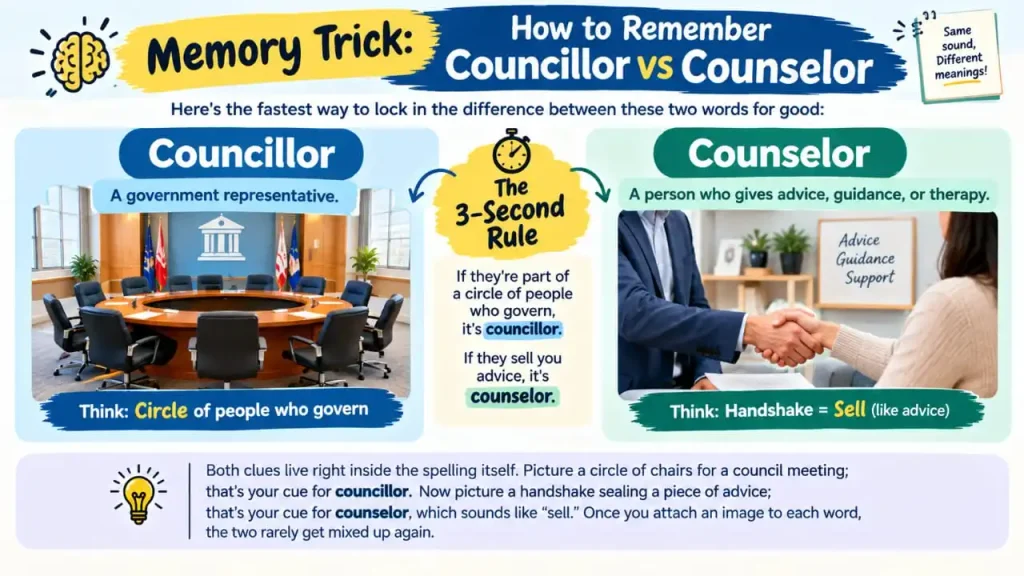
Memory Trick: How to Remember Councillor vs Counselor?
Here’s the fastest way to lock in the difference between these two words for good:
The 3 second rule: If they’re part of a circle of people who govern, it’s councillor. If they sell you advice, it’s counselor.
Both clues live right inside the spelling itself. Picture a circle of chairs arranged for a council meeting; that circle is your cue for councillor. Now picture a handshake sealing a piece of advice; that handshake is your cue for counselor, which sounds like “sell.” Once you attach an image to each word, the two rarely get mixed up again.
Common Mistakes with Councillor vs Counselor
Even confident writers slip on the councillor vs counselor pair, especially under deadline pressure or when autocorrect quietly “fixes” the wrong word. Here are the errors that show up most often, corrected side by side:
| ❌ Wrong | ✅ Correct |
| “She’s the school councillor.” | “She’s the school counselor.” |
| “He was elected town counselor.” | “He was elected town councillor.” |
| “My counselor voted against the new bylaw.” | “My councillor voted against the new bylaw.” |
| “I’m seeing a councillor about my anxiety.” | “I’m seeing a counselor about my anxiety.” |
| “councelor” | “counselor” (US) or “counsellor” (UK) |
That last one deserves a second look, because it comes up constantly in real search queries and casual writing. Plenty of people genuinely aren’t sure whether the correct spelling has an “e” in the middle at all. It doesn’t, in either regional version. The confusion just proves how easily this pair trips people up, typos included, and why it’s worth pausing before you hit send on anything official.
Quick Quiz: Test Yourself
Try filling in each blank before checking your answer below.
- “The city ___ proposed a new recycling program at last night’s meeting.” (councillor/counselor)
- “She works as a career ___ at the local high school.” (councillor/counselor)
- True or false: Councillor and counselor are pronounced differently.
- Which British spelling refers to a therapy-adjacent advisor: counselor or counsellor?
- “He’s running for re election as town ___ this November.” (councillor/counselor)
Answers: 1) councillor 2) counselor 3) false, they’re pronounced the same 4) counsellor 5) councillor
FAQ: Councillor vs Counselor
What is the correct spelling of councillor?
In British, Canadian, and Australian English, it’s “councillor,” with two Ls. In American English, it’s usually “councilor,” with one L.
What is the correct spelling of counselor?
American English uses “counselor,” with one L. British English uses “counsellor,” with two Ls.
Is councillor a real word?
Yes. It’s a standard, dictionary recognized word for a member of a governing council, with regional spelling variations depending on where you’re writing.
What’s the plural of councillor?
Simply add an “s”: councillors (or councilors, in American spelling). The same rule applies to counselor, which becomes counselors.
Can a councillor also be called a counselor?
Only if that same person separately works in an advisory role outside of their council seat. The two titles describe unrelated jobs and shouldn’t be swapped by default, even if one person happens to hold both.
Why do councillor and counselor sound the same?
They’re true homophones, identical in speech despite their different spellings, meanings, and Latin roots. That overlap is precisely why the councillor vs counselor question keeps coming up in search results, classrooms, and newsrooms alike, and probably will for as long as both words exist.
The Bottom Line
None of this requires memorizing grammar rules. It just requires one quick mental check before you hit publish or send: ask yourself whether the person sits on a governing body or offers advice and support. If it’s the former, you want the word built on “council.”
If it’s the latter, you want the one built on “counsel.” Bookmark the comparison table above, run through the 3 second rule when you’re unsure, and you’ll spell it correctly whether you’re writing a city council update, a school newsletter, or a quick note to HR.
To read more: Comradery vs Camaraderie: The Essential Guide to Correct Spelling (2026)

Marcus is a former product manager turned comparison writer who spent eight years testing tools and gadgets before quitting to write full-time. He specializes in breaking down tech and software matchups into plain-English verdicts, with a soft spot for buying guides nobody else wants to write.