
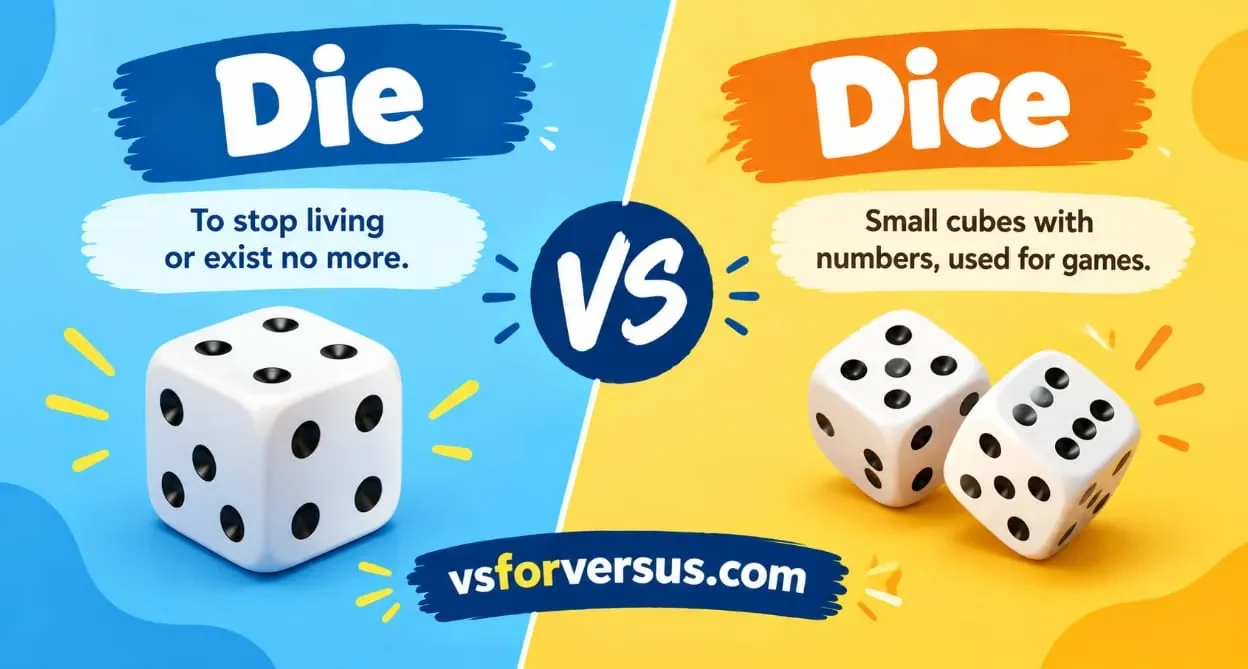
Die vs Dice: This pair often trips people up, but not for the reasons you’d expect. Unlike many confusing word pairs, the confusion here isn’t about meaning at all; it’s about grammar and number. Die is technically the singular form, referring to one small cube marked with numbers or dots used in games of chance.
On the other hand, dice is the plural form, referring to two or more of these cubes used together. Over time, however, everyday spoken English has blurred this line, with “dice” often being used informally as both singular and plural, leaving “die” sounding overly formal or even old fashioned to many ears. Interestingly, “die” also carries a completely unrelated meaning, to stop living, which adds another layer of confusion for language learners.
In this article, we’ll unpack the grammatical history behind these two words, clarify when each form is appropriate, and settle the singular versus plural debate once and for all.
Quick Answer
In the die vs dice comparison, “die” is always the singular noun, referring to one small numbered cube, while “dice” is its plural, referring to two or more cubes, so you’d say “roll a die” for one and “roll the dice” for several. That said, in casual speech and in British and Australian English, “dice” has become widely accepted as both singular and plural, meaning “roll a dice” for one cube is common and understood there too.
In formal, academic, and American English, however, the traditional distinction still holds, and “die” remains the expected singular form. So if you’re ever unsure which word to reach for, the safest rule is simple: use “die” for one cube and “dice” for more than one, and adjust only if you know your audience prefers otherwise.
Die vs Dice at a Glance
Before diving into the details, here’s the die vs dice comparison in one place:
| Word | Part of Speech | Meaning | Example |
| Die | Noun (singular) | One small cube with numbered or dotted sides, used in games of chance | “He rolled a die and got a six.” |
| Dice | Noun (plural) | Two or more of those cubes | “She rolled the dice and moved five spaces.” |
| Dice | Noun (informal singular) | Used for a single cube in casual or British English | “Hand me a dice, I only need one.” |
| Dice | Verb | To cut food into small, even cubes | “Dice the onions before adding them to the pan.” |
What Does “Die” Mean?
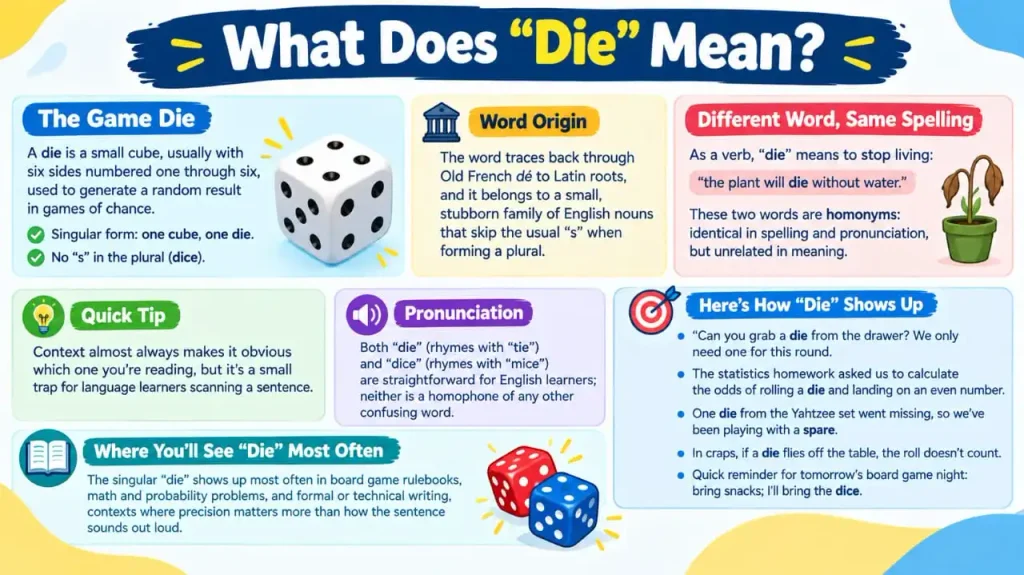
A die is a small cube, usually with six sides numbered one through six, used to generate a random result in games of chance. It’s the singular form: one cube, one die. The word traces back through Old French dé to Latin roots, and it belongs to a small, stubborn family of English nouns that skip the usual ” s” when forming a plural.
Worth clearing up early: “die” is also a completely different word when used as a verb, meaning to stop living: “the plant will die without water.” These two words are homonyms: identical in spelling and pronunciation, but unrelated in meaning.
Context almost always makes it obvious which one you’re reading, but it’s a small trap for language learners scanning a sentence. On pronunciation, both “die” (rhymes with “tie”) and “dice” (rhymes with “mice”) are straightforward for English learners; neither is a homophone of any other confusing word, so once you’ve heard them once, you won’t mispronounce them.
Here’s how “die” shows up in real writing:
- “Can you grab a die from the drawer? We only need one for this round.”
- “The statistics homework asked us to calculate the odds of rolling a die and landing on an even number.”
- “One die from the Yahtzee set went missing, so we’ve been playing with a spare.”
- “In craps, if a die flies off the table, the roll doesn’t count.”
- “Quick reminder for tomorrow’s board game night: bring snacks; I’ll bring the dice.” (a text where “dice” covers the whole set, not just one)
You’ll see the singular “die” most often in board game rulebooks, math and probability problems, and formal or technical writing, contexts where precision matters more than how the sentence sounds out loud.
What Does “Dice” Mean?
Dice is the plural of die, two or more cubes, but it’s also widely used, especially outside the U.S., as a singular. This dual role is what makes the die vs. dice question so genuinely tricky: the “wrong” answer in one dictionary is the standard answer in another.
Examples of “dice” in everyday use:
- “They rolled the dice and moved seven spaces, landing right on a hotel.”
- “Yahtzee comes with five dice, so keep track of all of them.”
- “I picked up a new set of dice at the game store for tonight.”
- “Can you toss me a die? Just one, I dropped mine under the couch.” (informal, singular)
- “Just posted a pic of my new dice collection, 40 sets and counting!” (a caption where “dice” reads naturally as plural)
There’s also a completely separate use worth knowing: dice as a verb, meaning to cut food into small, even cubes, “dice the peppers finely” or “she diced the mango for the salsa.” It has nothing to do with games, but the identical spelling trips people up in recipe writing more often than you’d think, and it’s yet another homonym pair layered onto an already confusing word.
Die vs Dice: Which One Should You Use? (AmE vs BrE)
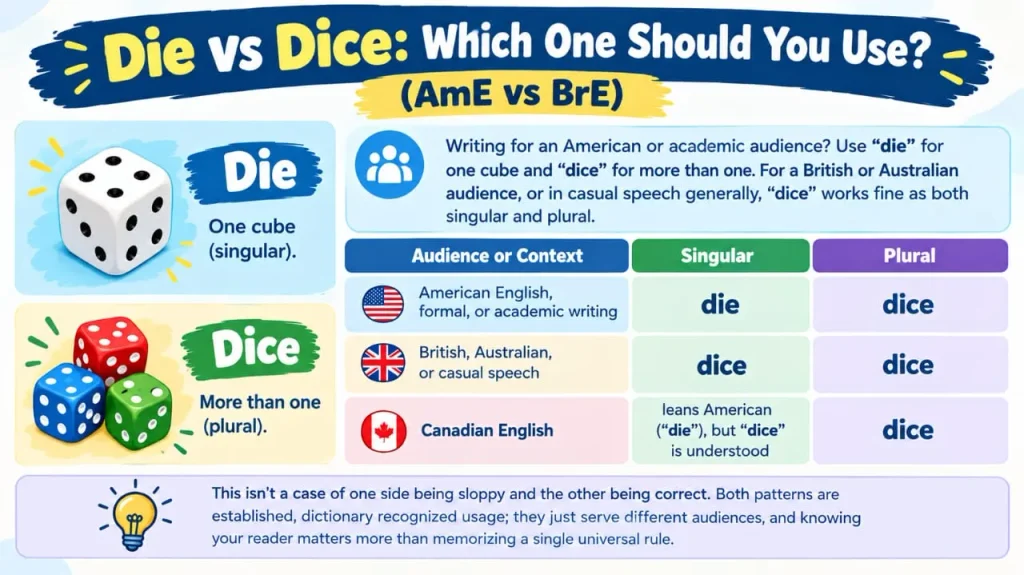
Writing for an American or academic audience? Use “die” for one cube and “dice” for more than one. For a British or Australian audience, or in casual speech generally, “dice” works fine as both singular and plural.
| Audience or Context | Singular | Plural |
| American English, formal, or academic writing | die | dice |
| British, Australian, or casual speech | dice | dice |
| Canadian English | leans American (“die”), but “dice” is understood | dice |
This isn’t a case of one side being sloppy and the other being correct. Both patterns are established, dictionary recognized usage; they just serve different audiences, and knowing your reader matters more than memorizing a single universal rule.
Why Even Careful English Speakers Disagree About This
What surprises most learners is this: it isn’t just an ESL problem, and it isn’t new. Die and dice make up one of the few irregular English plurals actively shifting in real time.
Most of English’s irregular plurals, mouse/mice, goose/geese, foot/feet, come from a historical sound change called i mutation, where an old plural ending altered the vowel in the root word. That’s why these pairs don’t just add ” s”; the whole word shape changes. Die and dice followed the same ancient pattern.
But unlike mouse/mice, which nobody debates, “dice” has drifted so far into everyday singular use that some major dictionaries now list it as standard both ways. Feeling confused doesn’t mean you missed a rule everyone else already knows; it means the language itself is genuinely in motion, and you’re catching it mid shift.
Key Differences Between Die vs Dice
- Die is singular (one cube); dice is plural (two or more cubes)
- Die is the standard choice in American, formal, and academic writing.
- Dice functions as both singular and plural in British and casual English
- Dice also works as a verb meaning “to cut into cubes” in cooking.
- Die is also an unrelated homonym meaning “to stop living” as a verb.
- The idiom “the die is cast” always uses die, never “dice”, no matter your audience.
- When you’re unsure, default to die for one, dice for more than one; this choice is never technically wrong.
How to Remember the Difference: Die vs Dice
A few tricks make die vs. dice easier to recall on the spot:
- Pattern match: “One foot, two feet. One die, two dice.” If you already trust that pattern, lean on it here too.
- Letter count: “Die” is short; think of it as the single cube. “Dice” has extra letters for the extra cubes.
- Idiom anchor: Remember “the die is cast.” That phrase is always singular, so it’s a quick, reliable proof that “die” means one.
Common Mistakes with Die vs Dice
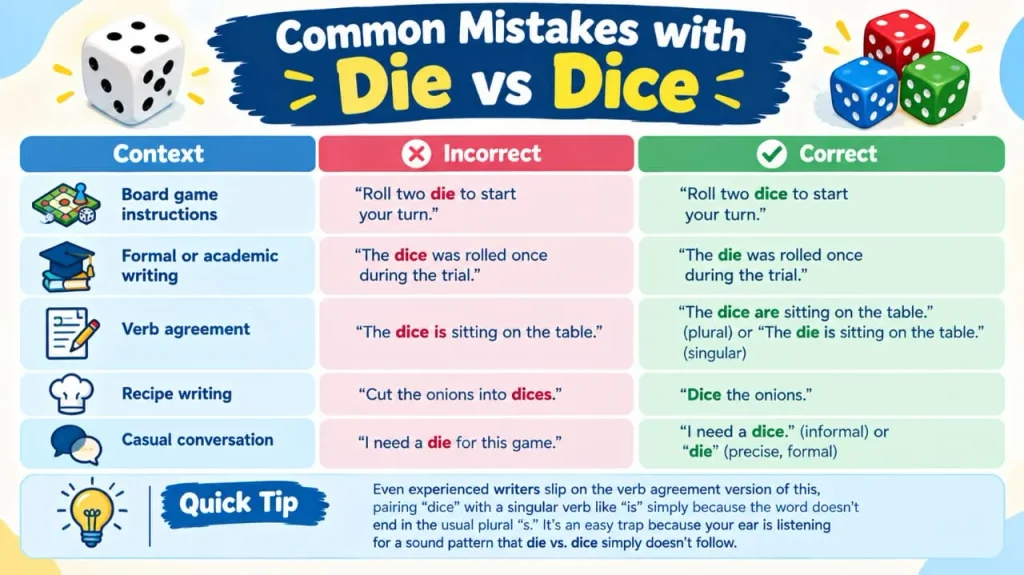
| Context | ❌ Incorrect | ✅ Correct |
| Board game instructions | “Roll two die to start your turn.” | “Roll two dice to start your turn.” |
| Formal or academic writing | “The dice was rolled once during the trial.” | “The die was rolled once during the trial.” |
| Verb agreement | “The dice is sitting on the table.” | “The dice are sitting on the table.” (plural) or “The die is sitting on the table.” (singular) |
| Recipe writing | “Cut the onions into dices.” | “Dice the onions.” |
| Casual conversation | “I need a die for this game.” | “I need a dice.” (informal) or “die” (precise, formal) |
Even experienced writers slip on the verb agreement version of this, pairing “dice” with a singular verb like “is” simply because the word doesn’t end in the usual plural ” s.” It’s an easy trap because your ear is listening for a sound pattern that die vs. dice simply doesn’t follow.
Quick Quiz: Test Yourself on Die vs. Dice
- “Roll the ___ to see who moves first.” (two cubes), dice
- “Only one ___ was left in the box.”, die.
- Fill in the blank: “The ___ is cast.”, die.
- True or False: “Dice” is always incorrect as a singular. False
- Which is correct in formal writing: “The die was loaded” or “The dice was loaded”? “The die was loaded.”
FAQ
Is dice singular or plural?
Dice is technically the plural of die, but it’s widely accepted as singular too, especially in British and casual English.
What is the plural of die?
The plural of die is dice.
Can you say “a dice”?
Yes, it’s informal and common in British and Australian English, though American and formal writing prefer “a die.”
Is it correct to say “roll the dice” for one die?
It’s common and understood in speech, but formal writing would use “roll the die” for a single cube.
Why is die the singular of dice?
It comes from an irregular plural pattern in English, similar to mouse/mice or foot/feet, inherited from Old French and Latin roots.
What does “the die is cast” mean?
It means a decision has been made and can’t be undone; the idiom always uses the singular “die,” never “dice,” regardless of style.
Is dice an irregular plural?
Yes. Like mouse/mice and foot/feet, dice forms its plural through a historical vowel change rather than adding ” s.”
Is “die” the same word as “die” meaning to stop living?
No, they’re homonyms. The gaming “die” and the verb meaning “to stop living” are spelled and pronounced the same but are completely unrelated in origin and meaning.
Final Thoughts
At the end of the day, die vs dice comes down to two things: number and audience. Use die for one cube and dice for more than one if you’re writing formally or for an American reader. Relax that rule for casual or British/Australian contexts, where dice comfortably covers both.
Whether you’re drafting a board game rulebook, a recipe, or just replying to an office email about game night, remembering this one distinction will keep your writing clear and might just save you from becoming the next reply all thread.
To read more: Denounce vs Renounce: 5 Ultimate Differences You Need to Know

Marcus is a former product manager turned comparison writer who spent eight years testing tools and gadgets before quitting to write full-time. He specializes in breaking down tech and software matchups into plain-English verdicts, with a soft spot for buying guides nobody else wants to write.