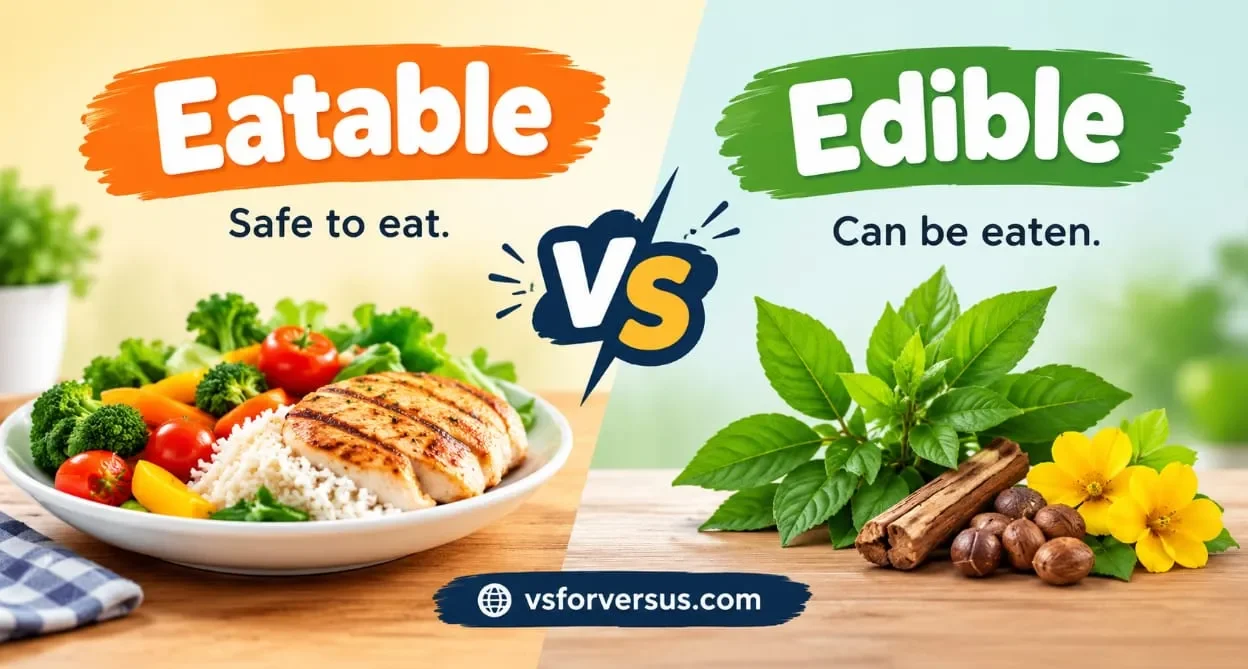
Eatable vs Edible: These two words often get used interchangeably, but they carry subtly different shades of meaning that many writers overlook. Both describe something that can be eaten, yet the context in which each word feels natural sets them apart.
Eatable typically refers to food that is fit or pleasant to eat in a practical, everyday sense; think of a dish that’s simply “good enough to eat.” Edible, on the other hand, is the more scientific and precise term, describing something safe and suitable for human consumption, often used to distinguish safe foods from poisonous or inedible substances, like edible mushrooms versus toxic ones.
This distinction matters more than you might think, especially in cooking, nature guides, and formal writing. In this article, we’ll break down the key differences between these two words, explore their correct usage, and share clear examples to help you choose the right one every time.
Quick Answer
Edible vs eatable both mean “able to be eaten,” but they are not interchangeable in everyday use. Edible describes something safe and fit for human consumption, regardless of how it tastes, and is the standard word in food labeling, science writing, and formal English.
Eatable is rarer, more informal, and often implies something is merely acceptable to eat rather than enjoyable. When comparing eatable vs edible in real writing, edible is the safer, more common default; reach for eatable only when you specifically want to comment on whether food is worth eating, not just safe to eat.
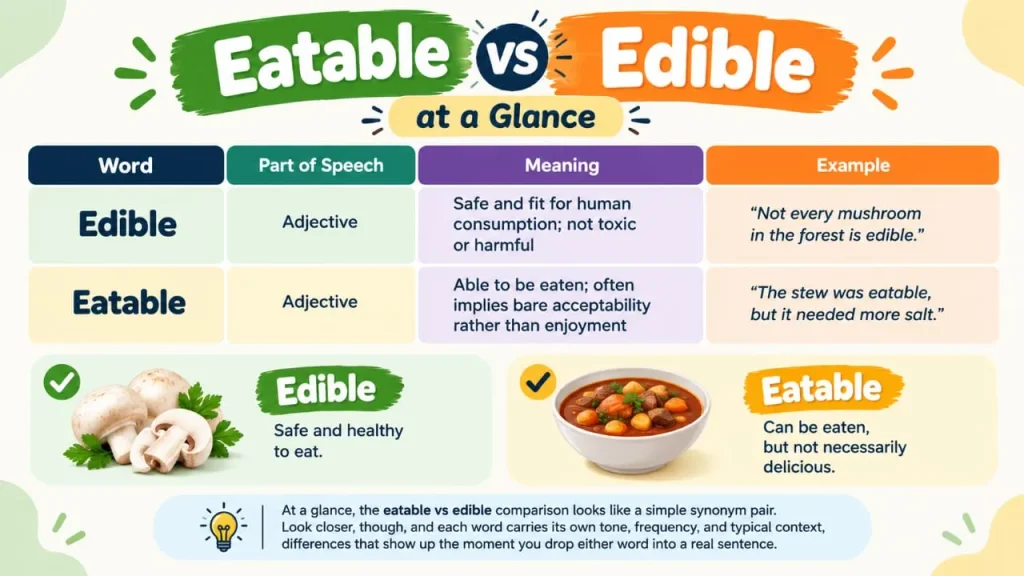
Eatable vs Edible at a Glance
| Word | Part of Speech | Meaning | Example |
| Edible | Adjective | Safe and fit for human consumption; not toxic or harmful | “Not every mushroom in the forest is edible.” |
| Eatable | Adjective | Able to be eaten; often implies bare acceptability rather than enjoyment | “The stew was eatable, but it needed more salt.” |
At a glance, the eatable vs edible comparison looks like a simple synonym pair. Look closer, though, and each word carries its own tone, frequency, and typical context, differences that show up the moment you drop either word into a real sentence.
Where the Two Words Come From
Part of why these words feel so close in meaning is that they come from two entirely different linguistic traditions that both ended up meaning almost the same thing.
Edible is a Latinate word, built from edibilis (“fit to be eaten”), which itself traces back to edere (“to eat”). Like many Latin derived English words, it entered the language through formal, written channels, law, science, and trade, which is a big part of why it still sounds clinical and precise today. Words borrowed from Latin tend to carry a certain authority in English, and edible inherited exactly that.
Eatable, on the other hand, is a native English word. It’s built directly from the Old English verb etan (“to eat”) plus the suffix able, with no detour through Latin or French. Native English word formations like this one tend to feel plainer and more conversational; think of pairs like begin (native) versus commence (Latinate), or ask versus inquire. The same pattern plays out here: eatable feels closer to the kitchen table, edible feels closer to the lab report or the ingredients label.
What Does “Edible” Mean?
Edible is the word you reach for when the question is about safety, not enjoyment: can this be consumed without making someone sick? That’s why edible dominates food labeling, nature writing, cooking content, and scientific contexts, where precision about safety matters more than opinion about flavor.
Here’s how it actually shows up in real writing:
- Recipe blog: “Edible flowers like nasturtiums and pansies make a beautiful, food safe garnish for summer salads.”
- Product packaging copy: “Made with 100% edible ingredients, safe for the whole family.”
- Foraging guide/nature essay: “Not every mushroom in the forest is edible; some look nearly identical to poisonous varieties.”
- Casual text message: “Is this mystery container from the back of the fridge even edible at this point?”
- Modern slang/noun usage: “She grabbed a pack of cannabis edibles for the trip.” (Yes, “edible” has picked up a noun sense in everyday speech, referring to cannabis infused food products, something older grammar guides never mention.)
Edible doesn’t tell you anything about taste. Something can be perfectly edible and still be bland, bitter, or unappetizing; the word is only making a claim about safety.
What Does “Eatable” Mean?
Eatable survives in modern English mostly in casual, spoken contexts. Where edible is precise and clinical, eatable often carries a faint undertone of “acceptable, if not exactly great.”
Real examples:
- Casual conversation: “The pizza’s been in the fridge for four days, but it’s still eatable.”
- Workplace Slack message: “Fair warning, the vending machine sandwich is barely edible today; pack your own lunch.”
- Personal essay/memoir tone: “Grandma’s first attempt at sourdough wasn’t pretty, but it was eatable, and that was enough for us.”
- ESL learner writing (a common slip): “This food is eatable for me”, grammatically fine, but a native speaker would more naturally say “I can eat this” or simply “this is edible.”
Even experienced writers occasionally default to “eatable” when they actually mean “edible”, especially when translating a thought directly from another language, since many languages don’t distinguish between “can be eaten” and “safe to eat” the way English quietly does. In French, for instance, comestible covers roughly the same ground as edible does in English, with no everyday equivalent that carries eatable’s more casual, taste based shading.
Spanish speakers run into a similar gap with comestible versus sabroso (“tasty”), which doesn’t map cleanly onto the eatable/edible split either. That mismatch is exactly why this pair trips up so many non native speakers; the underlying concept splits differently from one language to the next.
Why Do Sources Disagree About These Words?
Here’s something most articles on eatable vs edible won’t tell you upfront: dictionaries and grammar sites don’t fully agree on the connotation split. Some sources claim eatable implies good taste and edible implies mere safety. Others argue the opposite, that eatable is the more neutral, “technically consumable” word, while edible is the more polished, socially preferred choice regardless of flavor.
Merriam Webster’s own usage note cuts through the confusion: edible is generally used to describe something safe to eat, without regard to taste, while eatable more often describes food with some acceptable level of flavor. Other major dictionaries hedge more; several list eatable as a near total synonym of edible with only a faint usage note about frequency, rather than committing to a firm taste versus safety split.
The inconsistency across sources exists partly because eatable is used so rarely today that its connotation hasn’t fully stabilized; different writers and editors have nudged its meaning in slightly different directions over time, and with so few real world examples to draw on, no single definition has become the clear consensus.
What most sources do agree on, regardless of how they define the nuance, is the frequency gap: edible appears dramatically more often in books, news writing, and everyday speech than eatable does. That imbalance alone is often reason enough to default to edible when you’re unsure which word fits.
Key Differences Between Eatable vs Edible
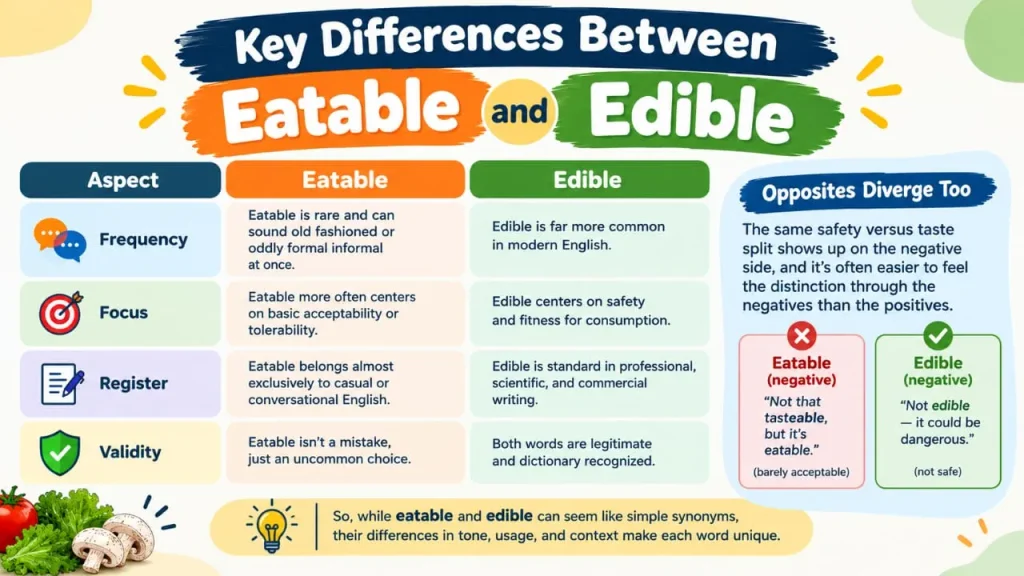
These distinctions are what most eatable vs edible searches are really trying to resolve:
- Frequency: Edible is far more common in modern English; eatable is rare and can sound old fashioned or oddly formal informal at once.
- Focus: Edible centers on safety and fitness for consumption; eatable more often centers on basic acceptability or tolerability.
- Register: Edible is standard in professional, scientific, and commercial writing; eatable belongs almost exclusively to casual or conversational English.
- Validity: Both words are legitimate and dictionary recognized; eatable isn’t a mistake, just an uncommon choice.
- Opposites diverge too: the same safety versus taste split shows up on the negative side, and it’s often easier to feel the distinction through the negatives than the positives.
Memory Trick to Remember the Difference
If you only remember one thing from this breakdown, make it this:
“Edible = Emergency safe. Eatable = Enjoyable, Actually.”
- Edible → think of the edge of safety: it won’t hurt you.
- Eatable → has “eat” sitting right inside it, closer to “worth eating,” not just “won’t kill you.”
Keep that pairing in your back pocket, and you’ll rarely reach for the wrong word again, whether you’re writing a recipe, a food label, or just texting a friend about leftovers.
Common Mistakes with Eatable vs Edible
This is a usage and register mix up, not a spelling or grammar error; both words are spelled correctly and grammatically valid. The mistake is choosing the wrong tone, or the wrong side of the safety/taste divide, for the context.
| ❌ Awkward or Off Tone | ✅ Better |
| “This label says eatable ingredients.” | “This label says edible ingredients.” |
| “Not eatable for me” (meaning personal dislike) | “I don’t like this” or “This is uneatable to me” |
| “Eatable mushrooms” in a foraging guide | “Edible mushrooms” |
| “The bread is inedible” (when you just mean it tastes bad) | “The bread is uneatable” (bad taste) vs. “inedible” (unsafe) |
| Marketing copy: “100% Eatable Ingredients” | Marketing copy: “100% Edible Ingredients” |
It’s worth pointing out that nearly every real world mistake happens in professional or public facing writing, packaging, labels, formal guides, exactly where “edible” is expected and “eatable” reads as slightly unpolished.
Quick Quiz: Test Yourself
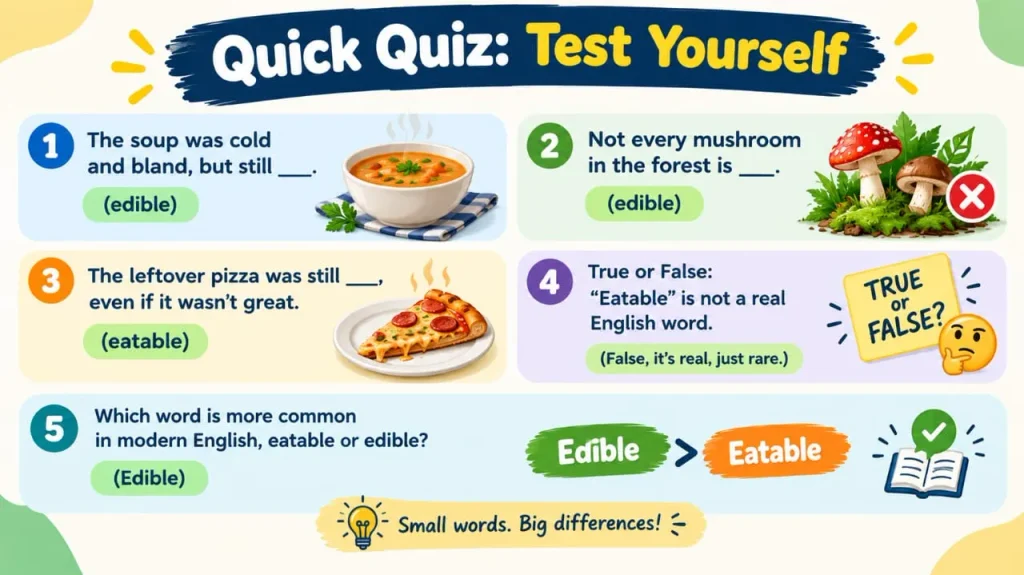
- The soup was cold and bland, but still ___. (edible)
- Not every mushroom in the forest is ___. (edible)
- The leftover pizza was still ___, even if it wasn’t great. (eatable)
- True or False: “Eatable” is not a real English word. (False, it’s real, just rare.)
- Which word is more common in modern English, eatable or edible? (Edible)
Frequently Asked Questions
Is “eatable” a real word? Yes. “Eatable” is a legitimate, dictionary recognized adjective meaning “able to be eaten.” It’s simply far less common than “edible” in modern English, which is why many people assume it isn’t real.
What is the difference between eatable and edible? The core eatable vs edible difference comes down to focus: edible emphasizes safety (“won’t harm you”), while eatable more often emphasizes basic acceptability or tolerable taste. Edible is also the far more commonly used word today.
Which is correct, eatable or edible? Both are grammatically correct. “Edible” is the standard, widely preferred choice in almost every context, formal writing, food labeling, and everyday conversation. “Eatable” isn’t wrong, but it’s rare enough that it can sound slightly unusual outside casual speech.
Are eatable and edible synonyms? They’re close synonyms with different shades of meaning and very different frequency of use. In most contexts, you can’t go wrong choosing “edible,” which is exactly why it has become the default.
What’s the difference between inedible and uneatable? Inedible means unsafe or toxic to eat. Uneatable means technically safe but unpleasant to eat, bad tasting, overcooked, or otherwise unappetizing rather than dangerous. The distinction mirrors the eatable vs edible split on the positive side.
Can “edible” be used as a noun, like in “cannabis edibles”? Yes, in everyday and legal cannabis industry language, “edible” has become a noun referring to cannabis infused food products. This newer usage exists alongside its original adjective meaning.
Final Thought
When in doubt, reach for edible; it’s the safer, more widely accepted choice in nearly every context, from casual conversation to formal food labeling. Save edible for the rare moments when you specifically want to signal “this is just barely good enough to eat,” not simply “this won’t hurt you.”
The two words aren’t wrong to confuse; they’re genuinely close cousins, but knowing which one is doing the safety job and which one is doing the acceptability job will make your writing sound more precise, whether you’re drafting a product label, a recipe, or just a text to a friend about last week’s leftovers.
To read more: Disorganized vs Unorganized: What’s the Ultimate Difference? 2026

Marcus is a former product manager turned comparison writer who spent eight years testing tools and gadgets before quitting to write full-time. He specializes in breaking down tech and software matchups into plain-English verdicts, with a soft spot for buying guides nobody else wants to write.