
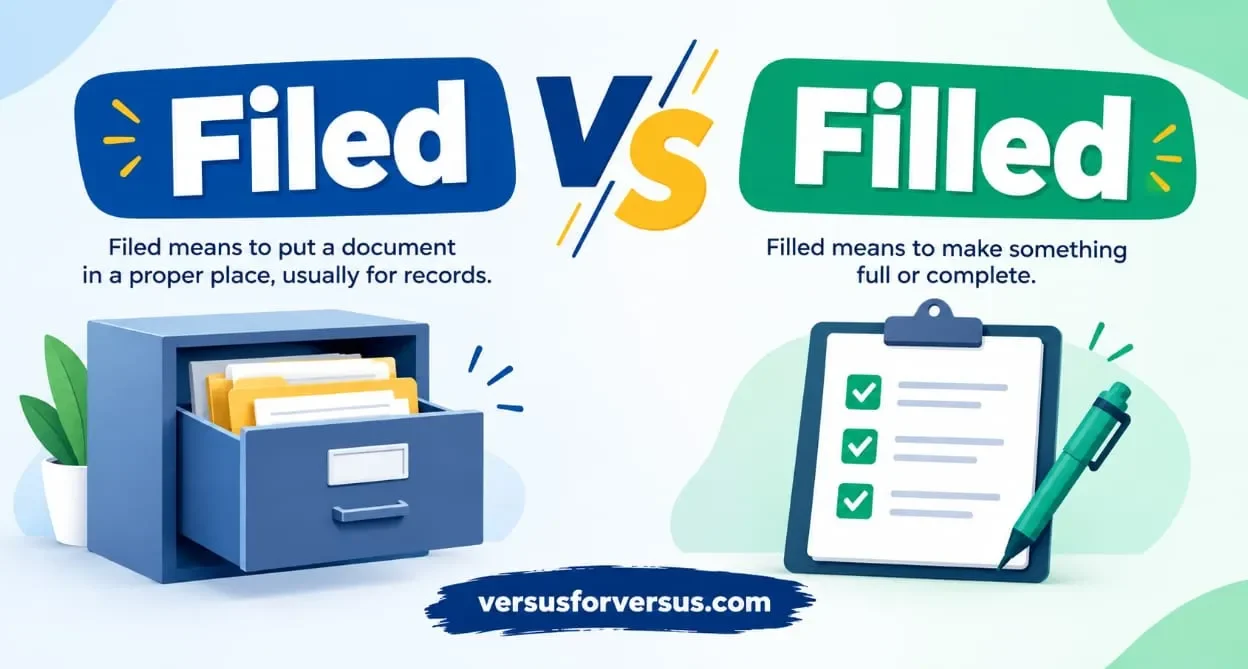
Filed vs Filled these two words look nearly identical and sound almost the same when spoken quickly, which is exactly why they’re so often confused in writing. Despite their similarity, they belong to completely different verbs with distinct meanings.
Filed comes from the verb “file,” meaning to submit or organize documents in a systematic way, such as filing a report, a legal case, or paperwork with an official authority. Filled, on the other hand, comes from the verb “fill,” meaning to make something complete by adding contents into it, like filling a glass with water or filling out a form.
Mixing these two up can lead to confusing or even incorrect sentences, especially in professional and legal writing. In this article, we’ll break down the key differences between these two words, explore their correct usage, and share clear examples to help you use them accurately every time.
Quick Answer
“Filed” is the past tense of “file,” meaning to submit, record, or officially store something, as in “she filed a complaint.” “Filled” is the past tense of “fill,” meaning to make something complete, as in “she filled out the form.” Neither word is misspelled; the filed vs filled mix up happens when the wrong correctly spelled word is used in the wrong context.
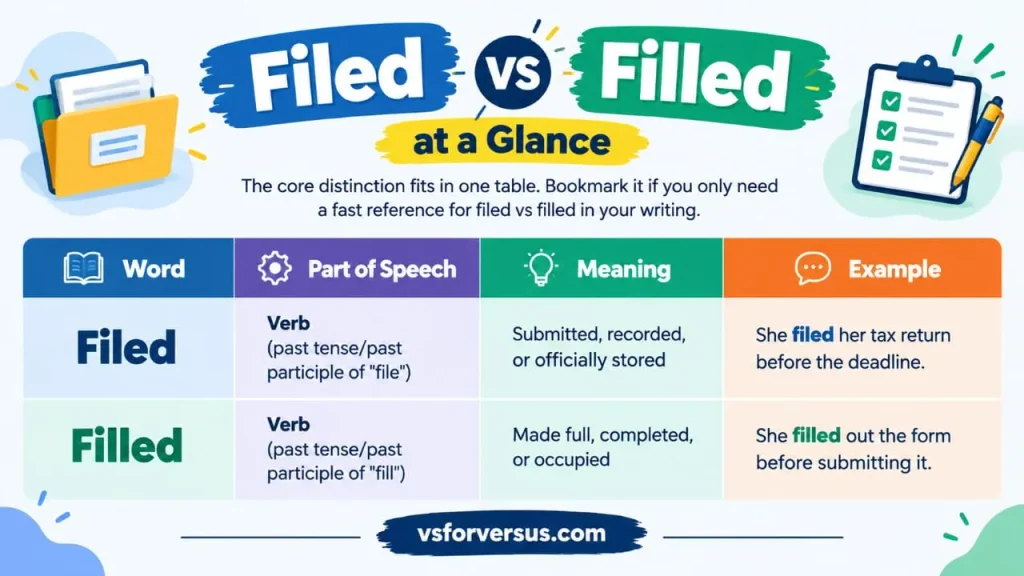
Filed vs Filled at a Glance
The core distinction fits in one table. Bookmark it if you only need a fast reference for filed vs filled in your writing.
| Word | Part of Speech | Meaning | Example |
| Filed | Verb (past tense/past participle of “file”) | Submitted, recorded, or officially stored | She filed her tax return before the deadline. |
| Filled | Verb (past tense/past participle of “fill”) | Made full, completed, or occupied | She filled out the form before submitting it. |
What Does “Filed” Mean?
“Filed” comes from the verb “file,” which means to submit something officially, organize it into a system, or place it on record. Think of a filing cabinet: papers go in, get sorted, and stay there for future reference. That mental image is exactly what “filed” describes, an action tied to paperwork, procedure, and record keeping.
You’ll see it constantly in legal, financial, and administrative writing:
- “The attorney filed the lawsuit on Monday morning.”
- “I filed my taxes two weeks early this year, for once.”
- “HR confirmed the incident report was filed and under review.”
- “The journalist filed her story minutes before the print deadline.”
- “The company filed for bankruptcy after months of speculation.”
- “The officer filed a formal report at the end of his shift.”
In every case, something is being submitted or recorded, not made full. Notice also that “filed” almost always takes an object that is a document, claim, or piece of information: a lawsuit, a report, a complaint, a return. It rarely, if ever, attaches to a person, a role, or a container.
Not to Be Confused With “Field”
One quick detour before moving on: “filed” is sometimes swapped with “field,” a completely different word with a different function. “Filed” is an action (submitted); “field” is usually a place, category, or data slot, as in “enter your name in the field” or “a soccer field.”
Field can also work as a verb, meaning to handle or respond to something, as in “she fielded questions from the audience.” If you’re second guessing between “filed” and “field,” ask whether you mean an action in the past tense or a place/category. That alone usually settles it, since “filed” only ever functions as a verb form, while “field” most often functions as a noun.
What Does “Filled” Mean?
“Filled” comes from “fill,” which means to make something full, complete it, or occupy it, whether physically or figuratively. Where “filed” is about submitting, “filled” is about completeness, a container reaching its capacity, a form reaching its final line, or a feeling reaching its peak.
- “I filled the kettle before I remembered we were out of tea bags.”
- “She filled out the application the night before it was due.”
- “By Friday, the open marketing role had already been filled.”
- “His message was filled with more excitement than the situation probably warranted.”
- “The bakery filled the display case with fresh pastries every morning.”
- “Their schedule was filled with back to back meetings all week.”
That example about excitement is worth pausing on: “filled” isn’t just for containers and forms. It’s also the natural choice for emotions, tone, and abstract fullness: a heart filled with gratitude, a room filled with tension, a speech filled with promises. This is one of the clearest tells for telling the two words apart: filed essentially never pairs with feelings, while filled almost always can.
“Filled In” vs “Filled Out”, US vs UK
There’s one wrinkle that trips people up even after they’ve nailed the basics: should you “fill in” a form or “fill out” a form? In American English, “fill out” is standard: “fill out the application,” “fill out the survey.” In British English, “fill in” is more common: “fill in the form,” “fill in your details.”
Both are correct. It’s a regional preference, not a grammar rule, so don’t let it shake your confidence in the broader distinction between filed and filled. Once you know which word family you’re dealing with, “in” versus “out” is just a matter of audience.
Key Differences Between Filed vs Filled
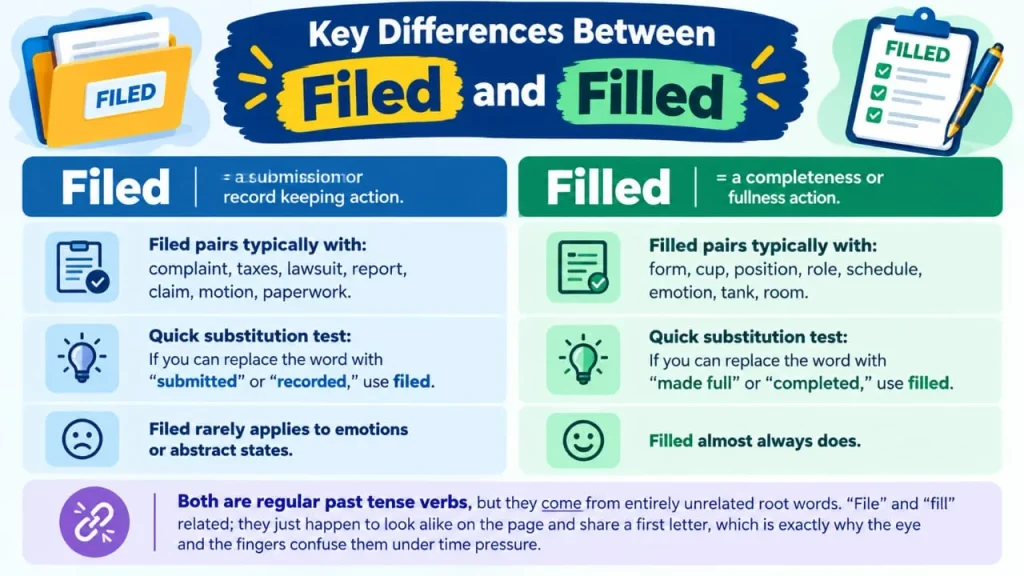
- Filed = a submission or record keeping action. Filled = a completeness or fullness action.
- Filed pairs typically with: complaint, taxes, lawsuit, report, claim, motion, paperwork.
- Filled pairs typically with: form, cup, position, role, schedule, emotion, tank, room.
- Quick substitution test: if you can replace the word with “submitted” or “recorded,” use filed. If you can replace it with “made full” or “completed,” use filled.
- Filed rarely applies to emotions or abstract states. Filled almost always does.
- Both are regular past tense verbs, but they come from entirely unrelated root words. “File” and “fill” aren’t related; they just happen to look alike on the page and share a first letter, which is exactly why the eye and the fingers confuse them under time pressure.
Memory Trick: How to Remember Filed vs Filled
Try this visual: “file” keeps its shape, like a folder, clean and single, with one L. “Fill” swells and expands to hold more, so it gets double the L for double the contents.
One L, one line, one folder → filed. Double L, double full → filled.
If that doesn’t land for you, fall back on the substitution test: swap the word for “submitted” or “made full” and see which one actually fits your sentence. A third option, if you’re a visual thinker, is to picture a filing cabinet drawer (filed) next to an overflowing glass of water (filled); the drawer organizes, the glass overflows, and neither image bleeds into the other.
Common Mistakes: Filed vs Filled in Real Writing
Even experienced writers slip here. This isn’t a beginner’s error. It usually happens when typing fast under a deadline, or when drafting in a context where both words show up constantly, like paperwork or HR writing, where the brain defaults to whichever word it typed most recently. The table below lays out the most frequent slip ups side by side with the correction.
| Context | ❌ Incorrect | ✅ Correct |
| Legal | She filled a complaint with HR last week. | She filed a complaint with HR last week. |
| HR / Business | The account manager position has been filed. | The account manager position has been filled. |
| Business | The contract was filled with procurement for approval. | The contract was filed with procurement for approval. |
| HR | The vacancy will remain filed until Q2. | The vacancy will remain unfilled until Q2. |
| Academic | I filed out the survey before the deadline. | I filled out the survey before the deadline. |
| Everyday | My heart was filed with gratitude after the surprise. | My heart was filled with gratitude after the surprise. |
| Everyday | The stadium was filed to capacity for the concert. | The stadium was filled to capacity for the concert. |
| Legal | He filled a patent application last spring. | He filed a patent application last spring. |
| Administrative | Please file in the attached form and return it. | Please fill in the attached form and return it. |
| Everyday | The tank was filed up before the trip. | The tank was filled up before the trip. |
“Filed” rarely appears with emotions, containers, or physical fullness. If you catch yourself writing “filed with” and what follows isn’t a person, office, or court, it’s very likely a mix up.
Quick Quiz: Filed or Filled?
Test yourself before moving to the FAQ. No peeking at the answers first.
- She ___ her taxes on time this year. (filed)
- Please ___ out the application before Friday. (fill/filled)
- The manager position has already been ___. (filled)
- He ___ a formal complaint with the department. (filed)
- My cup was ___ to the brim. (filled)
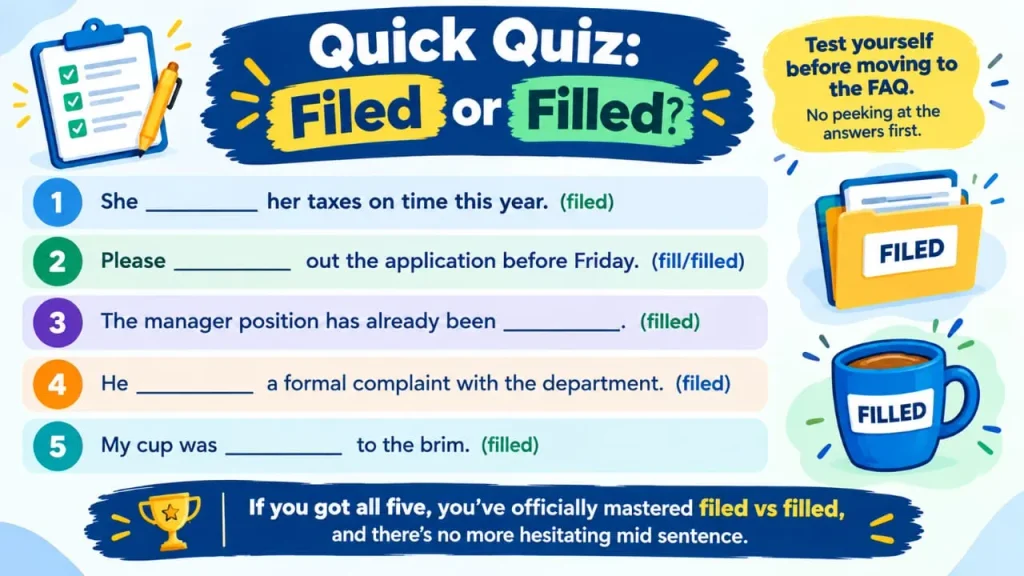
If you got all five, you’ve officially mastered filed vs filled, and there’s no more hesitating mid sentence.
FAQ
Is “filed” or “filled” a spelling mistake?
No. Both words are spelled correctly on their own. The actual error is a usage mistake, choosing the wrong correctly spelled word for the context, not misspelling either one.
Is it “filled in the form” or “filled out the form”?
Both are correct. “Filled out” is standard in American English, while “filled in” is more common in British English. Neither is wrong; it’s a regional style choice.
Can a job position be “filed”?
No. A job position is filled, meaning it’s been occupied by a candidate. “Filed” only applies to documents, claims, complaints, or official records, never to roles or positions.
Why doesn’t spellcheck catch this error?
Because both words are real and correctly spelled. Standard spellcheckers only flag misspellings, not wrong word choices. Catching this requires reading for meaning, using a context aware grammar tool, or simply reading your sentence back slowly.
Is “filed with joy” ever correct?
No. Emotions and abstract fullness always take “filled”: filled with joy, filled with relief, filled with dread. “Filed with” only works when something is submitted to a person or office, as in “filed with the court.”
What’s the difference between “filed” and “field”?
“Filed” is a verb meaning submitted or recorded. “Field” is typically a noun for a place, category, or data slot (a soccer field, a form field), though it can also be a verb meaning to handle or respond, as in “fielded the question.”
The Bottom Line
Filed vs filled isn’t a spelling problem; it’s a split second usage decision, and now you have the test to make it instantly. If you’re submitting or recording something, it’s filed. If you’re completing, occupying, or making something full, it’s filled. Keep the substitution trick in your back pocket, and you won’t hesitate over an email again.
To read more: Elude vs Allude: 5 Shocking Differences You Need to Know

Marcus is a former product manager turned comparison writer who spent eight years testing tools and gadgets before quitting to write full-time. He specializes in breaking down tech and software matchups into plain-English verdicts, with a soft spot for buying guides nobody else wants to write.