

Disorganized vs Unorganized these two words look almost like twins, differing by just a prefix, which is exactly why so many people use them interchangeably without realizing there’s a subtle but meaningful difference. Both describe a lack of order, but the reason behind that disorder is what truly sets them apart.
Disorganized describes something or someone that once had structure or order but has since fallen into chaos or confusion; think of a messy desk that used to be tidy. Unorganized, on the other hand, describes something that was never structured or organized in the first place, lacking any system from the start. This distinction, though small, can change the entire meaning of a sentence, especially in professional or academic writing.
In this article, we’ll dive into the roots of both words, explore how context shapes their correct usage, and share clear examples to help you pick the right one every time.
Quick Answer
Disorganized means something used to be organized but fell into disorder; the word implies a system existed and broke down. Unorganized means something never had a system in the first place; it’s neutral, describing the absence of structure rather than its collapse.
That’s the core of disorganized vs unorganized: history determines the word, not the mess itself. Both are grammatically correct, standard English adjectives. American English uses disorganized and unorganized, while British English typically uses disorganized and unorganized.
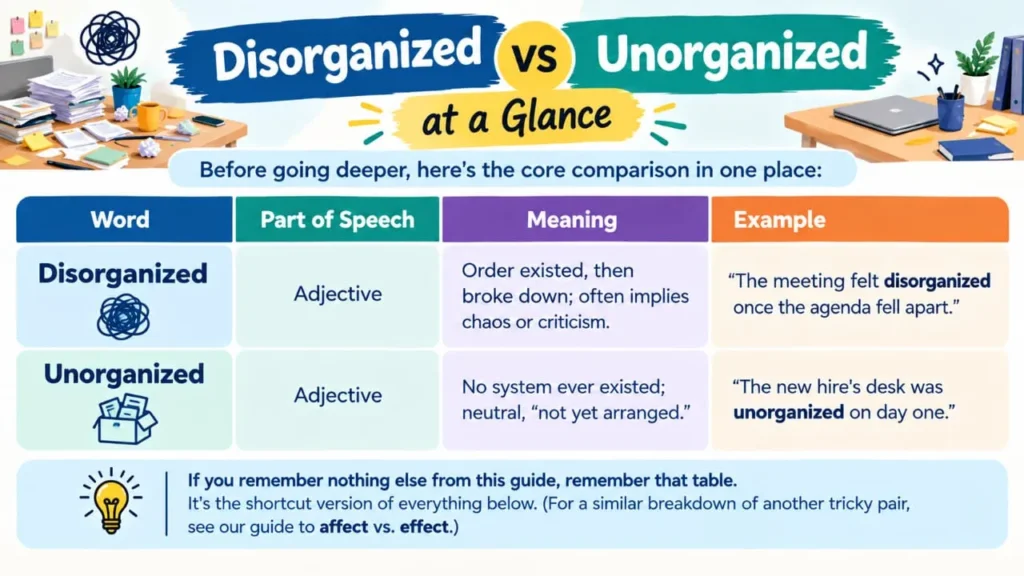
Disorganized vs Unorganized at a Glance
Before going deeper, here’s the core comparison in one place:
| Word | Part of Speech | Meaning | Example |
| Disorganized | Adjective | Order existed, then broke down; often implies chaos or criticism | “The meeting felt disorganized once the agenda fell apart.” |
| Unorganized | Adjective | No system ever existed; neutral, “not yet arranged” | “The new hire’s desk was unorganized on day one.” |
If you remember nothing else from this guide, remember that table. It’s the shortcut version of everything below. (For a similar breakdown of another tricky pair, see our guide to affect vs effect.)
What Does “Disorganized” Mean?
“Disorganized” describes something that had order and lost it. The prefix “dis ” signals reversal, the same logic behind “disconnect” and “disrupt.” Something was put together, and then it came apart.
- Workplace: “The presentation felt disorganized because the slides jumped randomly between topics.”
- Academic: “Her essay was well researched but disorganized; the argument kept doubling back on itself.”
- Legal: “The firm’s disorganized records led to a costly delay during discovery.”
- Personal/social media: “My whole week became disorganized after the flight got cancelled.”
Notice the pattern: in every example, something worked before and then didn’t. That’s the throughline. “Disorganized” tends to show up most in descriptions of people, habits, and situations that have visibly slipped: a desk that used to be tidy, a plan that used to make sense, a team that used to run smoothly.
Merriam Webster lists both “disorganized” and “unorganized” as standard dictionary entries; neither is slang or informal. Corpus data consistently shows “disorganized” used far more often in everyday and professional writing, which is one reason it feels like the “default” choice even when “unorganized” is technically more accurate.
What Does “Unorganized” Mean?
“Unorganized” describes something that never had a system to begin with. The prefix “un ” simply means “not”; no history implied, no judgment attached. Compare it to “unfinished” or “unprepared” (see also our guide to ensure vs insure for another prefix driven mix up): it states a current fact without explaining how things got that way.
- Business: “The archive remained unorganized after the company changed buildings.”
- Data: “The raw survey results stayed unorganized until we built a spreadsheet for them.”
- Institutional/group: “The new volunteer group is still unorganized; they haven’t picked a leader yet.”
- Everyday: “I left the garage boxes unorganized over the weekend; I’ll sort them next week.”
You’ll see the same logic in administrative, technical, and institutional writing, filing systems, inventories, new committees, raw datasets. “Unorganized” rarely describes a person’s personality, because personality implies a history, and “unorganized” doesn’t carry one.
Related Words Worth Knowing
Synonyms can help when neither word feels quite right:
- For disorganized: chaotic, cluttered, disorderly, scattered
- For unorganized: unsorted, unstructured, uncategorized, unclassified
These alternatives are useful when you want to soften or sharpen the tone without changing the underlying meaning.
Key Differences Between Disorganized vs Unorganized
The distinction breaks down like this:
- History: Disorganized = order existed and broke down. Unorganized = order never existed.
- Tone: Disorganized often sounds critical or personal. Unorganized sounds neutral, even temporary.
- Prefix logic: “Dis ” signals reversal (as in disconnect, disrupt, disorder). “Un ” signals plain absence (as in unfinished, unclear, unprepared), the same pattern you’ll find in farther vs. further.
- Best for describing people: “Disorganized” is the far more natural, common choice; “unorganized person” sounds stiff to most native speakers.
- Best for new or raw material: “Unorganized” fits fresh data, new committees, and unsorted files better than “disorganized” does.
- Spelling: No true US/UK spelling split for these exact forms, though British writers also use “organize” based spellings, disorganized and unorganized.
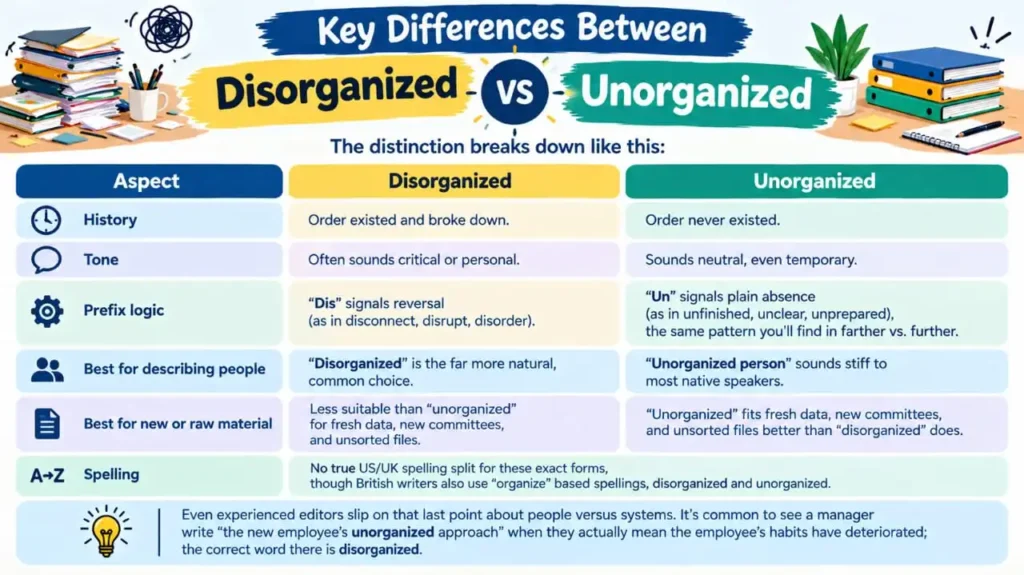
Even experienced editors slip on that last point about people versus systems. It’s common to see a manager write “the new employee’s unorganized approach” when they actually mean the employee’s habits have deteriorated; the correct word there is disorganized.
The “Was It Organized Before?” Memory Trick
Here’s the fastest way to settle disorganized vs unorganized in the moment: ask yourself one question: did order exist here before?
- If yes, and it fell apart → disorganized.
- If no, and it’s just starting → unorganized.
Picture two closets: one exploded, clothes everywhere, nothing where it used to be; that’s disorganized. The other just moved in, boxes stacked but unsorted; that’s unorganized. If you’re ever unsure and don’t know the backstory, default to “disorganized” for people and visible chaos, and “unorganized” for data, systems, or anything brand new.
Common Mistakes With Disorganized vs Unorganized
These mix ups show up constantly in workplace writing, and they’re an easy fix once you spot the pattern:
| ⚠️ Wrong | ✅ Correct | Why |
| “This brand new startup is disorganized.” | “This brand new startup is unorganized.” | Nothing existed yet to fall apart. |
| “My neat desk is now unorganized.” | “My neat desk is now disorganized.” | The desk had order that got disrupted. |
| “These fresh documents from the printer are disorganized.” | “These fresh documents from the printer are unorganized.” | Never sorted means no system broke down. |
If you’re giving feedback and want to soften the blow, word choice matters more than you’d think. “Your report is disorganized” reads as personal criticism. “The report feels unorganized” reads as something fixable, not a character flaw.
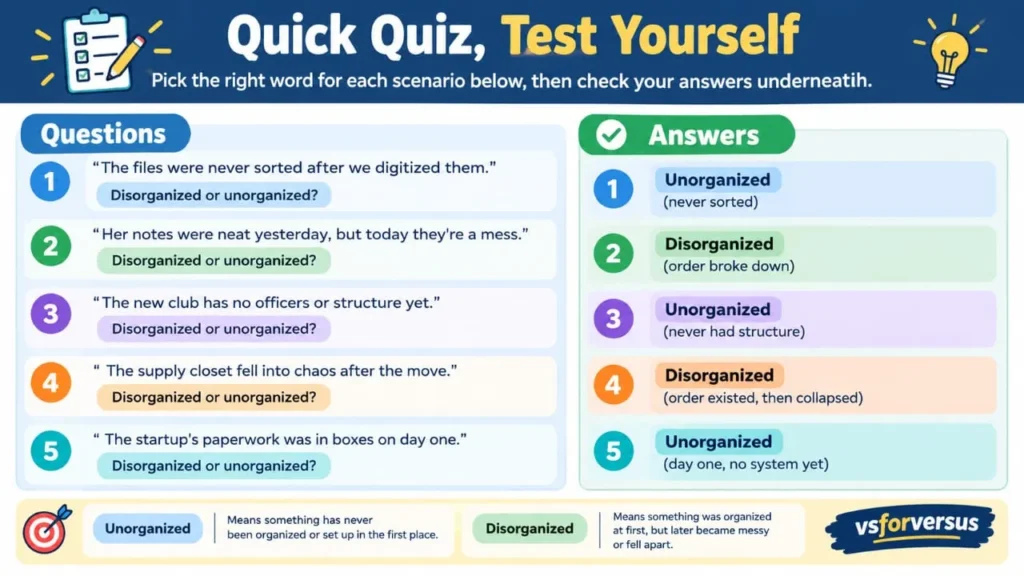
Quick Quiz, Test Yourself
Pick the right word for each scenario below, then check your answers underneath.
- “The files were never sorted after we digitized them.”, disorganized or unorganized?
- “Her notes were neat yesterday, but today they’re a mess.” Disorganized or unorganized?
- “The new club has no officers or structure yet.” Disorganized or unorganized?
- “The supply closet fell into chaos after the move.” Disorganized or unorganized?
- “The startup’s paperwork was in boxes on day one.” Disorganized or unorganized?
Answers: 1. Unorganized (never sorted), 2. Disorganized (order broke down), 3. Unorganized (never had structure), 4. Disorganized (order existed, then collapsed), 5. Unorganized (day one, no system yet)
Frequently Asked Questions
What is the main difference between disorganized and unorganized?
Disorganized means order existed and broke down; unorganized means no system was ever created in the first place. That’s the whole distinction behind disorganized vs unorganized.
Is “unorganized” even a real word?
Yes, it’s a standard, dictionary valid English adjective. It’s simply less common in everyday speech than “disorganized,” which is why some people mistakenly assume it’s informal or wrong.
Which word sounds more negative, disorganized or unorganized?
“Disorganized” typically carries a sharper, more critical tone, especially when describing a person. “Unorganized” tends to sound neutral or temporary by comparison.
Can disorganized and unorganized be used interchangeably?
Sometimes, in casual conversation, people use them loosely. But precise writing treats them differently; swapping one for the other can shift how critical or neutral a sentence feels.
Is there a spelling difference between American and British English?
Not for these specific forms. Both dialects use “disorganized” and “unorganized” (or “disorganized”/”unorganized” in British spelling of “organize”; see our full organize vs. organize guide), so the disorganized vs unorganized distinction isn’t a regional spelling issue.
What should I say instead of calling someone “disorganized” at work?
Try “unorganized” or a phrase like “still building a system”; both soften the tone while keeping your meaning accurate, which matters in performance reviews and team feedback.
Final Thoughts
The short version: disorganzied means order broke down, and unorganized means order never existed. That one question, did it have structure before?, settles the choice almost every time. Like other near synonym pairs such as affect vs effect or ensure vs insure, this distinction isn’t about right and wrong; it’s about precision.
Once the test clicks, you’ll stop guessing and start choosing the word that actually matches the situation, whether you’re writing an email, an essay, or quick feedback to your team.
To read more: Die vs Dice: The Ultimate Guide to 5 Key Differences

Marcus is a former product manager turned comparison writer who spent eight years testing tools and gadgets before quitting to write full-time. He specializes in breaking down tech and software matchups into plain-English verdicts, with a soft spot for buying guides nobody else wants to write.