

Regimen vs Regiment confusing similar sounding words is a common struggle for writers and speakers alike, and this pair is no exception. Though they share nearly the same spelling and sound almost identical when spoken, their meanings couldn’t be more different.
Regimen refers to a structured, disciplined plan or routine, often related to health, diet, exercise, or medical treatment, such as a “daily exercise regimen.” Regiment, on the other hand, is a military term, referring to a large, organized unit of soldiers, typically commanded by a colonel and made up of several battalions.
This distinction matters more than most people realize, especially since one wrong letter can shift a sentence from talking about your morning workout routine to an entire army unit. In this article, we’ll explore both terms in depth, covering their origins, correct usage, and real world examples.
Quick Answer
Regimen is a noun meaning a structured routine or plan, most often a diet, exercise schedule, or course of medical treatment, as in “a daily vitamin regimen.” Regiment is a noun for a military unit of soldiers commanded by a colonel, and less commonly a verb meaning to organize or control strictly, as in “rules that regiment every hour of the day.”
A third look alike, regime, refers to a system of government or rule. All three trace back to the Latin regere, “to rule” or “to guide,” which is exactly why regimen vs regiment mix ups happen even among careful writers.
Regimen vs Regiment at a Glance
The full comparison lives in the table below, useful if you just need a fast answer to regimen vs regiment questions and want to move on with your writing. Regimen and regiment are near homophones; they sound almost identical, which is exactly why this pair sits high on any list of commonly confused words in English.
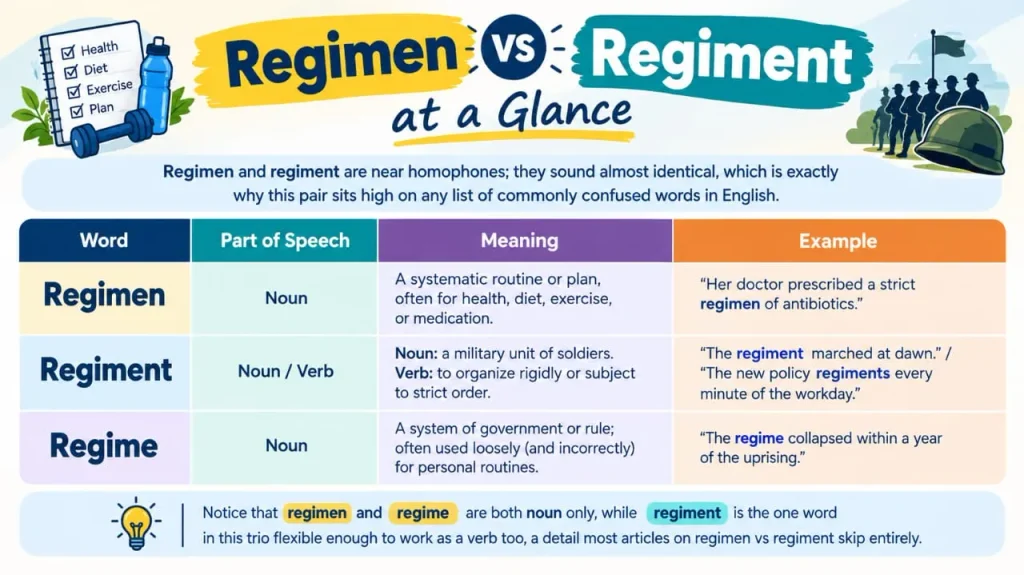
| Word | Part of Speech | Meaning | Example |
| Regimen | Noun | A systematic routine or plan, often for health, diet, exercise, or medication | “Her doctor prescribed a strict regimen of antibiotics.” |
| Regiment | Noun / Verb | Noun: a military unit of soldiers. Verb: to organize rigidly or subject to strict order | “The regiment marched at dawn.” / “The new policy regiments every minute of the workday.” |
| Regime | Noun | A system of government or rule; often used loosely (and incorrectly) for personal routines | “The regime collapsed within a year of the uprising.” |
Notice that regimen and regime are both noun only, while regiment is the one word in this trio flexible enough to work as a verb too, a detail most articles on regimen vs. regiment skip entirely.
What Does “Regimen” Mean?
A regimen is a systematic plan or routine that someone follows, usually to improve or maintain health, fitness, or productivity. It’s singular in structure even when the routine itself has many parts: one regimen, made up of several steps.
Real world examples:
- “My trainer put together a strength training regimen I can actually stick to on weeknights.”
- “The oncologist adjusted her chemotherapy regimen after the second round of scans.”
- “I’ve finally found a skincare regimen that doesn’t leave my skin dry by noon.”
- “Our team lead swears by a strict morning pages regimen, twenty minutes before checking email.”
You’ll see regimen most often in healthcare writing, fitness and wellness content, skincare marketing, and personal productivity posts. It shows up in emails between a patient and their physician, in fitness app copy, and in casual social captions (“day 14 of my new regimen”). The plural is regimens, and it never functions as a verb; you follow a regimen, you don’t “regimen” something.
What Does “Regiment” Mean?
Regiment shows up most often as a noun for a military unit, a group made up of several smaller units, such as battalions, companies, or squadrons, typically commanded by a colonel. Less often, it works as a verb meaning to organize something with rigid, sometimes oppressive, structure.
In practice, that looks like this:
- “Colonel Reyes has commanded the regiment since the reorganization last spring.”
- “The history essay traces the regiment’s movements across three campaigns.” (academic writing context)
- “New management tried to regiment our lunch breaks down to the minute, and morale tanked.” (verb usage)
- “Recruits from three counties were folded into the same regiment before deployment.”
- “In her fic, the soldier character was on a strict training regimen, an easy slip in fast drafted fanfiction, where ‘regimen’ was the word actually needed.”
Regiment appears constantly in military and history writing, academic essays about wars or armies, and, as a verb, in workplace or organizational writing about overly rigid structure or control. If you’re describing troops, a colonel, or battalions, regiment is almost always your word. If you’re describing someone tightly controlling a schedule or system, the verb form fits too.
Where Does “Regime” Fit In?
This is where regimen vs. regiment articles usually stop short, and it’s exactly where real confusion lives. Regime is a noun describing a system of government, rule, or administration, often with a political or institutional weight to it.
- “The regime introduced sweeping economic reforms in its first year.”
- “Historians still debate how the old regime maintained control for so long.”
The catch is this: people constantly borrow “regime” to describe a personal routine, “my skincare regime,” “my new workout regime”, when regimen is the correct word. It’s common enough in casual speech and social media that it barely registers as wrong to most readers, but in careful writing, it’s a genuine error worth fixing.
Key Differences Between Regimen, Regiment, and Regime
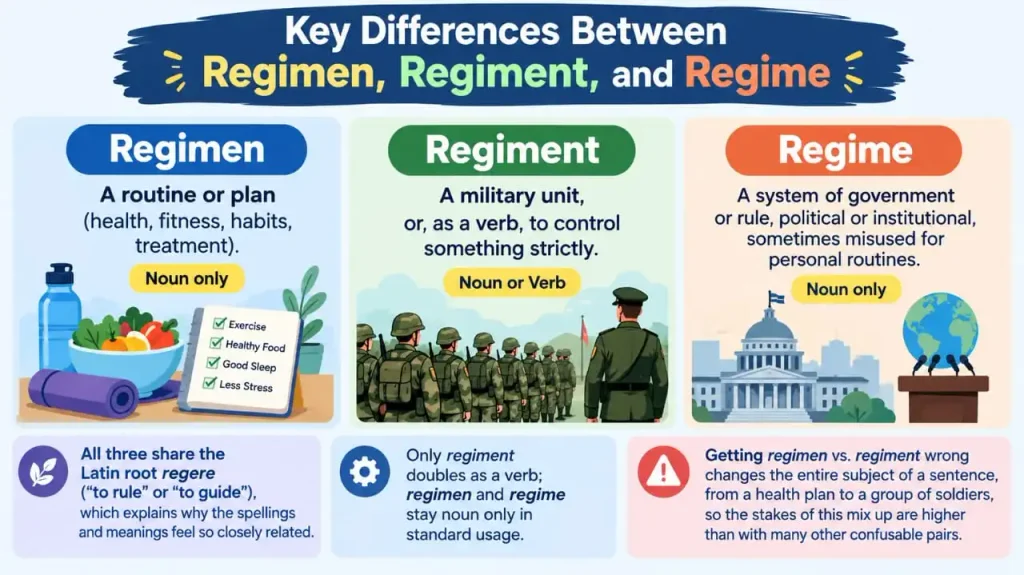
- Regimen = a routine or plan (health, fitness, habits, treatment), noun only
- Regiment = a military unit, or, as a verb, to control something strictly
- Regime = a system of government or rule, political or institutional, sometimes misused for personal routines.
- All three share the Latin root regere (“to rule” or “to guide”), which explains why the spellings and meanings feel so closely related.
- Only regiment doubles as a verb; regimen and regime stay noun only in standard usage.
- Getting regimen vs. regiment wrong changes the entire subject of a sentence, from a health plan to a group of soldiers, so the stakes of this mix up are higher than with many other confusable pairs
Memory Trick: How to Never Mix These Up Again?
Here’s the trick that sticks: regiment has an extra letter because it involves extra people, a whole military unit, not just you. Regimen is personal; it’s just your own routine, no extra “t,” no extra people.
A second angle, if etymology helps you more than wordplay: all three words come from regere, “to rule.” Regimen rules your body. Regiment rules soldiers. Regime rules a country. Same root, three completely different scales of “ruling.”
One more anchor, since so many people stumble here: ” ment” pairs visually with govern ment, order, structure, control. That’s your cue for regiment. Regimen doesn’t have that ending, so it doesn’t carry that institutional weight; it’s just yours.
Common Mistakes with Regimen, Regiment, and Regime
Even experienced writers slip on this one; it’s not just a beginner error, and it’s easy to see why. Spellcheck never flags either word, because both are spelled correctly; the mistake is entirely about meaning, not spelling.
| ❌ Incorrect | ✅ Correct |
| “My new skincare regime is amazing.” | “My new skincare regimen is amazing.” |
| “Colonel Reyes commands this regimen of soldiers.” | “Colonel Reyes commands this regiment of soldiers.” |
| “I started a new workout regiment this month.” | “I started a new workout regimen this month.” |
| “I’ve started a new eating regiment for the new year.” | “I’ve started a new eating regimen for the new year.” |
There’s a clear pattern here: the error almost always runs in one direction; a personal routine gets mislabeled as a regime or a regiment, rarely the reverse. That’s useful diagnostic knowledge: if you’re describing something personal and used a word with a “t” at the end, double check it.
Quick Quiz: Test Yourself
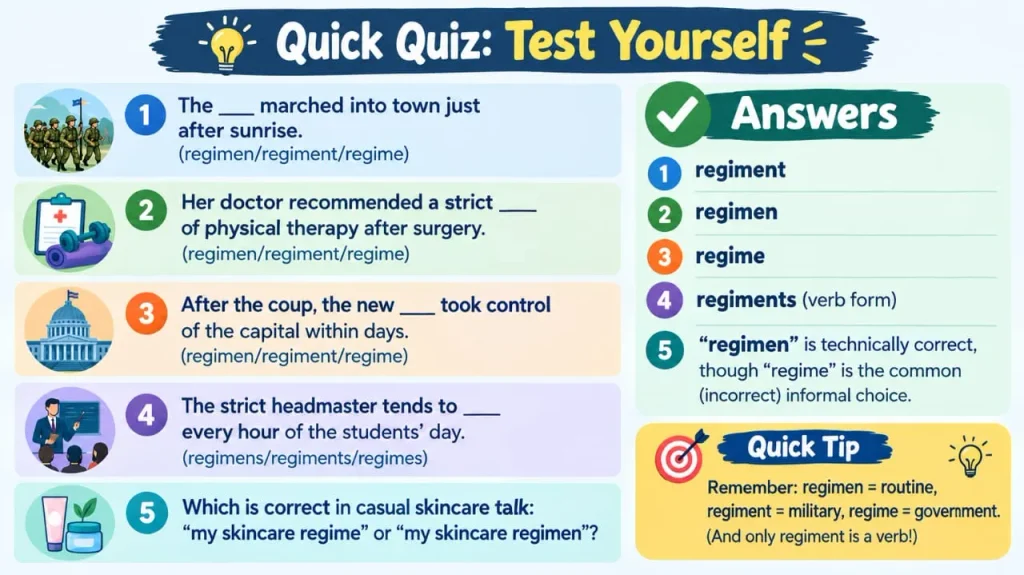
- “The ___ marched into town just after sunrise.” (regimen/regiment/regime)
- “Her doctor recommended a strict ___ of physical therapy after surgery.” (regimen/regiment/regime)
- “After the coup, the new ___ took control of the capital within days.” (regimen/regiment/regime)
- “The strict headmaster tends to ___ every hour of the students’ day.” (regimens/regiments/regimes)
- Which is correct in casual skincare talk: “my skincare regime” or “my skincare regimen”?
Answers: 1. regiment, 2. regimen, 3. regime, 4. regiments (verb form), 5. “regimen” is technically correct, though “regime” is the common (incorrect) informal choice.
Frequently Asked Questions
What is the difference between regimen and regiment?
Regimen is a noun for a personal routine or plan, usually health related. Regiment is a noun for a military unit (or a verb meaning to control strictly). That single letter “t” changes the entire meaning, which is why regimen vs. regiment trips up so many writers.
Is it “skincare regimen” or “skincare regime”?
“Regimen” is the technically correct word for a personal routine. “Regime” is common in casual speech but considered an error in careful or professional writing.
Is regiment a verb?
Yes. “To regiment” means to organize or control something rigidly, as in “the new rules regiment our schedule down to the minute.”
Are regime and regimen the same word?
No. They share a Latin root but mean different things; regime refers to a system of government or rule, while regimen refers to a personal routine or treatment plan.
How do you remember regimen vs. regiment vs. regime?
Think of scale: regimen rules your body, regiment rules soldiers, regime rules a country. Or remember that regiment’s extra letter matches the extra people involved: a whole unit, not just you.
What is a regimen of medication?
It’s a prescribed schedule of doses or treatments a patient follows, for example, “a twice daily regimen of blood pressure medication.”
Final Thoughts
The regimen vs regiment mix up isn’t a sign of poor grammar; it’s a sign of how closely English can pack different meanings into nearly identical words. Once you anchor regimen to a personal routine, regiment to a military unit (or strict control), and regime to a system of government, the confusion mostly disappears.
The next time you’re writing about a diet plan, a training schedule, or a historical army unit, pause for one extra second on that final letter; it’s a small check that saves you from a genuinely embarrassing, high consequence error.
To read more: Recurrence vs Reoccurrence: 5 Shocking Facts on Which Word You Should Use

Marcus is a former product manager turned comparison writer who spent eight years testing tools and gadgets before quitting to write full-time. He specializes in breaking down tech and software matchups into plain-English verdicts, with a soft spot for buying guides nobody else wants to write.