
Seen vs Saw this classic verb pair trips up even confident English speakers because both words come from “see,” yet they follow strict grammatical rules that don’t allow them to be swapped freely. The key difference lies entirely in sentence structure rather than meaning.
Saw is the simple past tense, used alone to describe something that happened at a specific point in the past, as in “I saw a movie last night.” Seen, on the other hand, is the past participle, which always needs a helping verb like “have,” “has,” or “had,” as in “I have seen that movie before.” Using “seen” without a helping verb, such as saying “I seen it,” is one of the most common grammar mistakes in casual English.
In this article, we’ll break down this irregular verb pattern, clarify correct usage, and provide clear examples to help you use both forms accurately every time.
Quick Answer
Saw is the simple past tense of “see” and stands alone in a sentence: I saw the movie. Seen is the past participle and always needs a helping verb such as have, has, or had: I have seen the movie. Writing “I seen” by itself, without a helping verb, is nonstandard in formal English; the correct options are I saw, or I have seen.
Seen vs Saw at a Glance
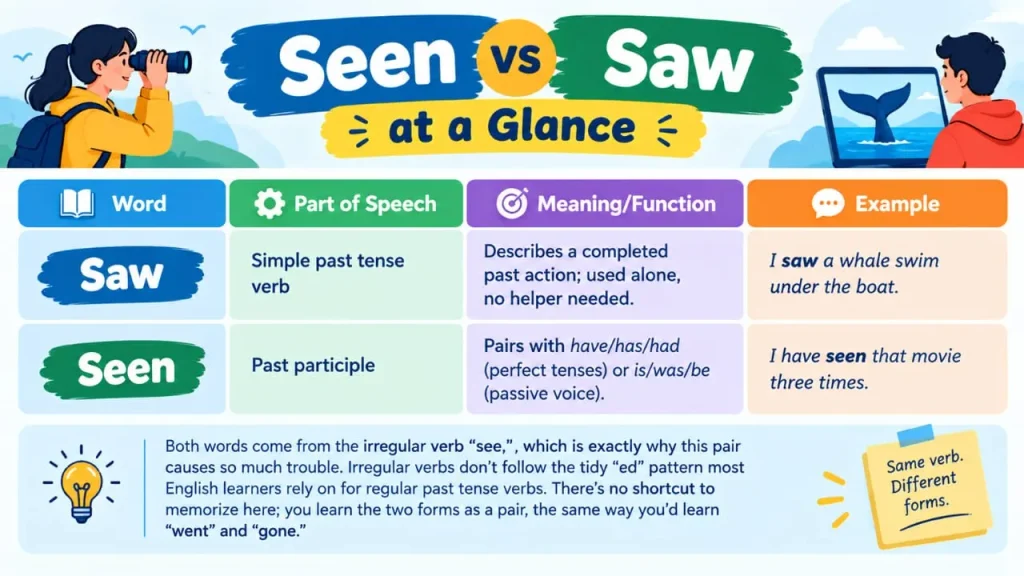
| Word | Part of Speech | Meaning/Function | Example |
| Saw | Simple past tense verb | Describes a completed past action; used alone, no helper needed | I saw a whale swim under the boat. |
| Seen | Past participle | Pairs with have/has/had (perfect tenses) or is/was/be (passive voice) | I have seen that movie three times. |
Both words come from the irregular verb “see,” which is exactly why this pair causes so much trouble. Irregular verbs don’t follow the tidy ” ed” pattern most English learners rely on for regular past tense verbs. There’s no shortcut to memorize here; you learn the two forms as a pair, the same way you’d learn “went” and “gone.”
What Does “Saw” Mean?
Saw is the simple past tense form of “see.” It works on its own, with no helping verb required, and it describes something that happened and finished at a specific point in the past.
- We saw a whale swim right under the boat during the tour.
- I saw your email this morning but haven’t replied yet. Sorry, today’s been chaos.
- She saw the mistake in the report before it went out to the board.
- No one saw the accident happen, so the police are relying on the dashcam footage.
- Honestly, I saw that plot twist coming from a mile away.
You’ll find saw everywhere: casual storytelling, quick work updates, eyewitness accounts, social media captions, and everyday recaps of what happened yesterday or last week. If you can swap the sentence into “I did see” and it still sounds natural, saw is almost always your word. Think of it as the version of “see” that needs no assistance. It walks into a sentence and does its job solo, no matter how formal or casual the writing is.
What Does “Seen” Mean?
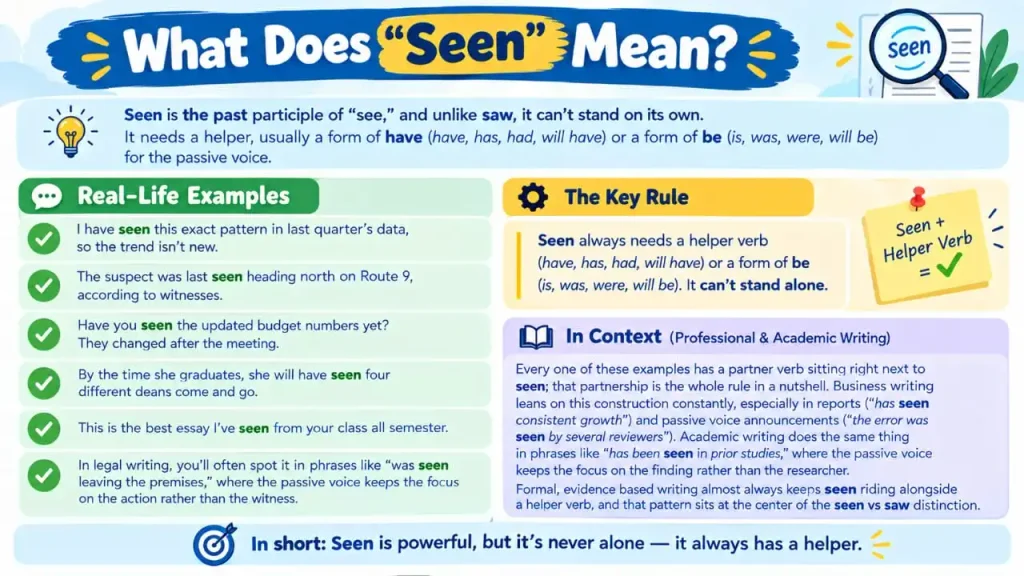
Seen is the past participle of “see,” and unlike saw, it can’t stand on its own. It needs a helper, usually a form of have (have, has, had, will have) or a form of be (is, was, were, will be) for the passive voice.
- I have seen this exact pattern in last quarter’s data, so the trend isn’t new.
- The suspect was last seen heading north on Route 9, according to witnesses.
- Have you seen the updated budget numbers yet? They changed after the meeting.
- By the time she graduates, she will have seen four different deans come and go.
- This is the best essay I’ve seen from your class all semester.
- In legal writing, you’ll often spot it in phrases like “was seen leaving the premises,” where the passive voice keeps the focus on the action rather than the witness.
Every one of these examples has a partner verb sitting right next to seen; that partnership is the whole rule in a nutshell. Business writing leans on this construction constantly, especially in reports (“has seen consistent growth”) and passive voice announcements (“the error was seen by several reviewers”).
Academic writing does the same thing in phrases like “has been seen in prior studies,” where the passive voice keeps the focus on the finding rather than the researcher. Formal, evidence based writing almost always keeps seen riding alongside a helper verb, and that pattern sits at the center of the seen vs saw distinction.
Why “I Seen” Sounds Right (Even Though It Isn’t)
Here’s the part almost no grammar guide explains: when people say “I’ve seen that” out loud at a normal conversational pace, the ‘ve often disappears entirely. “I’ve seen it” and “I seen it” can sound nearly identical, especially in fast, casual speech. This isn’t a sign of poor grammar instincts. It’s a normal feature of spoken English, where contractions blur together until they’re barely audible.
Trouble starts when that spoken shortcut gets typed exactly as it sounds. In speech, plenty of dialects use “I seen” as a standard past tense form, and no one bats an eye; it’s simply how that variety of English works, not a mistake within it.
But in emails, essays, and professional writing, Standard English expects either I saw or I have seen, never a bare seen. Even experienced writers slip here under deadline pressure, typing quickly the way they’d speak instead of the way they’d proofread. This gap between spoken habit and written expectation is really what drives the seen vs saw debate, and it’s why the correction can feel so jarring the first time someone points it out.
Key Differences Between Seen vs Saw
Once the “helper verb” idea clicks, most of the remaining confusion is really just about catching the pattern quickly while you’re writing. These six points cover almost every situation you’ll run into:
- Saw is simple past tense and stands completely alone: I saw.
- Seen is a past participle and always needs a helper verb: I have/has/had seen.
- Seen also shows up in the passive voice: was seen, is seen, were seen.
- Saw never pairs with have, has, or had. If you spot that combination, it’s a mistake.
- Both are irregular forms of “see,” so neither one ends in ed like regular past tense verbs.
- If you can delete the surrounding words and the sentence still works, you’re probably looking at saw.
Memory Trick: How to Remember Seen vs Saw
Try this: “Saw stands alone. Seen needs a friend.”
If there’s no have, has, had, or be verb nearby, reach for saw. If you spot one of those helper verbs sitting next to it, seen is the correct choice. Read the sentence back and ask yourself one question: is this word doing the job by itself, or does it have backup standing next to it?
That question alone resolves most mix ups in seconds, no formal grammar terminology required. Some learners picture it visually: a lone wolf for “saw,” two friends walking together for “seen.” Whatever image sticks, the underlying test is the same.
Common Mistakes With Seen vs Saw
| ❌ Incorrect | ✅ Correct |
| I seen him yesterday at the store. | I saw him yesterday at the store. |
| She has saw the final report already. | She has seen the final report already. |
| We had saw that coming from a mile away. | We had seen that coming from a mile away. |
| The email was saw by the whole team before it went out. | The email was seen by the whole team before it went out. |
| I seen the invoice, but I haven’t paid it yet. | I saw the invoice, but I haven’t paid it yet. |
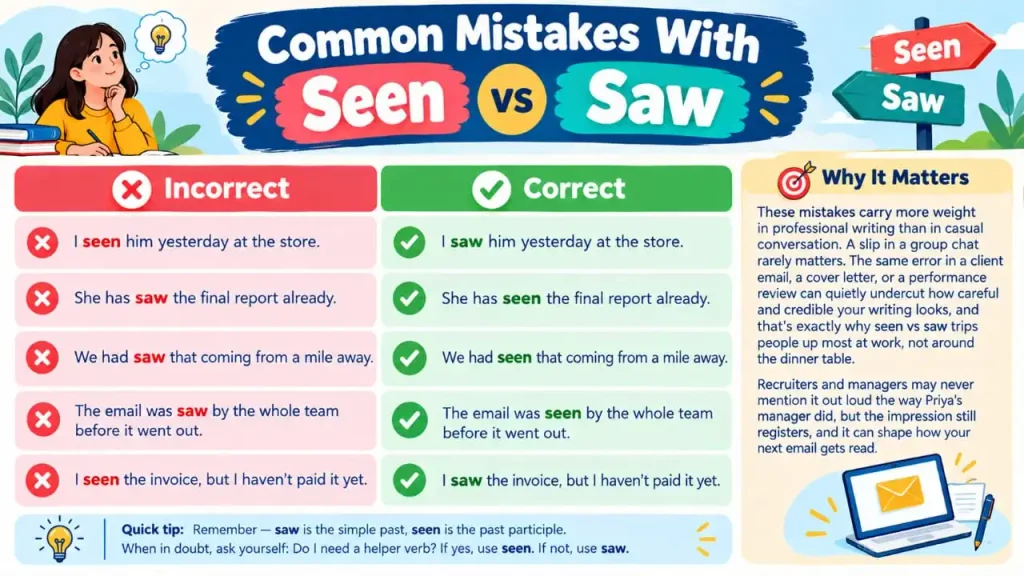
These mistakes carry more weight in professional writing than in casual conversation. A slip in a group chat rarely matters. The same error in a client email, a cover letter, or a performance review can quietly undercut how careful and credible your writing looks, and that’s exactly why seen vs saw trips people up most at work, not around the dinner table.
Recruiters and managers may never mention it out loud the way Priya’s manager did, but the impression still registers, and it can shape how your next email gets read.
Quick Quiz: Test Yourself on Seen vs Saw
- Yesterday, I ___ a great documentary about deep sea creatures. (saw)
- Have you ever ___ the Northern Lights in person? (seen)
- By the time we arrived, they had already ___ the opening act. (seen)
- She ___ the numbers before the meeting even started. (saw)
- The suspect was ___ leaving the building around midnight. (seen)
Check your answers against the italicized words above, then scroll back up to the Key Differences section if any of them surprised you. If you got all five right, the rule has already clicked. The trick now is just catching yourself before autopilot typing takes over and “seen” slips out without its helper verb.
Frequently Asked Questions
Is it correct to say “I seen”?
No. In Standard English, “I seen” without a helping verb is considered nonstandard. The correct forms are “I saw” (simple past) or “I have seen” (present perfect); both communicate the same idea in slightly different tenses.
What is the past participle of “see”?
The past participle of “see” is “seen.” It’s used with have, has, had, or a form of be, as in “I have seen” or “it was seen,” and it never appears correctly on its own.
When do you use “saw” instead of “seen”?
Use “saw” when the verb stands alone in a sentence describing a completed past action, with no helping verb attached, as in “I saw the show last night” rather than “I seen the show last night.”
Can you say “I have saw”?
No. “Saw” never follows “have,” “has,” or “had.” The correct phrase is always “I have seen,” even though “have saw” is a common typing slip when writing quickly, especially in emails typed fast without a proofreading pass.
Is “had saw” grammatically correct?
No. “Had” is a helping verb, and helping verbs pair with “seen,” not “saw.” The correct phrase is “had seen,” as in “I had seen that coming.”
Does “seen” always need a helping verb?
Yes. Whether it’s forming a perfect tense (“has seen”) or the passive voice (“was seen”), “seen” cannot function correctly on its own in a sentence. That missing helper is the single most common flag in the seen vs saw debate, and it’s usually the first thing worth checking when proofreading a draft.
Final Thoughts
The seen vs saw mix up isn’t a sign of weak grammar instincts; it’s a natural side effect of how English blends contractions in fast speech. The moment you remember the one line test, “saw stands alone, seen needs a friend,” the guesswork disappears for good.
Next time you catch yourself hesitating over an email or a caption, run the quick check: no helper verb nearby means saw; a helper verb sitting right beside it means seen. That’s the entire rule, and it holds true whether you’re writing a text to a friend or a report for your boss.
To read more: Sank vs Sunk: What’s the Ultimate Difference? 2026

Marcus is a former product manager turned comparison writer who spent eight years testing tools and gadgets before quitting to write full-time. He specializes in breaking down tech and software matchups into plain-English verdicts, with a soft spot for buying guides nobody else wants to write.