Suit vs Suite homophone like word pairs often cause trouble in writing, especially when both words look similar but carry entirely different meanings, and this pair fits that pattern perfectly. Though they sound almost identical, mixing them up can lead to some genuinely confusing sentences.
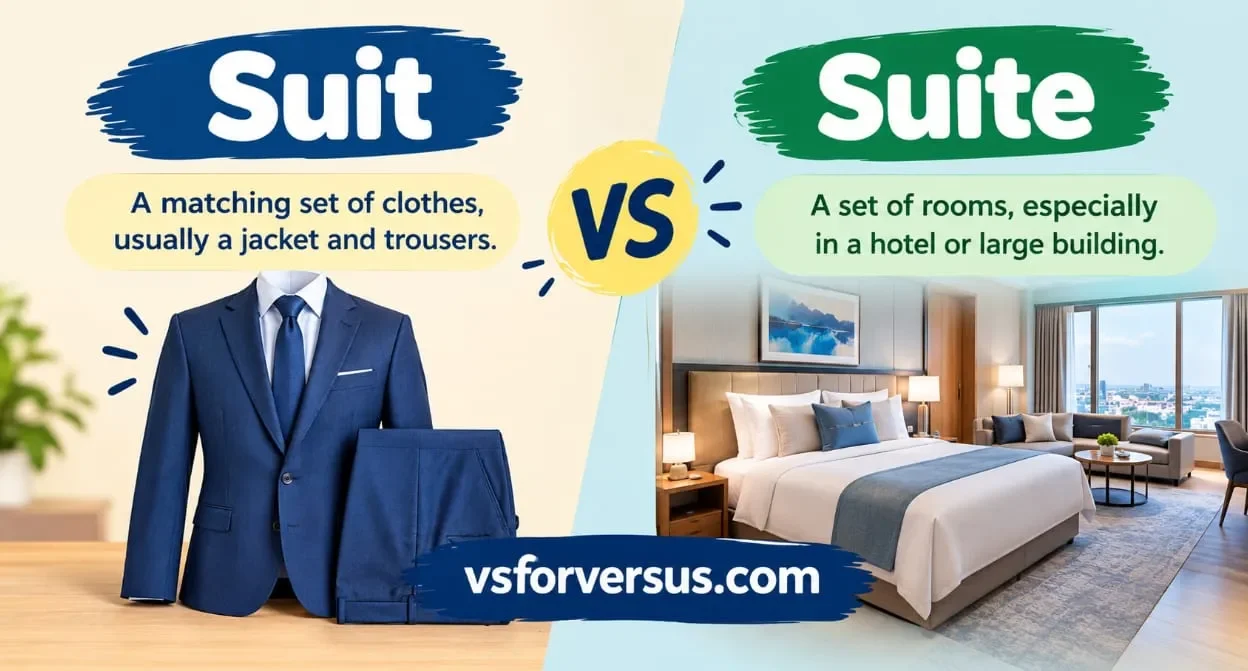
Suit typically refers to a matching set of clothing, such as a business suit, or can describe the act of being appropriate or fitting, as in “that color suits you.” Suite, on the other hand, refers to a set of connected rooms, often found in hotels, or a collection of related items, such as a furniture suite or a software suite.
Despite their close pronunciation, these words serve completely different purposes across fashion, hospitality, and technology. In this article, we’ll explore the origins of both words, break down their correct usage, and share clear examples to help you use each one with confidence.
Quick Answer
Suit (pronounced “soot”) is a noun or verb referring to a matching set of clothes, a legal case, or the act of fitting well. Suite (pronounced “sweet”) is always a noun, referring to a set of connected rooms, a group of related items like software, or a sequence of musical pieces. If you’re booking a hotel room, you want a suite; if you’re wearing formal clothes to a meeting, you want a suit.
Suit vs Suite at a Glance
The fastest way to settle a suit vs suite question is to look at both words side by side. Notice that only one of them can ever function as a verb, and only one of them can ever describe rooms, furniture, or software.
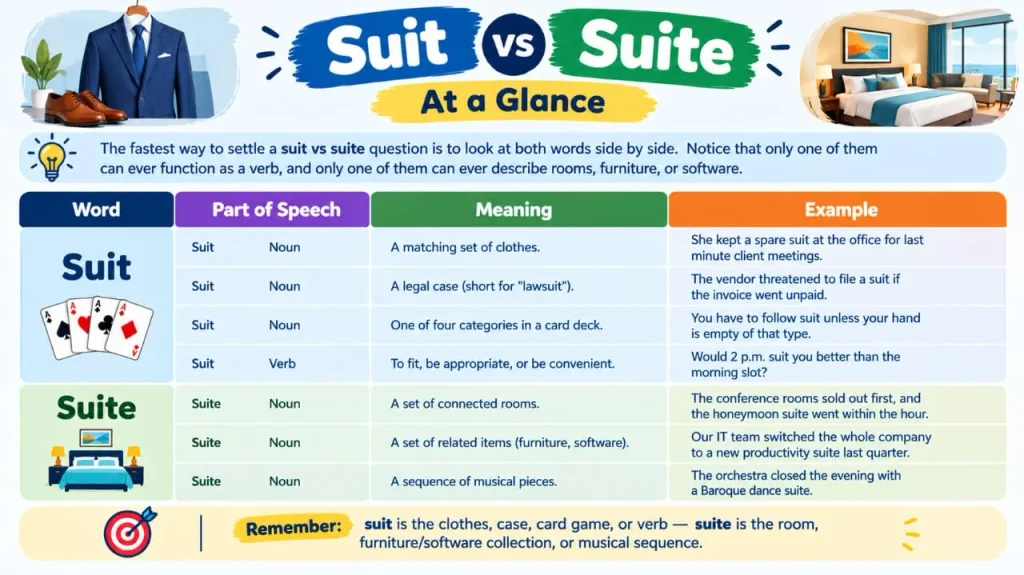
| Word | Part of Speech | Meaning | Example |
| Suit | Noun | A matching set of clothes | She kept a spare suit at the office for last minute client meetings. |
| Suit | Noun | A legal case (short for “lawsuit”) | The vendor threatened to file a suit if the invoice went unpaid. |
| Suit | Noun | One of four categories in a card deck | You have to follow suit unless your hand is empty of that type. |
| Suit | Verb | To fit, be appropriate, or be convenient | Would 2 p.m. suit you better than the morning slot? |
| Suite | Noun | A set of connected rooms | The conference rooms sold out first, and the honeymoon suite went within the hour. |
| Suite | Noun | A set of related items (furniture, software) | Our IT team switched the whole company to a new productivity suite last quarter. |
| Suite | Noun | A sequence of musical pieces | The orchestra closed the evening with a Baroque dance suite. |
This table is built as a standard semantic HTML table, which search engines can parse directly for Table rich results without requiring separate JSON LD markup.
What Does “Suit” Mean?
Suit is pronounced /suːt/, rhyming with “boot,” not “sweet.” It can act as either a noun or a verb, which already makes it more flexible in a sentence than its lookalike cousin.
As a noun, it most commonly refers to a matching outfit:
- He borrowed his brother’s charcoal suit for the funeral because his own didn’t fit anymore.
- The recruiter said the dress code was “business casual,” but half the room still showed up in suits.
- Her interview suit had been sitting in the closet since her last job change three years ago.
It also stands in for lawsuit in everyday writing:
- After the layoffs, three former employees joined a class action suit against the company.
And in card games, it identifies which of the four categories a card belongs to:
- If you don’t have a spade in your hand, you don’t have to follow suit.
As a verb, suit means to fit, work well, or be convenient:
- Let me know if Thursday still suits your schedule.
Suit shows up most often in job interviews, weddings, courtroom reporting, legal correspondence, and card games. It’s also the sense behind the idiom “suit yourself,” a phrase that has nothing to do with clothing but confirms that suit covers convenience and personal fit as well as fabric.
What Does “Suite” Mean?
Suite is pronounced /swiːt/, identical to the word “sweet,” which is exactly why it trips people up. Unlike suit, it is always a noun. It never functions as a verb in standard English.
Its most familiar meaning is a set of connected rooms:
- We upgraded to a suite for the anniversary trip since it had a separate living area.
- The dorm’s third floor is all suite style housing, with two bedrooms sharing one bathroom.
- The presidential suite came with its own private balcony overlooking the harbor.
It also describes a collection of related items, especially software:
- Half our marketing stack runs through one analytics suite now instead of five separate tools.
- Adobe’s Creative Suite used to bundle Photoshop, Illustrator, and InDesign together.
And in music, it refers to a sequence of instrumental pieces meant to be performed together:
- Her recital ended with a movement from Bach’s cello suites.
You’ll typically spot suite in hotel and travel writing, real estate listings, software documentation, and formal music programs. It also appears in the term “en suite,” used in British and real estate English to describe a bathroom directly attached to a bedroom, always spelled as two words (or hyphenated), never “en suit.”
Key Differences Between Suit vs Suite
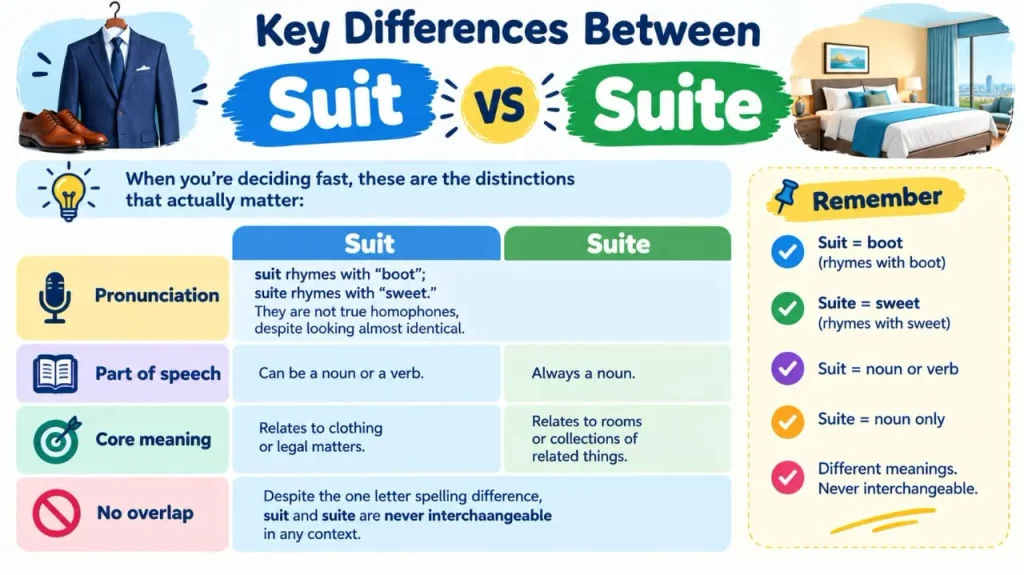
When you’re deciding fast, these are the distinctions that actually matter:
- Pronunciation: suit rhymes with “boot”; suite rhymes with “sweet.” They are not true homophones, despite looking almost identical.
- Part of speech: suit can be a noun or a verb; suite is always a noun.
- Core meaning: suit relates to clothing or legal matters; suite relates to rooms or collections of related things.
- No overlap: despite the one letter spelling difference, suit and suite are never interchangeable in any context.
Why Do Suit vs Suite Look So Similar?
Here’s the part most guides skip, and it actually explains the whole suit vs suite puzzle. Both words trace back to the same Old French root, suite or sivre, meaning “to follow.” Originally, the word described a retinue: a group of attendants who “followed” a noble. From that single idea, English split in two directions.
A suit became the matching set of clothes worn by that retinue, while a suite held onto the sense of a “following” set, such as a sequence of rooms or a sequence of musical movements performed one after another. They didn’t drift apart by accident. They’re etymological siblings that took different paths through the language, which is exactly why the spelling still echoes a shared origin even though the sound and meaning no longer do.
Memory Trick to Remember the Difference?
If the etymology doesn’t stick, a simpler shortcut will:
- Suite has an E, like sweet, like a hotel suite where you sleep. Three E linked words reinforcing each other.
- Suit fits you like a glove. No “sweet” hotel vibes anywhere in that sentence.
Even experienced writers slip here occasionally, usually while typing quickly. Autocorrect won’t catch it either, since both words are spelled correctly on their own. The mistake only shows up when a human proofreads for meaning, not spelling.
Bonus: Suit, Suite, or Sweet?
Here’s a detail worth flagging: the true homophone of suite isn’t suit. It’s sweet. “Suite” and “sweet” sound completely identical; “suit” just happens to look close on the page. If you’ve ever paused over a sentence like “the presidential suite came with a plate of sweets,” you were navigating three related but distinct words at once.
Common Mistakes with Suit vs Suite
Most suit vs suite errors fall into a small, predictable set of patterns:
| ❌ Wrong | ✅ Correct |
| I stayed in the hotel’s best suit. | I stayed in the hotel’s best suite. |
| He wore a nice suite to the wedding. | He wore a nice suit to the wedding. |
| Please find attached my software suit. | Please find attached my software suite. |
| They filed a suite against the landlord. | They filed a suit against the landlord. |
| We booked the honeymoon suit. | We booked the honeymoon suite. |
Two fixed expressions deserve special attention because they trip people up even when they already know the general rule. The idiom “follow suit” is always spelled with suit, regardless of context, even outside card games, where it now means “to do the same thing someone else just did.” And “en suite” is always two words (or hyphenated as “en suite”), never collapsed into “en suit.”
Most of these slips happen for a simple reason: spellcheck tools only flag words that don’t exist in the dictionary. Since both suit and suite are perfectly valid English words, no red squiggly line will ever warn you that you’ve picked the wrong one.
Autocorrect can make it worse by “fixing” a correctly typed word into the wrong lookalike if you’re typing fast on a phone. The only real safeguard is knowing the meaning behind each word well enough to catch the error yourself during a proofread.
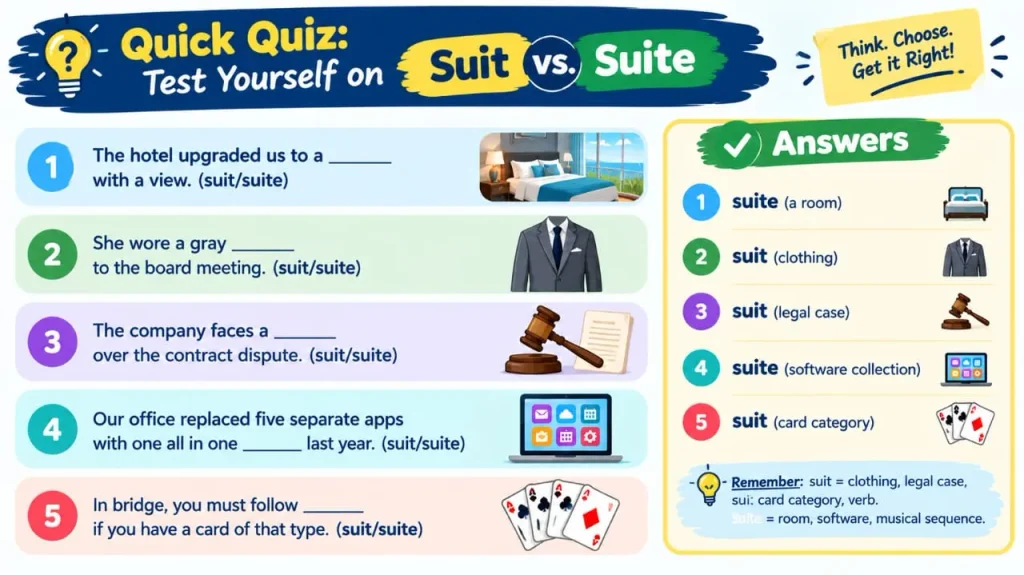
Quick Quiz: Test Yourself on Suit vs Suite
- The hotel upgraded us to a ______ with a view. (suit/suite)
- She wore a gray ______ to the board meeting. (suit/suite)
- The company faces a ______ over the contract dispute. (suit/suite)
- Our office replaced five separate apps with one all in one ______ last year. (suit/suite)
- In bridge, you must follow ______ if you have a card of that type. (suit/suite)
Answers: 1. suite (a room) · 2. suit (clothing) · 3. suit (legal case) · 4. suite (software collection) · 5. suit (card category)
Frequently Asked Questions
Here are the suit vs suite questions people search for most often, answered directly.
What is the difference between suit and suite?
A suit is a matching set of clothes, a legal case, or a verb meaning “to fit”; a suite is always a noun referring to connected rooms, a set of related items, or a musical sequence.
Is it “hotel suit” or “hotel suite”?
“Hotel suite” is correct. It refers to a set of connected rooms, not an outfit.
How do you pronounce suite like suit or like sweet?
Suite is pronounced like “sweet,” not like “suit.” The two words sound completely different despite their similar spelling.
Is suit pronounced like “soot”?
Yes. Suit rhymes with “boot” and “soot,” using a short, rounded vowel sound that is completely different from the long “ee” sound in suite.
Can suite mean furniture?
Yes. A “bedroom suite” or “dining suite” refers to a matching set of furniture pieces designed to be used together, which is a separate meaning from the hotel room sense of the word.
What is the plural of suite suites or suits?
The plural of suite is suites. Suits is the separate plural of suit, referring to multiple outfits, legal cases, or card categories.
Is “en suite” one word or two?
“En suite” is always written as two words or hyphenated (“en suite”), never as one word or as “en suit.”
What does “follow suit” mean?
“Follow suit” means to do the same thing someone else just did. The phrase always uses “suit,” never “suite,” even outside its original card game context.
Final Thoughts
The suit vs suite mix up rarely comes from not knowing English. It comes from two words that trace back to the same root but split off into completely different meanings, sounds, and jobs in a sentence.
Remember the shortcut: suit covers clothing, legal cases, and card games, and it’s the only one of the two that can act as a verb. Suite covers rooms, collections, and music, and it always sounds like “sweet.”
Whether you’re writing a quick email, a travel confirmation, or a formal report, pausing for that one second check between “clothing ” and ” rooms?” is usually all it takes to get it right every time.
To read more: Seel vs Seal: The Ultimate Guide to 5 Key Differences and Which Is Correct

Marcus is a former product manager turned comparison writer who spent eight years testing tools and gadgets before quitting to write full-time. He specializes in breaking down tech and software matchups into plain-English verdicts, with a soft spot for buying guides nobody else wants to write.