
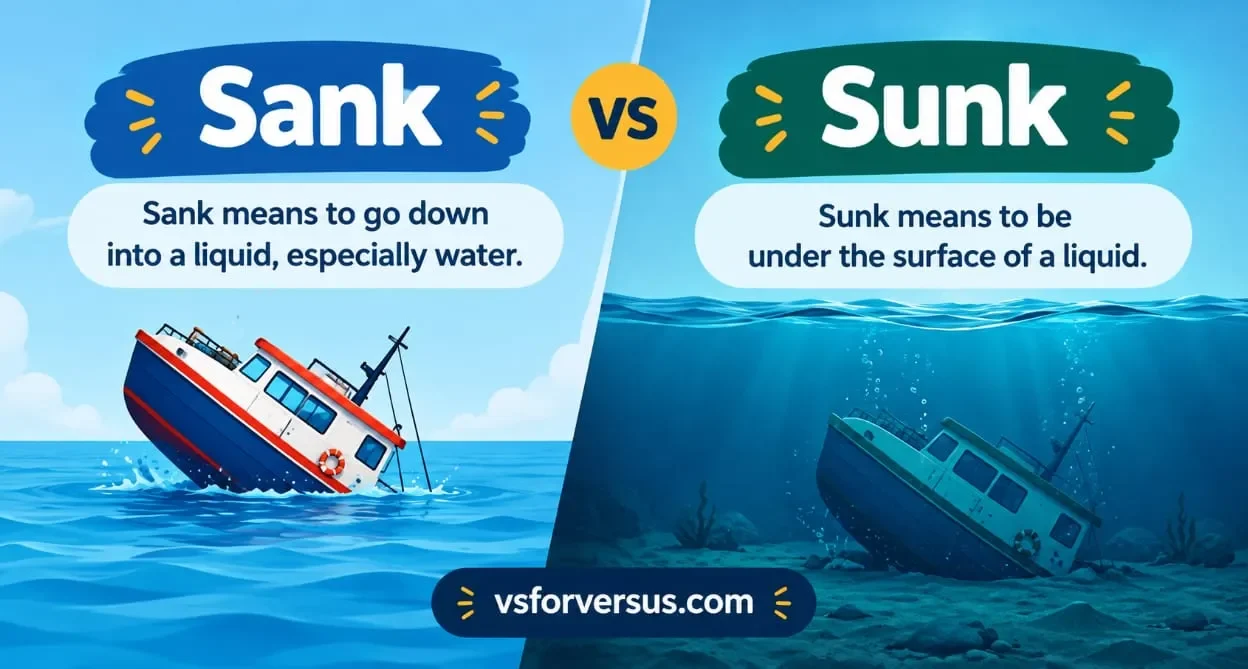
Sank vs Sunk these two words often confuse English learners and native speakers alike because they’re both forms of the same verb, “sink,” yet you can’t use them interchangeably in a sentence. The confusion usually comes down to grammar, not meaning.
Sank is the simple past tense form, used on its own to describe a completed action in the past, as in “the ship sank during the storm.” Sunk, on the other hand, is the past participle, which must be paired with a helping verb like “has,” “have,” or “had,” as in “the ship has sunk to the ocean floor.” Using “sunk” without a helping verb, or using “sank” incorrectly after “has,” is one of the most common grammar mistakes in English.
In this article, we’ll break down this irregular verb pattern, explore correct usage, and share clear examples to help you master it once and for all.
Quick Answer
Sank is the simple past tense of the verb sink and stands alone: “The ferry sank.” Sunk is the past participle of sink and follows a helper verb, such as has, had, or was: “The ferry has sunk.” For sank vs sunk, look for a helper verb anywhere before the word, even with another word like already in between: if one appears, use sunk; if not, use sank.
The Whole Story of Sank vs Sunk at a Glance
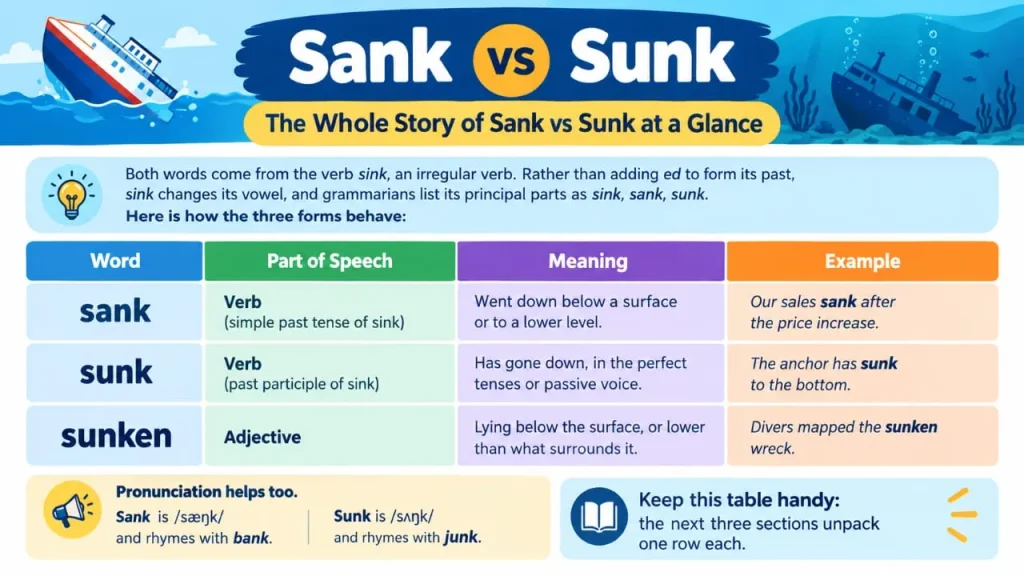
Both words come from the verb sink, an irregular verb. Rather than adding ed to form its past, sink changes its vowel, and grammarians list its principal parts as sink, sank, sunk. Here is how the three forms behave:
| Word | Part of Speech | Meaning | Example |
| sank | Verb (simple past tense of sink) | Went down below a surface or to a lower level | Our sales sank after the price increase. |
| sunk | Verb (past participle of sink) | Has gone down, in the perfect tenses or passive voice | The anchor has sunk to the bottom. |
| sunken | Adjective | Lying below the surface, or lower than what surrounds it | Divers mapped the sunken wreck. |
Keep that table handy: the next three sections unpack one row each.
Pronunciation helps too. Sank is /sæŋk/ and rhymes with bank. Sunk is /sʌŋk/ and rhymes with junk.
When to Use “Sank” (Simple Past Tense)
Sank is the past tense of sink. It describes something that happened and finished, and it never needs a helper verb. When no word like has or was appears anywhere before it, sank is what you want.
- “The ferry sank in less than an hour, but everyone made it to shore.”
- “My heart sank when I saw the email from HR.”
- “Our website traffic sank in March after the algorithm update.”
- “The sun sank behind the ridge, and the trail went dark.”
You’ll find sank wherever people tell a story about the past: news reports on shipwrecks, quarterly results, a text to a friend about a bad day. It also carries emotion, since spirits, hopes and stomachs all sink.
It can take an object too: “The storm sank three fishing boats.” Flip that sentence into the passive voice and the verb changes: “Three fishing boats were sunk by the storm.” That switch is the clearest proof that English needs both words. In the active sentence, sank stands alone. In the passive one, the helper verb were arrives and sunk follows.
When to Use “Sunk” (Past Participle)
Sunk is the past participle of sink, so it depends on a helper verb, also called an auxiliary verb, such as has, have, had, was, or were, to build the present perfect, the past perfect, or the passive voice.
- “The anchor has sunk to the bottom of the harbor.”
- “By the time the coast guard arrived, the fishing boat had already sunk.”
- “Two cargo ships were sunk during the storm.”
- “If the rebrand flops, we will have sunk half our annual budget into a logo.”
Notice the second example: had and sunk are separated by already. The rule still holds, since the helper verb just needs to appear somewhere before the word.
Away from the water, sunk shows up mostly in money talk. A sunk cost is money already spent that can’t be recovered, and the sunk cost fallacy describes the habit of throwing more money at a failing project because of what has already gone in. When someone groans “I’m sunk,” they mean they are in serious trouble. These fixed phrases behave almost like adjectives, but they still grow out of the past participle.
And What About “Sunken”?
Sunken is the adjective you place before a noun: sunken treasure, sunken cheeks, a sunken living room. When the word comes before a noun and describes it, sunken is the usual choice. “She looked tired, with sunken eyes” reads more naturally than “sunk eyes.”
Key Differences Between Sank vs Sunk
Here is sank vs sunk in scannable form:
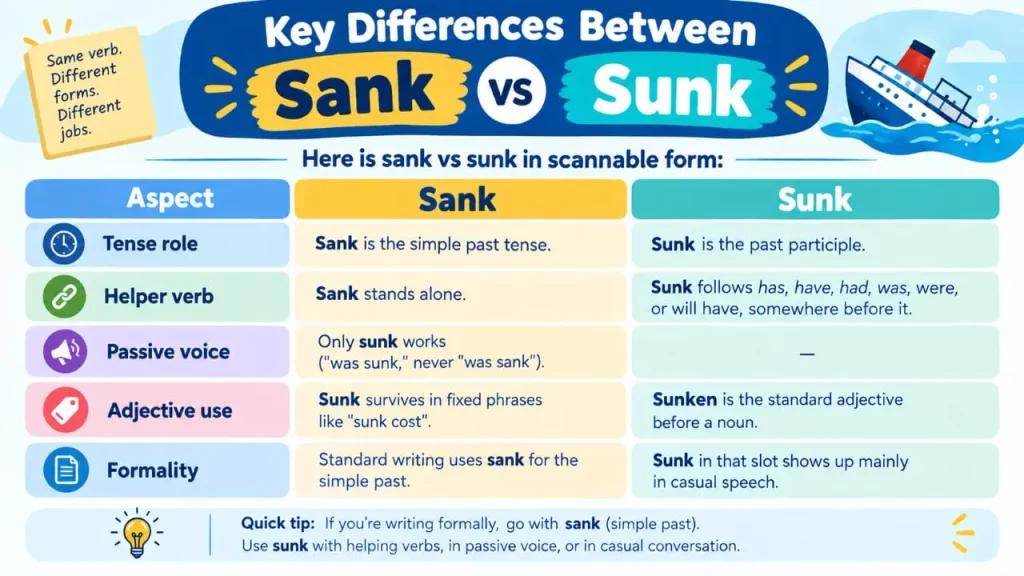
- Tense role: sank is the simple past tense; sunk is the past participle.
- Helper verb: sank stands alone; sunk follows has, have, had, was, were, or will have, somewhere before it.
- Passive voice: only sunk works (“was sunk,” never “was sank”).
- Adjective use: sunk survives in fixed phrases like “sunk cost”; sunken is the standard adjective before a noun.
- Formality: standard writing uses sank for the simple past; sunk in that slot shows up mainly in casual speech.
The Helper Verb Test (Memory Trick)
Ask one question: is there a helper verb anywhere before the word? If yes, use sunk. If no, use sank.
Try it on four sentences:
- “The ship ___ at midnight.” No helper verb, so sank.
- “The ship has ___.” Helper verb, so sunk.
- “The ship was ___ by a mine.” Helper verb, so sunk.
- “The ship had already ___ by dawn.” Helper verb, even with already in the way, so sunk.
Why does the test work? A past participle is a verb form that cannot carry the sentence by itself. It needs a helper verb to place the action in time. The simple past tense does that job on its own, so it needs no help. Once you see that, the rule stops feeling like memorization.
If you already know drank vs drunk, you know this rule. “She drank the coffee” has no helper verb; “she has drunk the coffee” does. Sank matches drank, and sunk matches drunk. The same pattern runs through sing, sang, sung and ring, rang, rung, a shared verb conjugation pattern for old, irregular English verbs. Linguists call this vowel swap ablaut, and it explains why a whole family of verbs inherited from Old English behaves alike. Learn one, and you have learned the group.
Why Even Experienced Writers Slip
The slippery part of sank vs sunk is this: sunk sounds right in the simple past because people say it out loud all the time. “The ship sunk” and “it finally sunk in” both roll off the tongue, and Merriam Webster does list sunk as a variant of sank. Even seasoned editors, who spot this error easily in other people’s drafts, can let it slip into their own rushed emails, because the ear approves before the eye checks.
The cure is small: pause for two seconds before you hit send and look for the helper verb. Formal writing, exams, and professional documents still expect sank for the simple past, so the pause is worth taking.
Common Mistakes (Wrong vs Correct)
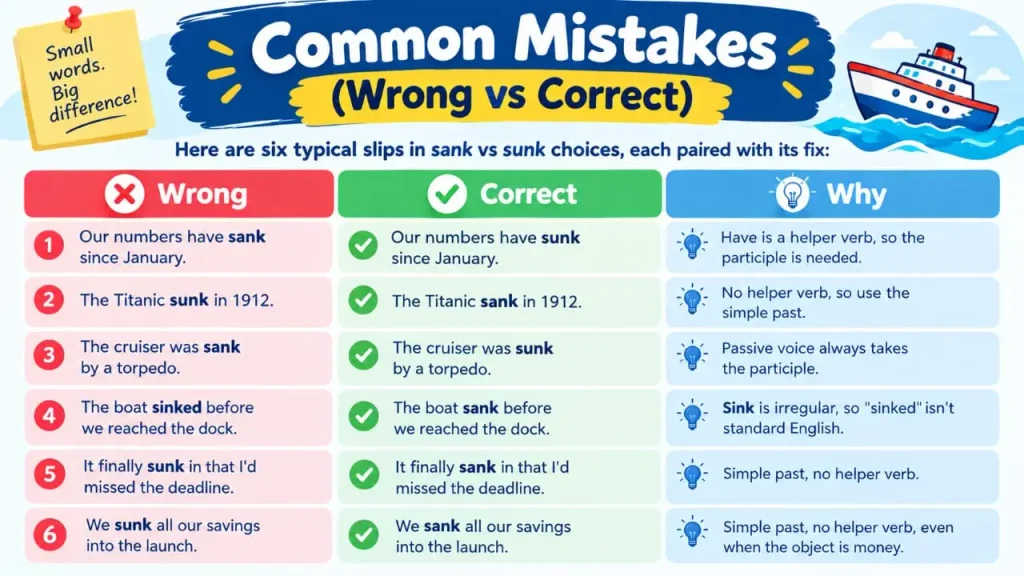
Here are six typical slips in sank vs sunk choices, each paired with its fix:
| Wrong | Correct | Why |
| Our numbers have sank since January. | Our numbers have sunk since January. | Have is a helper verb, so the participle is needed. |
| The Titanic sunk in 1912. | The Titanic sank in 1912. | No helper verb, so use the simple past. |
| The cruiser was sank by a torpedo. | The cruiser was sunk by a torpedo. | Passive voice always takes the participle. |
| The boat sinked before we reached the dock. | The boat sank before we reached the dock. | Sink is irregular, so “sinked” isn’t standard English. |
| It finally sunk in that I’d missed the deadline. | It finally sank in that I’d missed the deadline. | Simple past, no helper verb. |
| We sunk all our savings into the launch. | We sank all our savings into the launch. | Simple past, no helper verb, even when the object is money. |
Quick Quiz: Sank or Sunk?
Test yourself on sank vs sunk. Each answer comes with its reason.
- The treasure ship ___ off the coast in 1715. Sank. No helping verb.
- Three vessels have ___ in this bay since spring. Sunk. It follows have.
- The battleship was ___ by a submarine. Sunk. Passive voice takes the participle.
- My stomach ___ when the manager said, “We need to talk.” Sank. Simple past tense.
- Spot the error: “The company has sank millions into the project.” Has sunk. A helper verb needs the participle.
- Bonus: Divers explored the ___ wreck. Sunken. It is an adjective before a noun.
Missed a few? That’s normal. Copy the one line test onto a sticky note and keep it beside your monitor for a week. Before long, the check becomes automatic.
Frequently Asked Questions
Is it sank or sunk?
The choice between sank vs sunk depends on a helper verb: use sank without one (“it sank”) and sunk after one (“it has sunk”).
What is the past tense of sink?
The simple past tense of sink is sank. The past participle of sink is sunk, used with helper verbs.
What is the past participle of sink?
The past participle of sink is sunk. It follows has, have, had, was, or were, as in “The ship had sunk before dawn.”
Is “has sank” correct?
No, “has sank” is not correct. Has is a helper verb, so it takes the past participle: “has sunk.”
Is “sunk” ever used as the simple past?
Sunk is sometimes used as the simple past in casual speech, and Merriam Webster lists it as a variant of sank. In formal, academic, and professional writing, use sank.
What’s the difference between sunk and sunken?
Sunk is the verb form, used after a helper verb, while sunken is an adjective that describes something lying underwater or below its surroundings, like a sunken ship.
Final Thoughts
Pause, find the helper verb, and choose. That habit turns sank vs sunk from a coin flip into a two second check. Sank stands on its own; sunk always leans on a helper like has, had, or was somewhere in front of it. And if a coworker’s report says the numbers “have sank,” you now know exactly what to fix and how to explain it kindly.
To read more: Regimen vs Regiment: What’s the Shocking Difference? 2026

Marcus is a former product manager turned comparison writer who spent eight years testing tools and gadgets before quitting to write full-time. He specializes in breaking down tech and software matchups into plain-English verdicts, with a soft spot for buying guides nobody else wants to write.