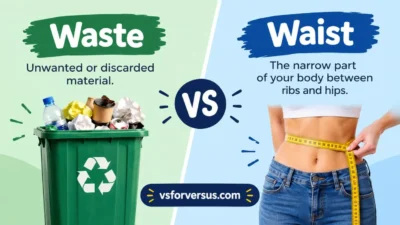
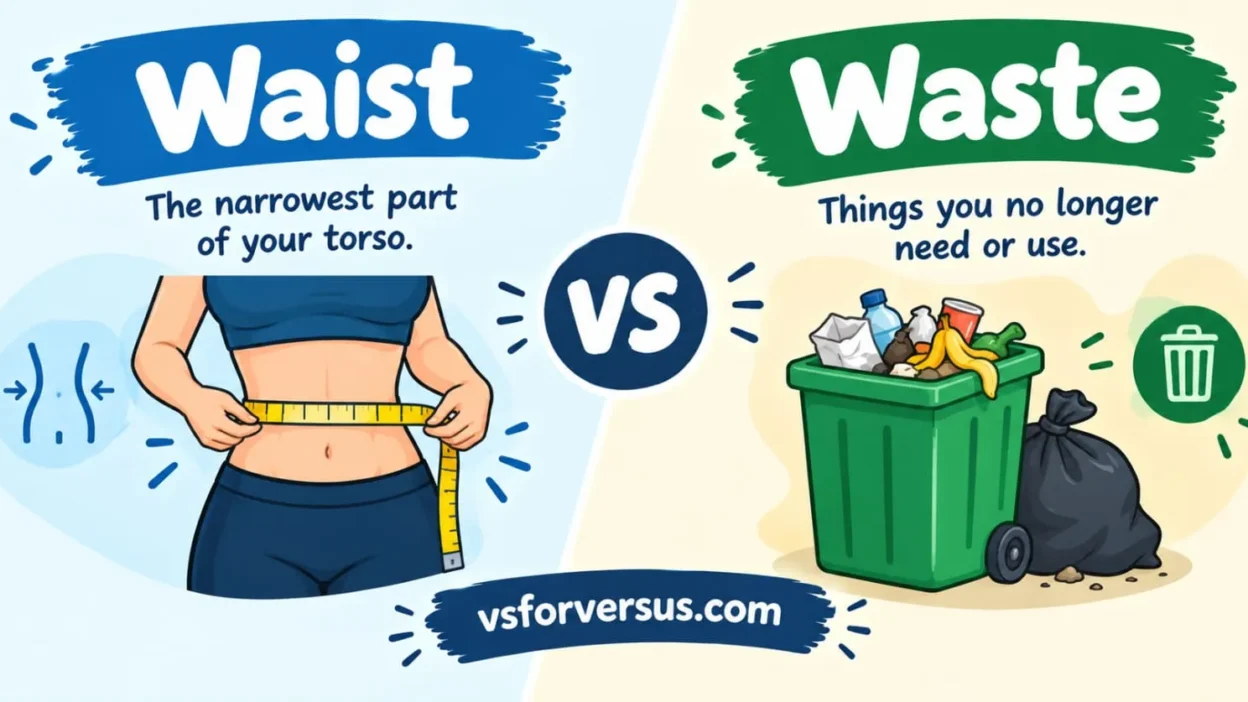
Waist vs Waste are the homophones often create the trickiest spelling challenges because the ear offers no clues, and this pair is a perfect example of that problem. Despite sounding exactly the same, these two words belong to entirely different categories of meaning.
Waist refers to the narrow part of the human body between the ribs and hips, commonly used in fashion, fitness, and anatomy, as in “she wore a belt around her waist.” Waste, on the other hand, refers to the careless or unnecessary use of resources, or materials that are discarded as unusable, such as “food waste” or “a waste of time.” Since these words sound identical but serve completely unrelated purposes, mixing them up is a common and easily overlooked mistake.
In this article, we’ll explore the origins of both words, clarify their correct usage, and provide clear examples to help you avoid this mix up for good.
Quick Answer:
A few terms in that box deserve plain English definitions. A noun names a thing, such as a belt, a body part, or a pile of trash. A verb names an action, such as measuring, cutting, or throwing away. An adjective describes a noun, as in “waste ground.” A homophone is a word that sounds exactly like another but differs in spelling and meaning. Waist and waste fit that last label perfectly: same pronunciation, completely different jobs.
Put simply, waist always points to a body or a garment, and waste always points to misuse or leftovers. Want more pairs like this one?
Waist vs Waste at a Glance
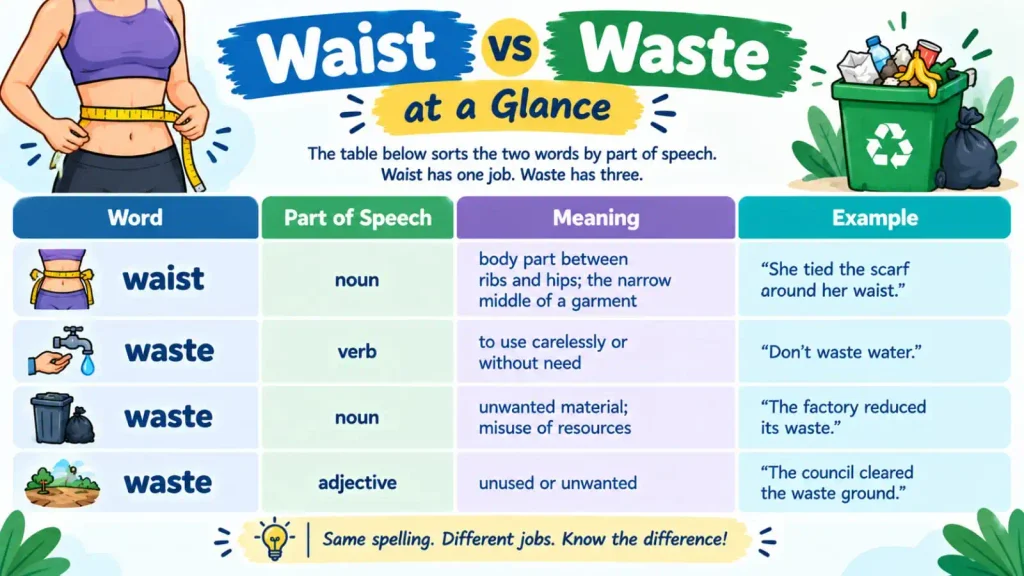
The table below sorts the two words by part of speech. Waist has one job. Waste has three.
| Word | Part of Speech | Meaning | Example |
| waist | noun | body part between ribs and hips; the narrow middle of a garment | She tied the scarf around her waist. |
| waste | verb | to use carelessly or without need | Don’t waste water. |
| waste | noun | unwanted material; misuse of resources | The factory reduced its waste. |
| waste | adjective | unused or unwanted | The council cleared the waste ground. |
What Does “Waist” Mean?
Waist is a noun, and only a noun. In dictionary terms, the waist definition is short: the part of the body between the ribs and hips, or the matching narrow part of a garment or object. If a sentence needs an action, the word you want is waste.
Here is how it sounds in real writing:
- “I need a belt that actually cinches my waist instead of sliding down.”
- The tailor measured his waist twice before cutting the fabric.
- High waisted jeans are back in every store this season.
- The bridesmaid dress fit well everywhere except the waist, which was too loose.
That one word, waist meaning turns up mostly in fashion and sizing, fitness and health (doctors use waist to hip ratio as one screening measure), and tailoring. Compounds such as waistband, waistline, and waistcoat all grow from the same root. Waistcoat has a quirk: in traditional British English, it is often pronounced /ˈwɛskət/, so the compound does not always sound like its parent word. On its own, waist is always /weɪst/, whether you are reading a sewing pattern or a fitness article.
What Does “Waste” Mean?
Waste is the flexible one. It works as a verb, a noun, and an adjective, and each sense turns up in everyday writing. The waste meaning you need depends on the sentence: an action, a thing, or a description.
Waste as a verb
To waste is to use something carelessly or to no purpose. “Don’t waste your time worrying about a typo in a text message,” a friend might say. The verb also powers “waste away,” which describes a person or thing slowly losing strength.
Waste as a noun
As a noun, waste means unwanted material, or the act of misusing a resource. “The city manages household waste through weekly pickups” is one everyday example. “That meeting was a complete waste of an afternoon” is another, and the “waste of time” family is where the spelling error strikes most often.
Waste as an adjective
This sense is rarer, but it is real. It means unused, unwanted, or uncultivated. “The waste ground behind the factory became a community garden” uses it correctly. The compound noun wasteland, meaning barren or empty land, grows out of the same idea.
A workplace example shows the split clearly. A quarterly report might say, “We cut packaging waste by 18 percent this quarter.” The same company’s uniform order would say, “Please confirm the waist size for each employee.” One sentence concerns loss, the other measurement, and swapping them would puzzle both readers. Here is a simple test: if no clothing or anatomy is in sight, waist is rarely the right choice.
Waste also dominates environmental writing, business reports, and money talk (“that subscription is a waste of money”). Idioms lean on it too. Invaders “lay waste to” a city, and forgotten groceries “go to waste” in the fridge.
Key Differences Between Waist vs Waste
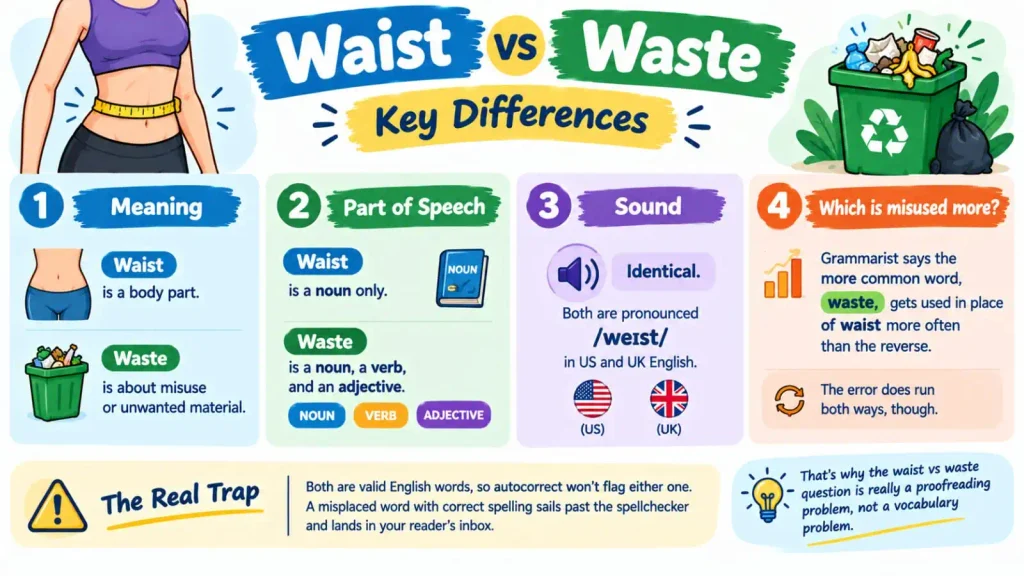
If you remember only four things, make them these:
- Meaning: Waist is a body part. Waste is about misuse or unwanted material.
- Part of speech: Waist is a noun only. Waste is a noun, a verb, and an adjective.
- Sound: Identical. Both are pronounced /weɪst/ in US and UK English.
- Which is misused more: Grammarist says the more common word, waste, gets used in place of waist more often than the reverse. The error does run both ways, though.
There is a practical trap here, too. Both are valid English words, so autocorrect will not flag either one. A misplaced word with correct spelling sails past the spellchecker and lands in your reader’s inbox. That is why the waist vs waste question is really a proofreading problem, not a vocabulary problem.
Why Are Waist vs Waste Spelled Differently?
Two words that sound alike but look different often have separate family trees, and this pair fits the pattern. It is a classic case of same sound, different spelling. English collected many such pairs over the centuries, borrowing from Old English, French, and Latin and then letting the pronunciations drift together.
Dictionaries trace waist, with some caution, to an Old English root meaning growth or size. That makes sense for the part of the body where a person’s build is measured. Waste took a different road. It came through Old French from the Latin vastus, meaning empty or desolate, which explains why the word carries ideas of barren land and loss.
So the two words never began as one word that split apart. They started as strangers and ended up sounding alike. Some people insist the words are pronounced differently, but in modern standard English they are not. Spelling is the only place they part ways.
How to Remember the Difference (Memory Tricks)
A good mnemonic device for waist vs waste works in under two seconds. Try one of these, then test yourself.
The “i” trick. Waist has an “i” for inches, the unit you measure it in. If the sentence involves a tape measure or a belt, that “i” belongs there. Self test: “The trousers fit everywhere except the.” (waist)
The “e” trick. Waste ends in “e” for excess or extra, which describes what gets thrown out. Self test: “Please don’t the leftovers.” (waste)
The narrow “i.” Look at the middle of waist. The slim letter “i” sits near the center, just like a narrow waist. Self test: which spelling keeps the slim letter in the middle? (waist)
Want more tricks in this style?
Common Mistakes (Wrong vs Correct)
These waist vs waste errors turn up in emails, product listings, and social media captions. A caption like “my jeans were a total waste of money” earns a few laughing replies, and a brand account that posts it earns screenshots.
| Wrong | Correct |
| a waist of time | a waste of time |
| a waste measurement | a waist measurement |
| waist management | waste management |
| high waste jeans | high waist jeans |
| it went to waist | it went to waste |
| waist disposal | waste disposal |
A spelling mistake that produces a real word is the hardest kind to catch. Spellcheck misses all six of these because each wrong version is a legitimate word in the wrong place. The software checks whether a word exists, not whether it fits. Reading aloud will not help either, since the words sound identical. Instead, pause on each one and ask what job it is doing: naming a body part, or describing misuse?
Words and Phrases to Know
Knowing the family of each word makes the waist vs waste choice automatic.
Waist family: waistband, waistline, waistcoat, high waisted.
Waste family: wastebasket, wasteland, wasteful, waste away, lay waste, go to waste, “waste not, want not,” and “haste makes waste.”
One more note: “waist basket” is not a standard word. The bin under your desk is a wastebasket.
Quick Quiz
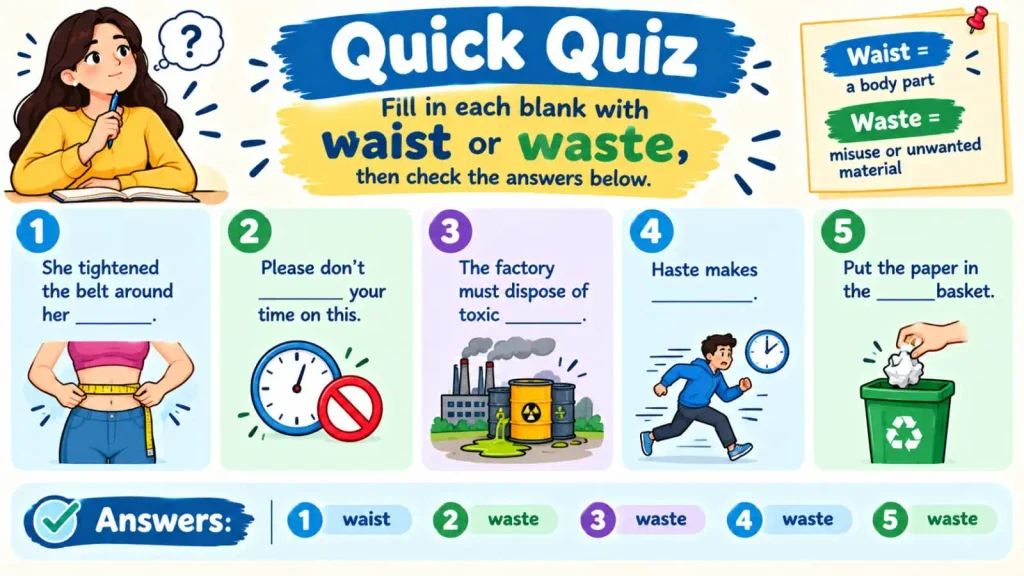
Fill in each blank with waist or waste, then check the answers below.
- She tightened the belt around her ______.
- Please don’t ______ your time on this.
- The factory must dispose of toxic ______.
- Haste makes ______.
- Put the paper in the ______basket.
Answers: 1. waist. 2. waste. 3. waste. 4. waste. 5. waste.
Waist vs Waste FAQ
Is it waist or waste?
Use waist for the body part or the narrow middle of a garment. Use waste for anything used carelessly, thrown away, or left unused. If your sentence involves a belt, a tape measure, or a pair of trousers, choose waist. If it involves time, money, trash, or effort, choose waste.
Are waist and waste homophones?
Yes. Waist and waste are homophones, meaning they sound exactly alike while carrying different meanings and spellings. Both are pronounced /weɪst/ in standard American and British English. Because the sound offers no clue, writers must rely on meaning and spelling to choose correctly.
Is waste a noun or a verb?
Waste is both, and it can also be an adjective. As a verb, it means to use carelessly, as in “waste money.” As a noun, it means unwanted material or misuse, as in “food waste.” As an adjective, it means unused or unwanted, as in “waste ground.”
Is waist ever a verb?
No. Waist is a noun only. If a sentence needs a verb and you feel tempted to write waist, the word you want is almost certainly waste. Compounds such as waistband and waistline are nouns too, and they follow the same rule.
How do you spell “waist of time”?
The correct phrase is “waste of time.” Waist is only ever the body part, so it can never describe time, effort, or money. This is the most common error involving the pair, and it shows up in emails and captions alike.
Is it wastebasket or waist basket?
The correct word is wastebasket. It is a container for waste, meaning unwanted material. A “waist basket” is not a standard word in English, so it should never appear in professional writing. If the noun and verb distinction still feels shaky, see.
Final Thoughts
The waist vs waste decision comes down to one question: is the sentence about a body or a garment, or about misuse and leftovers? Waist belongs to the first group, and waste belongs to everything else. Keep the “i for inches” trick handy, run a quick search for both words before you hit publish, and the mistake that cost our job applicant his first impression will never reach your readers.
To read more: Valuable vs Invaluable: What’s the Difference? (With Examples)2026

Marcus is a former product manager turned comparison writer who spent eight years testing tools and gadgets before quitting to write full-time. He specializes in breaking down tech and software matchups into plain-English verdicts, with a soft spot for buying guides nobody else wants to write.