
Dreamt vs Dreamed is a few verbs show how flexible English can be quite like this one, where two past tense forms live side by side and neither one is wrong. The real difference comes down to region, rhythm, and personal style rather than grammar.
Dreamed is the regular past tense and past participle of “dream,” formed by simply adding “ ed,” and it is the preferred form in American English, as in “she dreamed of traveling the world.” Dreamt, on the other hand, is an irregular variant that is far more common in British and Australian English, often carrying a slightly softer, more literary feel, as in “he dreamt of a quiet life by the sea.”
Both forms also work as past participles, so the choice rarely changes the meaning of a sentence. In this article, we’ll explore the origins of both forms, their regional preferences, and clear examples to help you choose confidently.
Quick Answer
Dreamt vs dreamed are two correct past forms of the verb “dream,” meaning to experience images during sleep or to imagine something, and each works as both the past tense and the past participle. When it comes to dreamt vs dreamed, the main differences are region and tone: dreamed is standard in American English, while British English uses both forms. Choose one form for each piece of writing and use it consistently.
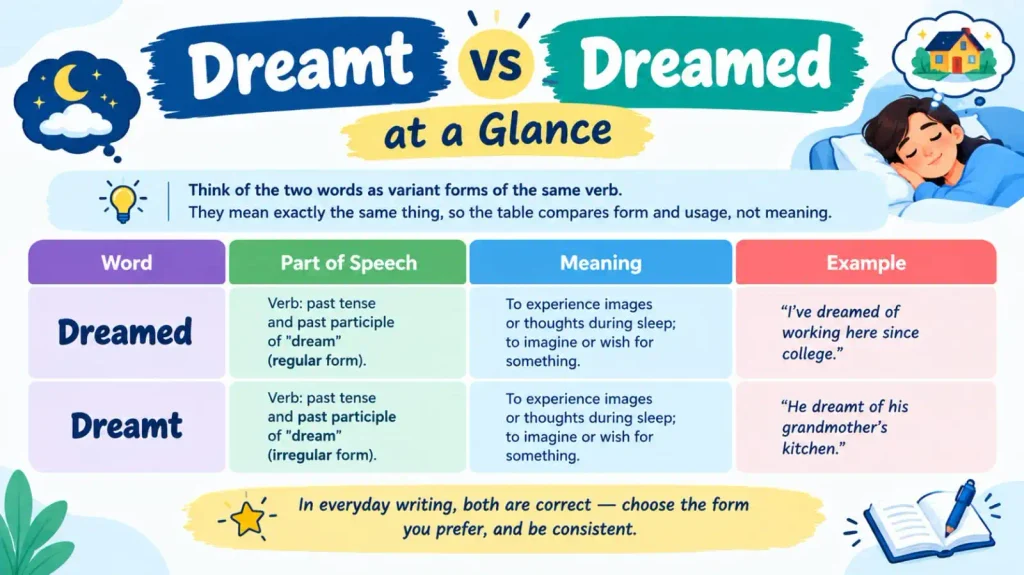
Dreamt vs Dreamed at a Glance
Think of the two words as variant forms of the same verb. They mean exactly the same thing, so the table compares form and usage, not meaning.
| Word | Part of Speech | Meaning | Example |
| Dreamed | Verb: past tense and past participle of “dream” (regular form) | To experience images or thoughts during sleep; to imagine or wish for something | “I’ve dreamed of working here since college.” |
| Dreamt | Verb: past tense and past participle of “dream” (irregular form) | To experience images or thoughts during sleep; to imagine or wish for something | “He dreamt of his grandmother’s kitchen.” |
The Past Tense and Past Participle of Dream
Most English verbs are regular: they add ed in the past. Irregular verbs change in other ways. “Dream” is unusual because it does both, and that dual status is the root of the dreamt vs dreamed puzzle. Here is the conjugation at a glance:
| Form | Verb |
| Base form | dream |
| Third person singular | dreams |
| Present participle | dreaming |
| Simple past | dreamed / dreamt |
| Past participle | dreamed / dreamt |
Because each form covers both jobs, “I dreamed” and “I dreamt” are both simple past, while “I have dreamed” and “I have dreamt” are both present perfect. The pattern carries over to the phrasal verb “dream up,” which means to invent: “Marketing dreamed up the slogan” and “Marketing dreamt up the slogan” are equally correct.
What Does “Dreamed” Mean?
“Dreamed” is the regular form, made by adding the ed suffix. It is pronounced /driːmd/, with the same long vowel as “seemed.” This is the standard choice in American English, and it is the safest option for readers in several countries at once.
- “Last night I dreamed that I was late for my own wedding.”
- “She has dreamed of opening a bakery since she was a teenager.”
- “I never dreamed this post would get so many shares.”
- “Our team dreamed up the whole campaign over one long lunch.”
You will see it in US publications and exams, business email to mixed audiences, blogs and websites with a global readership, and social media captions.
What Does “Dreamt” Mean?
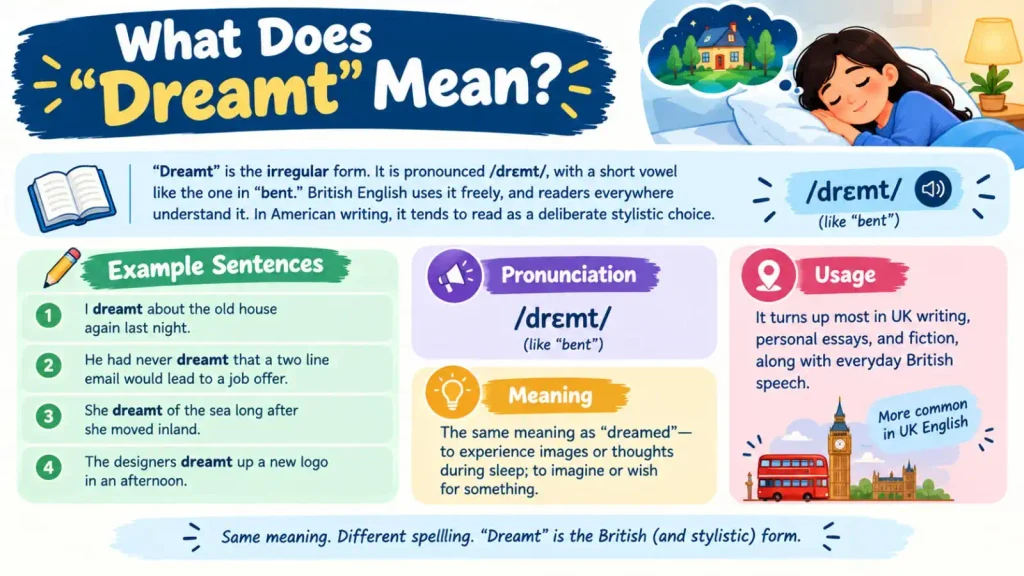
“Dreamt” is the irregular form. It is pronounced /drɛmt/, with a short vowel like the one in “bent.” British English uses it freely, and readers everywhere understand it. In American writing, it tends to read as a deliberate stylistic choice.
- “I dreamt about the old house again last night.”
- “He had never dreamt that a two line email would lead to a job offer.”
- “She dreamt of the sea long after she moved inland.”
- “The designers dreamt up a new logo in an afternoon.”
It turns up most in UK writing, personal essays, and fiction, along with everyday British speech.
Key Differences Between Dreamt vs Dreamed
Here is how dreamt vs dreamed compares on each point a writer needs:
- Meaning: Identical. Both describe experiencing images during sleep or imagining something while awake.
- Grammar: Each form is both a simple past tense and a past participle.
- Region: “Dreamed” is standard in American English. British English uses both.
- Pronunciation: “Dreamed” is /driːmd/; “dreamt” is /drɛmt/.
- Frequency: “Dreamed” is more common in both varieties, though “dreamt” holds more ground in Britain.
- Tone: “Dreamed” reads as neutral. Some readers hear “dreamt” as more literary.
- Safe default: “Dreamed,” unless your audience or style guide is British.
Is Dreamed the Past Tense and Dreamt the Participle?
Many people settle the dreamt vs dreamed debate with a private rule: “dreamed” for “I did,” “dreamt” for “I have.” It feels logical, and in one online language community, a reader wondered whether the split was theirs alone while another replied that it works for them too.
The grammar references and usage guides reviewed for this article do not support the split. Each form handles both jobs, so “I dreamed” and “I have dreamed” are fine, and so are “I dreamt” and “I have dreamt.” A personal rule can help you stay consistent, and there is nothing wrong with keeping it. Just don’t present it as grammar to a student or an editor.
What Usage Guides and Data Say
Popular wisdom says “dreamt” is the British word and “dreamed” the American one. The numbers complicate that story. Quick and Dirty Tips reported a Google Books Ngram comparison in which “dreamed” beat “dreamt” in both varieties: by about 2.5 to 1 in British English and about 7 to 1 in American English. The same article lists Garner’s Modern American Usage and Merriam Webster’s Dictionary of English Usage among the guides that call “dreamt” the British version.
Both claims can be true at once. “Dreamt” is more at home in Britain than in the United States, yet “dreamed” is still the more frequent form on both sides of the Atlantic. Scribbr describes both forms as commonly used in UK English and “dreamt” as acceptable in American English, which matches that picture: a spelling variant can be fully acceptable without being the most frequent.
Ngram ratios depend on the corpus and the years you choose, so treat them as a guide and not a law. If you need to settle the question for a house style sheet, run the comparison yourself and record the date.
Does the Choice Change the Tone?
Not in grammar, but sometimes in voice. Compare two lines from a personal essay:
- “We dreamed of a quiet life by the water.” Plain and direct, at home in an email or a news report.
- “We dreamt of a quiet life by the water.” To some readers, a little more literary, with a hint of storytelling.
Neither line is better. The choice can shape how a sentence feels, so decide on purpose when voice matters.
Which One Should You Use? Pick by Audience
For the dreamt vs dreamed choice, start with your reader, then check any style guide, and only then think about voice.
- American readers, exams, or publications: Use “dreamed.”
- British readers: Either form works. Follow the publication’s house style, and if it has none, choose one form and keep it.
- Academic essays: Follow your institution’s required spelling variety, and apply it across the whole paper.
- Business emails and cover letters: “Dreamed” travels well to mixed audiences. If the company’s own website uses British spelling, match it.
- Fiction: Let the narrator’s voice decide, then stay uniform across the book.
- Websites: Use “dreamed” on US pages, and follow your style sheet on UK pages.
Many Commonwealth varieties follow British spelling conventions, so the same advice usually applies. When in doubt, ask for the style sheet.
A Simple Memory Trick
Two cues settle most dreamt vs dreamed doubts. The first is a sound cue. “Dreamt” belongs to a family of verbs that shorten the vowel and add a t, as in keep/kept, sleep/slept, and feel/felt. If you hear the short vowel, you are hearing “dreamt.”
The second is a choice cue: “dreamed” is the default, and “dreamt” is a deliberate choice. Both words start with D, so the line is easy to carry around. If you are not making a deliberate stylistic decision, take the default.
Common Mistakes with Dreamt vs Dreamed
Even experienced writers slip here, and the slip is rarely about choosing the wrong word. In a long draft, each form feels natural at the moment you type it, so neither one sets off an alarm. LanguageTool warns that alternating between the two can make writing look sloppy. The usual problems are consistency and verb form.
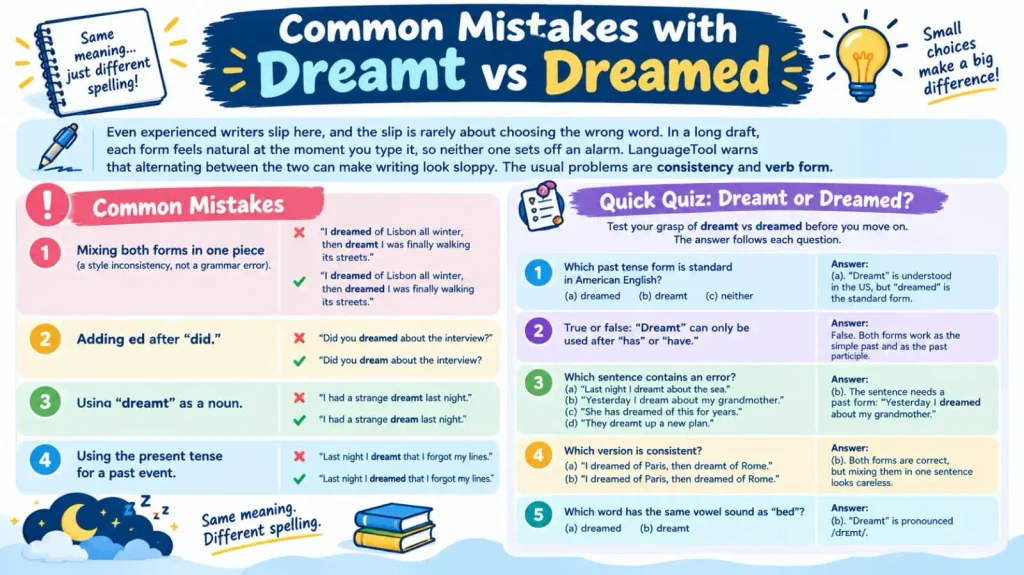
- Mixing both forms in one piece (a style inconsistency, not a grammar error). ✗ “I dreamed of Lisbon all winter, then dreamt I was finally walking its streets.” ✓ “I dreamed of Lisbon all winter, then dreamed I was finally walking its streets.”
- Adding ed after “did.” ✗ “Did you dreamed about the interview?” ✓ “Did you dream about the interview?”
- Using “dreamt” as a noun. ✗ “I had a strange dreamt last night.” ✓ “I had a strange dream last night.”
- Using the present tense for a past event. ✗ “Last night I dream that I forgot my lines.” ✓ “Last night I dreamed that I forgot my lines.”
Quick Quiz: Dreamt or Dreamed?
Test your grasp of dreamt vs dreamed before you move on. The answer follows each question.
1. Which past tense form is standard in American English? (a) dreamed (b) dreamt (c) neither Answer: (a). “Dreamt” is understood in the US, but “dreamed” is the standard form.
2. True or false: “Dreamt” can only be used after “has” or “have.” Answer: False. Both forms work as the simple past and as the past participle.
3. Which sentence contains an error? (a) “Last night I dreamt about the sea.” (b) “Yesterday I dream about my grandmother.” (c) “She has dreamed of this for years.” (d) “They dreamt up a new plan.” Answer: (b). The sentence needs a past form: “Yesterday I dreamed about my grandmother.”
4. Which version is consistent? (a) “I dreamed of Paris, then dreamt of Rome.” (b) “I dreamed of Paris, then dreamed of Rome.” Answer: (b). Both forms are correct, but mixing them in one sentence looks careless.
5. Which word has the same vowel sound as “bed”? (a) dreamed (b) dreamt Answer: (b). “Dreamt” is pronounced /drɛmt/.
Frequently Asked Questions
Is it dreamt or dreamed?
Both are correct. “Dreamed” is the standard form in American English, British English uses both, and either one is fine as long as the writing stays consistent.
Is dreamt a real word?
Yes. “Dreamt” is an established past tense and past participle of “dream.” It is used mainly in British English and understood in American English.
Is dreamt British or American?
“Dreamt” is more closely associated with British English. Even so, “dreamed” is the more frequent form in both Britain and the United States.
What are the past tense and past participle of dream?
Both “dreamed” and “dreamt” serve as the past tense (“I dreamed”) and the past participle (“I have dreamed”).
Can you use dreamt and dreamed interchangeably?
Yes. “Dreamt” and “dreamed” mean the same thing, so the dreamt vs dreamed decision is about audience and consistency, not accuracy. Use one form per piece of writing.
Is dreamt more formal or poetic than dreamed?
No grammatical rule makes “dreamt” more formal or poetic than “dreamed.” Some readers hear “dreamt” as more literary, which makes it a question of tone, not correctness.
Final Thoughts
Dreamt vs dreamed are both correct, so the real skill is choosing on purpose. Use dreamed when your readers are American or international, treat dreamt as a natural British choice, and above all stay consistent from the first line to the last. Once you know your audience, the decision takes about ten seconds.
To read more: Dialogue vs Dialog: Which Spelling Should You Use? Best Guide 2026

Elena covers lifestyle and consumer comparisons — everything from mattresses to meal kits — drawing on a background in market research. She’s known for digging past marketing copy to find the one detail that actually decides a purchase, and for admitting when two options are basically a coin flip.