
Two adjectives built from the same root, both describing the ability to share another person’s feelings, often leave writers wondering whether they are looking at a real distinction or just a stylistic quirk. The answer sits somewhere in between.
Empathetic is the more common and widely recognized form, used in everyday conversation, workplaces, and general writing to describe someone who understands and cares about others’ emotions, as in “she gave an empathetic response to his concerns.” Empathic, on the other hand, is the older and shorter variant, favored in psychology, therapy, and scientific writing, where it often describes a deeper, almost intuitive ability to sense what another person feels.
Most dictionaries treat them as near synonyms, so the choice usually depends on context and audience. In this article, we’ll explore the origins of both words, their subtle differences, and clear examples to help you use each one confidently.
Quick Answer:
Empathetic vs empathic is a question of context, not correctness. Empathetic vs empathic are both correct adjectives meaning “showing or feeling empathy,” and in most sentences either one fits. Empathetic is the more common choice in everyday and workplace English, while empathic is more typical of psychology, counseling, and research writing. When unsure, choose empathetic.
Empathetic vs Empathic at a Glance
The table below puts the empathetic vs empathic comparison in one place, along with the related noun that trips people up. The two adjectives share a definition. What separates them is where each tends to appear.

| Word | Part of Speech | Meaning | Example |
| empathetic | Adjective | Showing or having empathy; understanding and sharing another person’s feelings | “Thanks for being so empathetic about the deadline.” |
| empathic | Adjective | Showing or having empathy; common in psychological and clinical writing | “The counselor used empathic listening throughout the session.” |
| empath | Noun | A person said to sense others’ emotions unusually strongly (not an established scientific category) | “My sister calls herself an empath.” |
What Does “Empathetic” Mean?
A plain definition of empathetic: it describes a person, response, or tone characterized by empathy, the ability to understand and share another person’s feelings. You’ll most often see it in newspapers, blogs, workplace emails, and everyday conversation. Say it em puh THET ik, with the stress on the third syllable. Its adverb is empathetically, and the related verb is empathize (empathise in British spelling; see empathize or empathise).
The empathetic meaning is easiest to see in real writing:
- Email: “I really appreciate how empathetic you were when I asked for an extension.”
- Workplace: “The best managers on my team were empathetic without lowering the bar.”
- Customer service: “The agent’s empathetic tone calmed the caller within a minute.”
- Social media: “Reminder: being empathetic doesn’t mean agreeing with everyone.”
It turns up most in writing about relationships, leadership, emotional intelligence, customer service, and reviews, usually in collocations like empathetic listener, empathetic response, and empathetic leader. Close synonyms include understanding, compassionate, and sensitive, though each shades the meaning slightly.
What Does “Empathic” Mean?
The empathic meaning is the same at its core: showing or having empathy. It is a standard word, not a typo, and it is actually the shorter, older form. Empathetic likely spread by analogy with sympathetic, a pair we untangle in sympathetic vs empathetic. The whole spelling difference is the ending: ic versus etic, the same etic you see in sympathetic and apathetic.
The empathic definition in psychology is where the word is most at home. Researchers and clinicians use it for responses and approaches built on empathy, as in empathic accuracy or empathic concern. Say it em PATH ik, with the stress on the second syllable, so the two words sound distinct aloud. Its adverb is empathically.
- Clinical: “The therapist stayed empathic even when the client turned defensive.”
- Research: “Participants showed greater empathic accuracy after the training.”
- Training: “Our workshop covers empathic listening for nurses and social workers.”
- General: “He gave her an empathic nod and let her keep talking.”
Counseling, healthcare, psychology papers, communication training, and some self help books all lean on it, often in set phrases such as empathic listening.
Key Differences Between Empathetic vs Empathic
The meanings overlap almost completely, but the words behave differently in practice. When people compare empathetic vs empathic, these are the differences that matter:
- Meaning: nearly identical. Dictionaries define them in very similar terms.
- Frequency: empathetic is more common in news, blogs, and general writing. Empathic is rarer overall.
- Register: empathetic reads as neutral and everyday. Empathic reads as more technical.
- Field: psychology and counseling literature leans toward empathic. Mainstream media leans toward empathetic.
- Region: sources disagree. Some claim British writers prefer empathic, while others find no real split. Until that’s settled, follow your audience.
- Related forms: the adverbs differ (empathetically and empathically), but both trace back to the noun empathy.

Dictionaries treat the two as variants of one another, and not every dictionary lists the same form first. If you write for an employer or publisher, check the dictionary and style guide that organization prefers.
Which One Should You Use? A Context Guide
Because the words are interchangeable in meaning, the right choice depends on who will read your writing. The empathetic vs empathic decision gets easier when you match the word to the setting.
| Context | Safe default | Notes |
| Everyday emails and messages | empathetic | Empathic may read as slightly formal |
| Resume, cover letter, LinkedIn | empathetic | Empathic is correct, but empathetic is more familiar |
| Performance reviews and HR documents | empathetic | Match the terms your company already uses |
| Counseling, healthcare, psychology | empathic | It’s the convention in that literature |
| Academic papers | follow your field | Check the journal or style guide |
Treat this as a tendency, not a rule. Either word is correct in every row; the bigger risk is inconsistency. Even experienced writers slip here: it’s easy to write empathetic in the first paragraph of a long report and empathic by the fifth without noticing. Before you send, search the document for the form you didn’t mean to use.
By profession, the choice looks like this:
- HR and management: “Her feedback was direct but empathetic, which made the team more willing to act on it.” (Everyday workplace register, so the familiar form fits.)
- Healthcare: “The nurse used empathic communication to explain the discharge plan.” (Clinical settings favor the technical form.)
- Academic writing: “The study measures empathic responding in adolescents.” (Research literature follows this convention.)
- Customer support: “We want every reply to feel empathetic, not scripted.” (A plain, warm tone suits customers.)
- Personal branding: “I’m a product designer who leads with empathy” often reads better than any adjective at all.
So what should Dana have done? Nothing was wrong with “empathic team member,” but her review would be read by an operations manager who skims dozens each week. “Sam is an exceptionally empathetic team member” would pass without a second glance and keep the reader’s attention on Sam, not on the vocabulary.
A ten second test helps when you’re stuck:
- Is the reader a general audience? Choose empathetic.
- Is the reader a clinician, researcher, or trainer? Empathic fits naturally.
- Is there an existing document or style guide? Match it.
Empathetic, Empathic, and Empath: Three Words, Not Two
Much of the confusion online isn’t about spelling at all. Browse forum threads on “empathetic vs empathic,” and you’ll find many posts asking something deeper: does calling yourself empathic mean something extra, and how does it relate to empath?
An empath is a noun. It usually means someone who claims to feel other people’s emotions unusually strongly. That idea is popular in self help and spiritual writing, but it isn’t an established scientific category. In those circles, empathic can carry a heightened, almost intuitive sense that empathetic doesn’t share.
Why do people adopt the label? For many, it reframes being told they are “too sensitive” into something positive. That’s a personal choice, and you don’t need to argue with it. In professional writing, though, “empathetic” is the safer way to describe yourself, because empath or empathic can read as a claim rather than a description.
Words like compassionate and sympathetic are close neighbors (see compassionate vs empathetic), but they stress concern for someone, not understanding of their feelings. If a colleague is grieving, you might feel sympathetic; if you’ve lived through the same loss and can sense what they’re going through, that’s closer to empathy. For more on that line, read empathy vs sympathy.
Common Mistakes
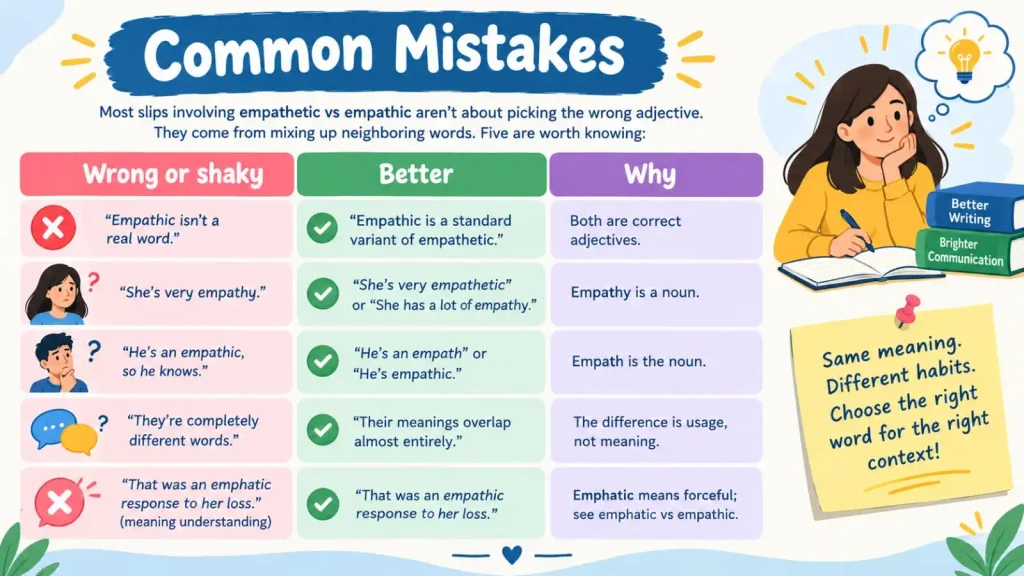
Most slips involving empathetic vs empathic aren’t about picking the wrong adjective. They come from mixing up neighboring words. Five are worth knowing:
| Wrong or shaky | Better | Why |
| “Empathic isn’t a real word.” | “Empathic is a standard variant of empathetic.” | Both are correct adjectives |
| “She’s very empathy.” | “She’s very empathetic” or “She has a lot of empathy.” | Empathy is a noun |
| “He’s an empathic, so he knows.” | “He’s an empath” or “He’s empathic.” | Empath is the noun |
| “They’re completely different words.” | “Their meanings overlap almost entirely.” | The difference is usage, not meaning |
| “That was an emphatic response to her loss.” (meaning understanding) | “That was an empathic response to her loss.” | Emphatic means forceful; see emphatic vs empathic |
Quick Quiz: Test Yourself
- True or false: Empathic is a misspelling of empathetic. Answer: False. It’s a standard variant.
- Fill in the blank: “As a counselor, she takes an ___ approach.” Answer: Either works, though empathic is the conventional fit in counseling.
- Which is the noun? empath, empathic, or empathetic? Answer: Empath.
- Choose the adverb of empathetic: empathetically, empathicly, or empathetical? Answer: Empathetically.
- Spot the error: “He is a very empathy person.” Answer: Empathy is a noun. Use empathetic or empathic.
Frequently Asked Questions
Is empathic a word?
Yes. Empathic is a standard English adjective meaning the same as empathetic. It is simply the less common form in everyday writing.
Is it empathetic or empathic?
Both are correct. Empathetic is the more common choice in everyday and professional English, while empathic is typical in psychology and counseling.
Are empathetic and empathic the same thing?
Empathetic and empathic have the same meaning: both describe understanding or sharing another person’s feelings. The empathetic vs empathic choice is mostly about frequency, register, and audience.
Which is more common, empathic or empathetic?
Empathetic is more common in general writing, while empathic holds its ground in scientific and clinical sources.
Can I use empathic on a resume or cover letter?
Yes, empathic is acceptable on a resume or cover letter, but empathetic is the more familiar choice. Whichever word you pick, use it consistently throughout the document.
Is empathic British or American English?
Empathic is not exclusive to British or American English. Sources disagree on any regional preference, so choose the form your audience expects and use it consistently.
What is the adverb form of empathic?
The adverb form of empathic is empathically. The adverb form of empathetic is empathetically.
What does empathic mean in psychology?
In psychology, empathic describes a person, response, or approach characterized by empathy, as in “empathic listening” or “empathic accuracy.”
Final Thoughts
Empathetic vs empathic are two doors into the same room. The empathetic vs empathic choice rarely changes your meaning; it changes how your sentence lands for a particular reader. Default to empathetic for general audiences, reach for empathic in clinical or research writing, and above all, stay consistent. Do that, and the difference stops being a worry and becomes a small, confident choice.
To read more: Exception vs Acception: Which Word Is Actually Correct? Essential Guide 2026

Elena covers lifestyle and consumer comparisons — everything from mattresses to meal kits — drawing on a background in market research. She’s known for digging past marketing copy to find the one detail that actually decides a purchase, and for admitting when two options are basically a coin flip.