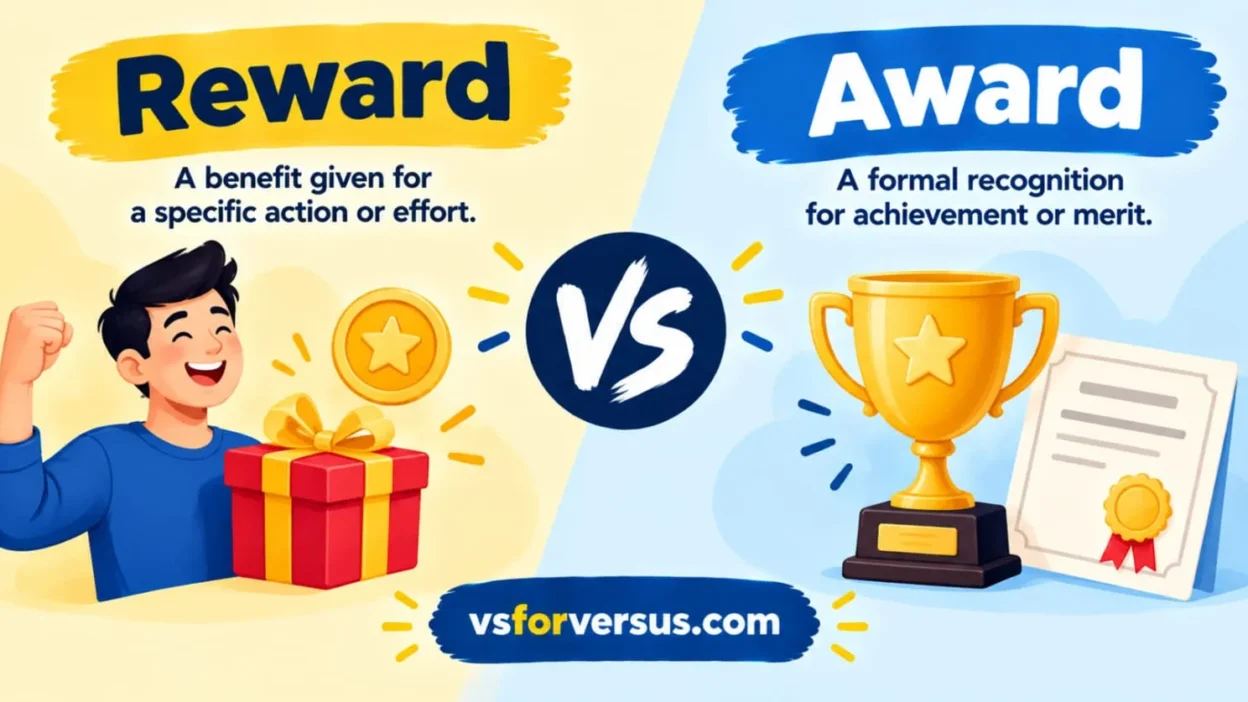
Reward vs Award may look alike on paper, but each carries its own distinct role in English usage. A reward is something given in recognition of a good deed, effort, or achievement, often to encourage or thank someone, such as a cash reward for finding a lost pet.
An award, meanwhile, is typically a formal recognition or prize given for outstanding achievement, skill, or performance, usually after a competition or evaluation, such as a Nobel Prize or an Oscar award.
The key distinction lies in formality and context: rewards tend to be personal and spontaneous, while awards are structured and ceremonial. Both words honor achievement, yet the setting, tone, and manner of giving set them clearly apart.
Quick Answer
An award is a formal honor, like a trophy, medal, certificate, or prize, given after a judged or competitive process to recognize achievement. A reward is something given, often money, praise, or a treat, in return for effort, good behavior, or useful information, with no competition or judging panel involved.
Both words work as nouns and verbs: you can award a prize or reward someone, and understanding this reward vs award distinction comes down to one question: was it earned through competition, or given in response to behavior?
Reward vs Award at a Glance
Before diving into definitions, here’s the sid by side breakdown that makes the reward vs award comparison easy to scan:
| Word | Part of Speech | Meaning | Example |
| Award | Noun / Verb | A formal honor given for achievement, usually after judging, nomination, or competition | She won the award for Best Actress. / The judge awarded her full custody. |
| Reward | Noun / Verb | Something given, money, praise, a treat, in exchange for effort, behavior, or information | There’s a $500 reward for the lost dog. / I rewarded myself with a slow Sunday. |
Both words carry real weight as verbs, too. “Awarded” and “rewarded” show up constantly in professional writing, and mixing them up is one of the most common small errors in workplace emails.
What Does “Award” Mean?
An award is a formal recognition, a trophy, medal, certificate, title, or sum of money, given to someone after their achievement has been judged, nominated, or ranked against others. Awards almost always involve some kind of authority: a panel of judges, a court, an institution, or a committee deciding who deserves recognition.
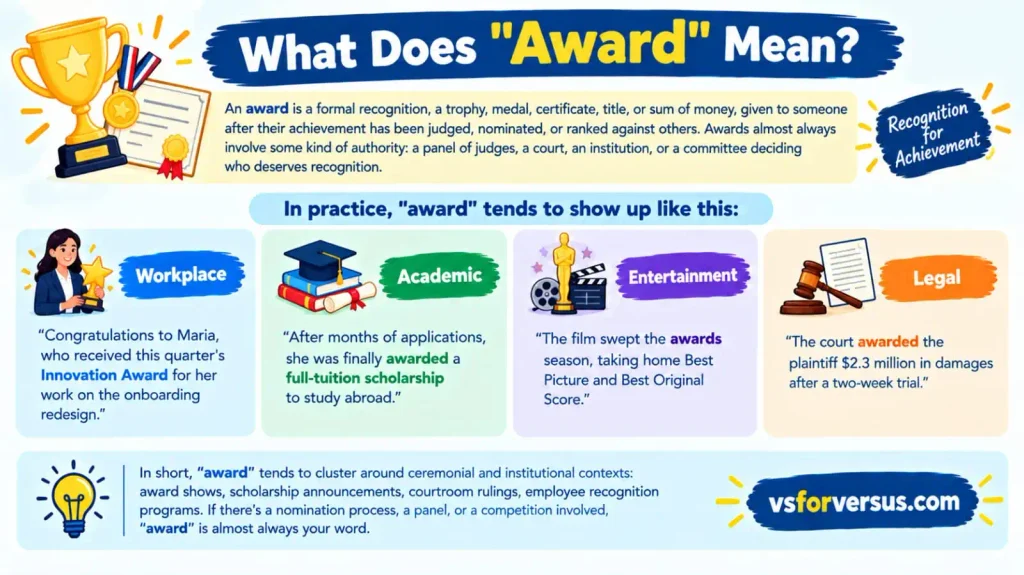
In practice, “award” tends to show up like this:
- Workplace: “Congratulations to Maria, who received this quarter’s Innovation Award for her work on the onboarding redesign.”
- Academic: “After months of applications, she was finally awarded a full tuition scholarship to study abroad.”
- Entertainment: “The film swept the awards season, taking home Best Picture and Best Original Score.”
- Legal: “The court awarded the plaintiff $2.3 million in damages after a two week trial.”
In short, “award” tends to cluster around ceremonial and institutional contexts: award shows, scholarship announcements, courtroom rulings, employee recognition programs. If there’s a nomination process, a panel, or a competition involved, “award” is almost always your word.
What Does “Reward” Mean?
A reward is something given in exchange for effort, good behavior, or useful action, and crucially, it doesn’t require a judging process at all. Rewards can be tangible (cash, gift cards, snacks) or intangible (praise, relief, satisfaction), and unlike awards, they’re often self given.
“Reward,” on the other hand, shows up more like this:
- Parenting/pets: “We use a sticker based reward chart to encourage the kids to finish homework early.”
- Workplace: “Our loyalty program rewards frequent customers with points toward free shipping.”
- Personal: “After finishing the report at midnight, she rewarded herself with a slice of cake and an early bedtime.”
- Crime/safety: “Police are offering a cash reward for information leading to an arrest.”
Rewards show up constantly in incentive programs, credit card perks, dog training, and personal motivation, anywhere behavior is being reinforced rather than judged. It’s worth noting that “reward” often gets grouped with related words like incentive or prize; those carry their own shades of meaning and deserve their own comparison, but for everyday writing, the reward vs award distinction is the one that matters most.
Key Differences Between Award vs Reward
Once you see these side by side, the reward vs award pattern becomes much easier to apply on the fly:
- Process: Awards involve judging, nomination, or competition; rewards don’t require any of that.
- Formality: Awards are formal and ceremonial; rewards tend to be casual, personal, or transactional.
- Given by: Awards almost always come from an outside authority, a committee, court, or institution; rewards can be given by anyone, including yourself.
- Form: Awards typically take the shape of trophies, medals, certificates, or titles; rewards are more often money, treats, perks, or praise.
- What triggers it: Awards recognize excellence or achievement; rewards respond to behavior, effort, or cooperation.
Memory Trick to Remember the Difference
Try this simple hook: “Award” vs “Achievement” both start with A, so if something is being given for a genuine achievement, judged against others, you want “award.” Picture it visually: 🏆 Award = the trophy shelf (formal, earned through competition), while 🎁 Reward = the treat jar (casual, earned through behavior).
A second version that sticks for a lot of learners: “You’re awarded on a stage. You’re rewarded at home.” Ceremonies and podiums mean award; treats and personal incentives mean reward. Keep that trophy shelf versus treat jar image in your head, and the reward vs award difference becomes second nature.
Common Mistakes with Award vs Reward
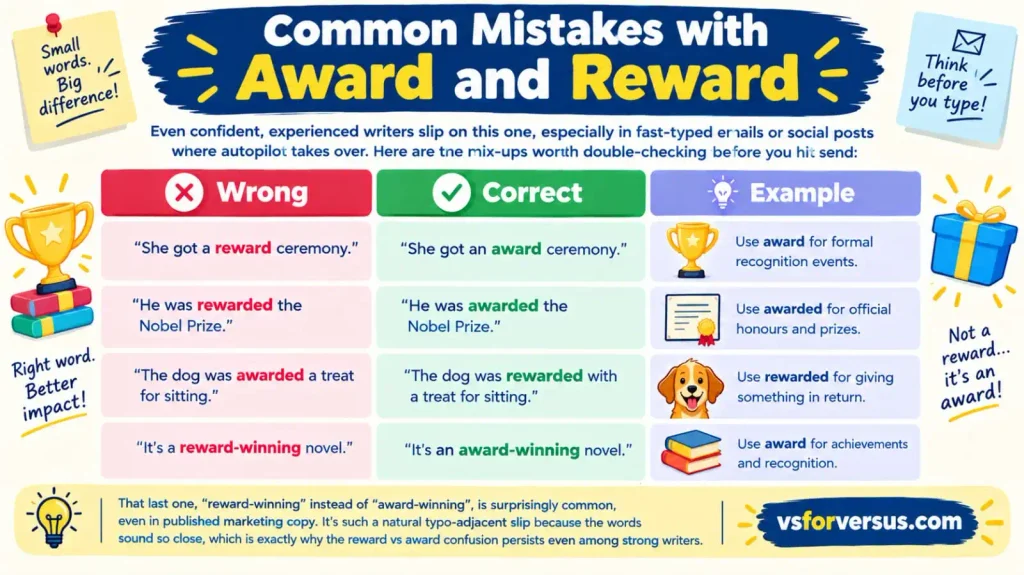
Even confident, experienced writers slip on this one, especially in fast typed emails or social posts where autopilot takes over. And it’s not a beginner only problem: this mix up shows up regularly in native speaker writing too, not just among English learners. Here are the mix ups worth double checking before you hit send:
| ❌ Wrong | ✅ Correct |
| “She got a reward ceremony.” | “She got an award ceremony.” |
| “He was rewarded the Nobel Prize.” | “He was awarded the Nobel Prize.” |
| “The dog was awarded a treat for sitting.” | “The dog was rewarded with a treat for sitting.” |
| “It’s a reward-winning novel.” | “It’s an award-winning novel.” |
That last one, “reward winning” instead of “award winning”, is surprisingly common, even in published marketing copy. It’s such a natural typo adjacent slip because the words sound so close, which is exactly why the reward vs award confusion persists even among strong writers.
Quick Quiz: Test Yourself
Try filling in the blanks before checking your answers:
- The Oscars give out an ___ for Best Director.
- She ___ her kids with ice cream for finishing their chores.
- Is a certificate typically a reward or an award?
- Is a $100 cash offer for a lost cat a reward or an award?
- Fill in: “He was ___ a medal for bravery in the line of duty.”
Answers: 1. award, 2. rewarded, 3. award, 4. reward, 5. awarded
Frequently Asked Questions
Is it “award ceremony” or “reward ceremony”?
“Award ceremony” is correct. It’s a formal event built around recognizing achievement, which is the defining feature of an award.
Is a certificate a reward or an award?
Usually an award. Certificates typically mark formal recognition of achievement, completion, or excellence, even when the tone is casual, like a certificate of participation.
Is a bonus a reward or an award?
A bonus is a reward. It’s tied to performance or behavior rather than a judged or competitive process, which is the key line in the reward vs award divide.
Can you “reward” yourself, or only “award” yourself?
You can absolutely reward yourself; treating yourself after a long week is a classic reward. You wouldn’t “award” yourself anything, though, since awards come from an outside authority, not from you.
Do you “award” or “reward” a scholarship?
Scholarships are awarded. They go through a selection or judging process, which puts them firmly on the “award” side of the reward vs award line.
Why do award and reward sound so similar?
Both words trace back to Old French roots tied to the idea of “regard” or “consideration”; one became award (formal judgment), and the other became reward (a return for behavior), which explains why their meanings still overlap today.
Final Thoughts
The reward vs award mix up isn’t really about spelling; it’s about process. Ask yourself one question before you write either word: was this earned through judging or competition, or given in response to behavior? If it’s the former, reach for an award.
If it’s the latter, reach for reward. Keep the trophy shelf vs treat jar image in mind, run through the quick checklist above when you’re unsure, and you’ll never second guess an email, or an awards night caption, again.
To read more: Revenge vs Vengeance: What’s the Difference? 2026

Marcus is a former product manager turned comparison writer who spent eight years testing tools and gadgets before quitting to write full-time. He specializes in breaking down tech and software matchups into plain-English verdicts, with a soft spot for buying guides nobody else wants to write.