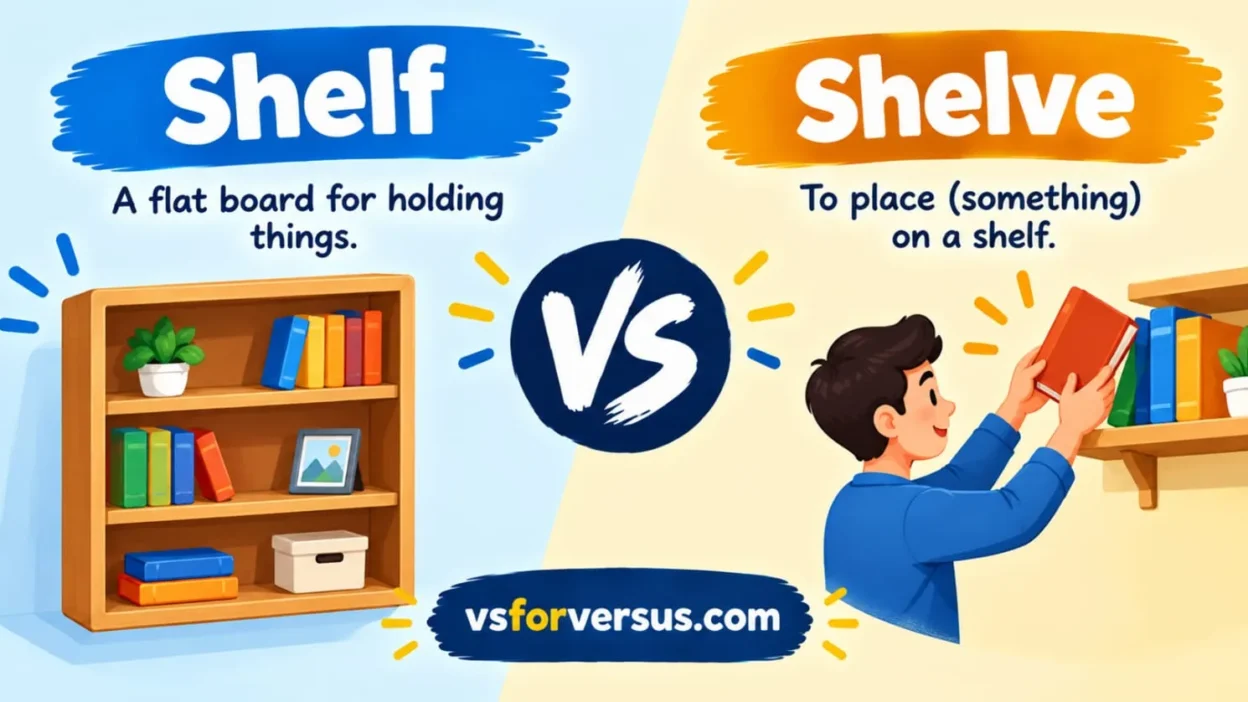
Shelf vs Shelve may share the same root, but they belong to entirely different parts of speech. Shelf is a noun, referring to a flat, horizontal surface used for storing or displaying items, such as books arranged neatly on a shelf.
Shelve, however, is a verb with two distinct meanings: it can mean to place something on a shelf, as in “she shelved the books,” or, more commonly in a figurative sense, to postpone or set aside a plan or project, as in “the project was shelved due to budget cuts.”
This shift from noun to verb also changes the pronunciation slightly, with the final “f” sound of shelf becoming a soft “v” sound in shelve. Understanding this pattern helps in recognising similar noun verb pairs in English.
Quick Answer
Shelf is a noun, a flat surface used to store or display things; for example, “Put the book on the shelf.” Shelve is a verb; it means to place something on a shelf, or to postpone or cancel a plan, such as “We had to shelve the merger talks.”
The plural of shelf is shelves, which doubles as the verb form used with he, she, or it: “She shelves the new arrivals every morning.” So if you’ve been wondering whether it’s shelf or shelve in your sentence, the part of speech is your answer: nouns get shelf, actions get shelve.
Shelf vs Shelve at a Glance
Before going deeper into the shelf vs shelve distinction, here’s a quick reference table you can scan and bookmark.
| Word | Part of Speech | Meaning | Example |
| Shelf | Noun (singular) | A flat surface for storing or displaying items | “The mug is on the top shelf.” |
| Shelves | Noun (plural) or Verb (he/she/it form) | Multiple shelves, or “puts away / postpones” | “The shelves are empty.” / “He shelves the returns daily.” |
| Shelve | Verb (base form) | To put on a shelf; to postpone or set aside | “Let’s shelve this idea for now.” |
Notice that shelves shows up twice in that table, under two different parts of speech. That overlap is the real engine behind most shelf vs shelve confusion, and we’ll unpack it below.
What Does “Shelf” Mean?
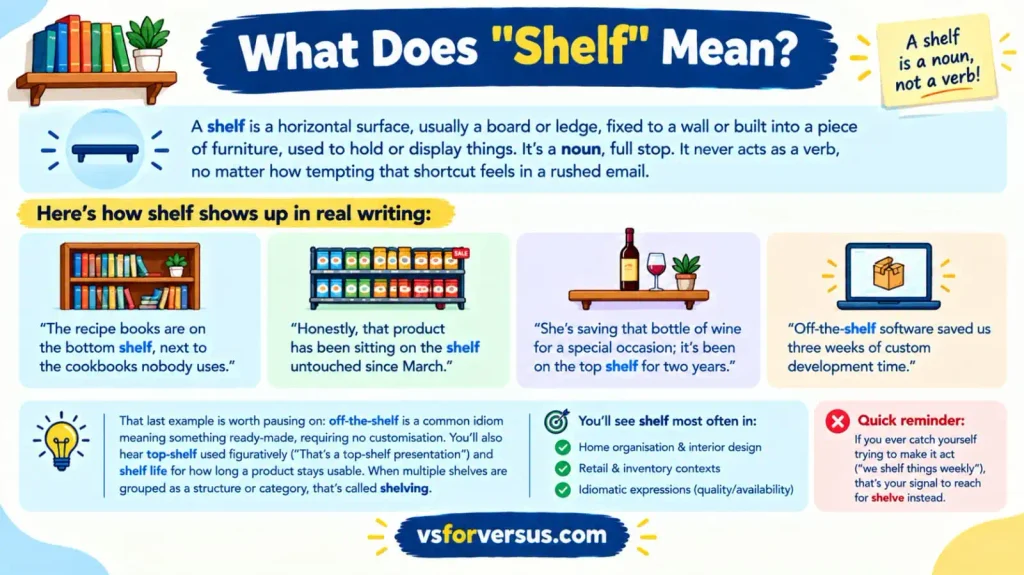
A shelf is a horizontal surface, usually a board or ledge, fixed to a wall or built into a piece of furniture, used to hold or display things. It’s a noun, full stop. It never acts as a verb, no matter how tempting that shortcut feels in a rushed email.
Here’s how shelf shows up in real writing:
- “The recipe books are on the bottom shelf, next to the cookbooks nobody uses.”
- “Honestly, that product has been sitting on the shelf untouched since March.”
- “She’s saving that bottle of wine for a special occasion; it’s been on the top shelf for two years.”
- “Off the shelf software saved us three weeks of custom development time.”
That last example is worth pausing on: off the shelf is a common idiom meaning something ready made, requiring no customisation. You’ll also hear top shelf used figuratively to describe something high quality; “That’s a top shelf presentation” has nothing to do with furniture.
A canned product’s shelf life, meanwhile, refers to how long it stays usable before it spoils, another figurative extension of the same noun. And when multiple shelves are grouped as a structure or a category of store fixtures, that whole system is often called shelving, a related noun in its own right.
You’ll run into shelf most often in three settings: home organisation and interior design writing, retail and inventory contexts (product descriptions, stock reports, store signage), and idiomatic expressions that borrow the image of a physical shelf to describe quality or availability.
Across all three, shelf is doing noun work, naming a thing, not describing an action. If you ever catch yourself trying to make it act (“we shelf things weekly”), that’s your signal to reach for shelve instead.
The Plural of Shelf: Shelf vs Shelves
Like several English nouns ending in f, shelf doesn’t simply add an s in the plural. It shifts to shelves, following the as knife → knives, leaf → leaves, and wife → wives. So “I need two more shelfs” is incorrect; it should be “I need two more shelves.” It’s a purely spelling based irregularity, not a meaning change, but it trips up plenty of fluent writers because the plural suddenly resembles the verb shelve.
What Does “Shelve” Mean?
Shelve is a verb with two related meanings. Literally, it means to put something onto a shelf. Figuratively, and this is the meaning that shows up constantly in workplace and academic writing, it means to postpone, defer, or abandon a plan.
You’ll see shelve used like this across different registers:
- “Please shelve these returns before your shift ends.” (literal)
- “We’ve decided to shelve the product launch until Q3; the numbers just aren’t there yet.” (business email)
- “The committee voted to shelve the proposal pending further review.” (academic/formal)
- “Let’s shelve this discussion for now and come back to it after lunch.” (meeting notes)
That figurative sense, postponing or setting something aside, is exactly where the shelf vs shelve mix up tends to happen. It feels natural to reach for the shorter, more familiar word “shelf” as a verb, especially in a fast typed email. But English simply doesn’t allow that. If you’re putting an idea on hold, you’re shelving it, not shelfing it.
This figurative use of shelve has become especially common in business, academic, and journalistic writing, where projects, budgets, lawsuits, and negotiations get “shelved” far more often than physical objects get placed on physical shelves.
A news article might report that a company “shelved its expansion plans amid rising costs,” or that lawmakers “shelved the bill until the next session.” In each case, shelve signals a deliberate pause, not necessarily a permanent cancellation, which is a useful nuance to keep in mind if precision matters in your writing.
Shelves as a Verb Form
There’s a twist here that catches people off guard no matter how long they’ve been writing: shelves isn’t only the plural of shelf. It’s also the verb shelve conjugated for he, she, or it. Compare these two sentences:
- “The shelves in the stockroom need dusting.” (plural noun)
- “He shelves the new inventory every Tuesday morning.” (verb, third person singular)
Both sentences use the identical word, doing completely different jobs. If you’ve ever paused mid sentence wondering whether “shelves” looked right, this dual role is almost certainly why. It’s not that you don’t understand the noun verb rule; it’s that one word is secretly doing both jobs at once, which makes the whole pair feel unstable even to fluent speakers.
Key Differences Between Shelf vs Shelve
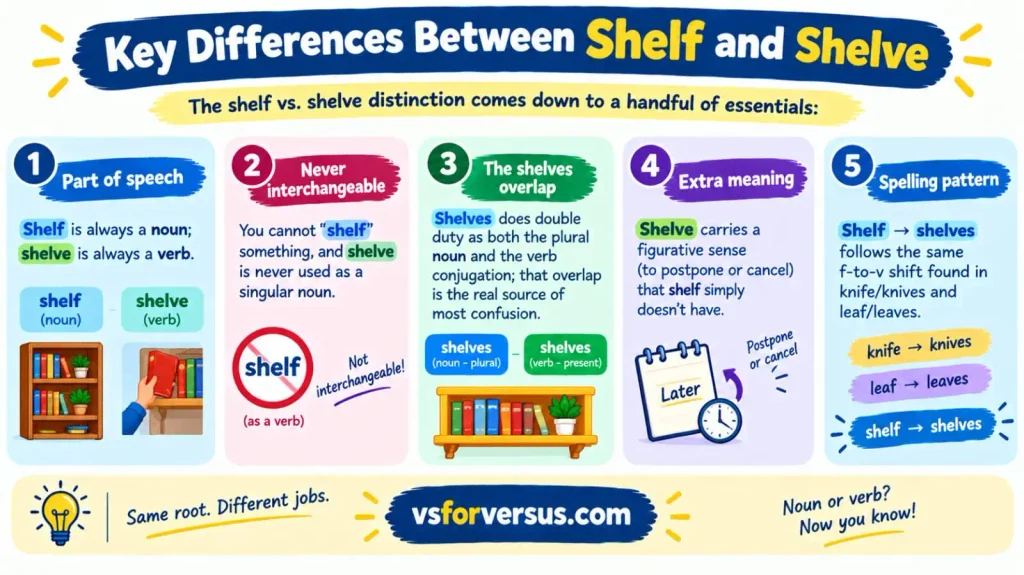
The shelf vs shelve distinction comes down to a handful of essentials:
- Part of speech: shelf is always a noun; shelve is always a verb.
- Never interchangeable: you cannot “shelf” something, and shelve is never used as a singular noun.
- The shelves overlap: shelves does double duty as both the plural noun and the verb conjugation; that overlap is the real source of most confusion.
- Extra meaning: shelve carries a figurative sense (to postpone or cancel) that shelf simply doesn’t have.
- Spelling pattern: shelf → shelves follows the same f-to-v shift found in knife/knives and leaf/leaves.
Memory Trick: How to Remember Shelf vs Shelve
The easiest hook: shelve has a V, just like a verb. Both words share that letter, so whenever the word is doing an action placing, postponing, deciding reach for the one with the V.
A second, equally reliable check: you shelf nothing, but you shelve something. Shelf never takes a direct object; it simply names a surface. Shelve always acts on something; you shelve the plan, the books, the proposal, the merger. If there’s an object receiving the action, you need the verb. This same object test works for, so it’s worth keeping in your back pocket beyond just this one word.
Even experienced writers slip on this one under deadline pressure, usually because “shelve” briefly looks like a typo of “shelf” when you’re typing fast. If a sentence ever feels off, try swapping in “postpone”; if that word fits, you need shelve, not shelf.
Common Mistakes with Shelf vs Shelve
Most mix ups between these two words fall into one of four patterns. Recognising the pattern is often faster than memorising a rule, because you start to notice the shape of the mistake before you even finish typing the sentence.
| Incorrect | Correct | Why |
| “We had to shelf the meeting.” | “We had to shelve the meeting.” | Shelf can never function as a verb. |
| “Can you shelve me that book real quick?” | “Can you hand me that book from the shelf?” | Shelve means to place something on a shelf, not to hand it over. |
| “There are two shelfs in the closet.” | “There are two shelves in the closet.” | Irregular plural: f becomes ves. |
| “The idea is on shelve right now.” | “The idea has been shelved.” | Shelve needs a proper verb tense, not a bare noun slot. |
Quick Quiz: Shelf or Shelve?
Test yourself before checking the answers below.
- Please put the towels on the top ______.
- The board voted to ______ the merger talks.
- She ______ new arrivals in the library every morning.
- We need three more ______ for all these files.
- Don’t ______ this project, we need it finished by Friday.
Answers: 1. shelf 2. shelve 3. shelves (verb) 4. shelves (plural noun) 5. shelve
FAQ: Shelf vs Shelve
Is “shelve” a real word? Yes. Shelve is a standard English verb meaning to place something on a shelf or to postpone it, and it appears in every major dictionary, including Merriam Webster.
Is “shelves” a noun or a verb? Both, depending on context. Shelves is the plural of the noun shelf (“two shelves”) and also the third person singular form of the verb shelve (“she shelves the boxes”). The surrounding sentence tells you which one is meant.
Can “shelf” ever be used as a verb? No. Shelf is only ever a noun. Using it as a verb, as in “we shelved the plan,” is a common but incorrect shortcut; the correct verb is always shelve.
What does it mean to “shelve” a project? To shelve a project means to postpone it indefinitely or decide not to move forward with it right now, similar to “put on hold” or “table.”
Is a bookshelf the same as a shelf? A bookshelf is a piece of furniture made up of multiple shelves stacked together. Each level inside it is still a “shelf”; a bookshelf is really just a collection of shelves in one frame.
Do “shelf” and “shelve” sound the same? No. Shelf ends with an “f” sound, while shelve ends with a “v” sound, the same contrast you hear in “belief”.
What’s the plural of shelf? Shelves, not “shelfs.” Several English nouns ending in f switch to ves in the plural, including knife/knives and leaf/leaves.
Why do people mix up shelf and shelve? Mostly through backformation: since English plurals typically add “s,” some writers assume shelve is a singular form of shelves, when really, shelve has always been its own separate verb.
Final Thought
This whole Shelf vs Shelve isn’t really about not knowing grammar; it’s about one small word, shelves, quietly doing two jobs at once. Once you separate the noun (shelf, shelves) from the verb (shelve, shelves), the rest falls into place. Remember the shortcut: shelve has a V, just like verb, and you’ll never shelf an idea by mistake again.
To read more: Revenge vs Vengeance: What’s the Difference? 2026

Marcus is a former product manager turned comparison writer who spent eight years testing tools and gadgets before quitting to write full-time. He specializes in breaking down tech and software matchups into plain-English verdicts, with a soft spot for buying guides nobody else wants to write.