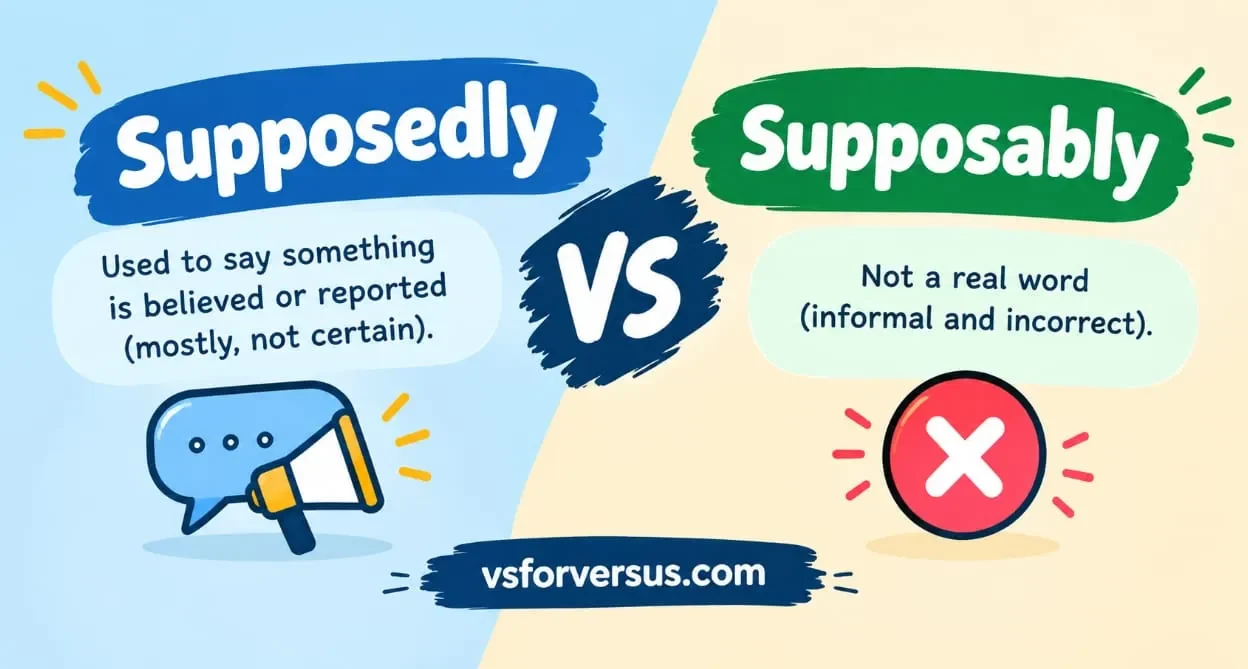
Supposedly vs Supposably these two words look almost the same, but only one of them is considered correct in standard English. Supposedly means according to what is believed or claimed, often without solid proof. It is commonly used when someone wants to express that something is said to be true, but it hasn’t been confirmed.
On the other hand, ” supposably “ means capable of being supposed or imagined, but it is rarely used and is often seen as a mistaken version of “supposedly.” Many people accidentally use “supposably” instead of “supposedly” in casual speech.
In this article, we will explain the meanings of both words, “Supposedly” and “Supposably,” in a simple way, so that you can easily understand the difference between them.
Quick Answer:
In the debate between supposedly vs supposably, “supposedly” is almost always the word you want. It means “as people believe or claim, though not confirmed.” “Supposably” is a real but rare word meaning “conceivably” or “able to be supposed,” and it is not simply a casual spelling of “supposedly.” When in doubt, use “supposedly.”
Supposedly vs Supposably at a Glance
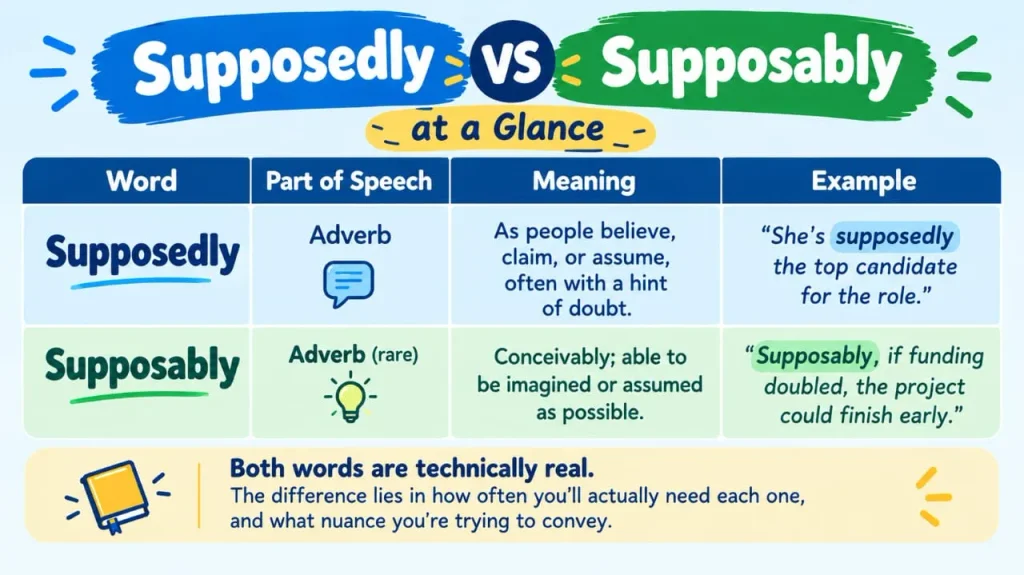
Start with the simplest version of the comparison. This table captures the core distinction in the supposedly vs supposably debate at a glance.
| Word | Part of Speech | Meaning | Example |
| Supposedly | Adverb | As people believe, claim, or assume, often with a hint of doubt | “She’s supposedly the top candidate for the role.” |
| Supposably | Adverb (rare) | Conceivably; able to be imagined or assumed as possible | “Supposably, if funding doubled, the project could finish early.” |
Both words are technically real. The difference lies in how often you’ll actually need each one, and what nuance you’re trying to convey.
What Does “Supposedly” Mean?
“Supposedly” is an adverb built from the adjective “supposed.” It signals that something is claimed, reported, or generally believed, but not necessarily verified. Understanding this half of the supposedly vs supposably pair starts with that root: there’s often a light undercurrent of skepticism baked into the word, which is exactly why it shows up so often in gossip, news reporting, and hedge your bets workplace language.
Look at how it plays out in real writing:
- Casual conversation: “The new café on Fifth is supposedly the best coffee in town, but I haven’t tried it yet.”
- Workplace email: “He’s supposedly finalizing the vendor contract this week, so let’s hold off on the backup plan for now.”
- Academic writing: “The intervention supposedly reduced symptoms, though the study’s small sample size raises questions about how much weight to give that result.”
- Social media: “This restaurant is supposedly closing for good at the end of the month; anyone know if that’s confirmed?”
- Customer service note: “The shipment is supposedly out for delivery today, but tracking hasn’t updated since yesterday.”
Notice the pattern: in every case, “supposedly” softens a claim. It tells the reader, “I’ve heard this, but I’m not vouching for it.” That’s what makes it so common in professional hedging, journalism, and everyday storytelling. It lets you pass along information while keeping a healthy distance from full endorsement, which is exactly the kind of nuance that gets lost when the word is spelled wrong.
What Does “Supposably” Mean?
“Supposably” is where things get more interesting than most quick explainers let on. It’s not a misspelling in the strict sense. It’s a legitimate adverb built from “supposable,” meaning “able to be supposed” or “conceivable.” The trouble is that almost nobody actually means this when they reach for it.
A few genuine, correctly used examples:
- Philosophical or theoretical register: “Supposably, a machine could one day compose an original symphony, though we’re nowhere close to that yet.”
- Hypothetical business scenario: “Supposably, if the market shifted overnight, our whole pricing model would need rethinking, but that’s a stretch scenario, not a forecast.”
- Pure hypothetical: “Supposably, a truly random shuffle could, just by chance, deal the same hand of cards twice in a row.”
- Classroom debate framing: “Supposably, a small country could out innovate a larger one, though history rarely plays out that cleanly.”
Look closely, and the pattern flips here. These examples aren’t about something already claimed or rumored; they’re about pure conceivability. That’s a narrow, mostly academic use case. In everyday writing, emails, essays, social posts, workplace updates, you rarely need this meaning. If you’re describing a rumor, a claim, or something “people say,” you want “supposedly,” not “supposably.”
It’s also worth knowing that “supposably” shows up as a dialectal variant in some regional speech patterns across American English, where it’s used almost interchangeably with “supposedly” in casual conversation. That regional familiarity is part of why the word feels acceptable to say out loud, even though it rarely matches standard written English.
Key Differences Between Supposedly vs Supposably
The supposedly vs supposably distinction comes down to a few scannable points:
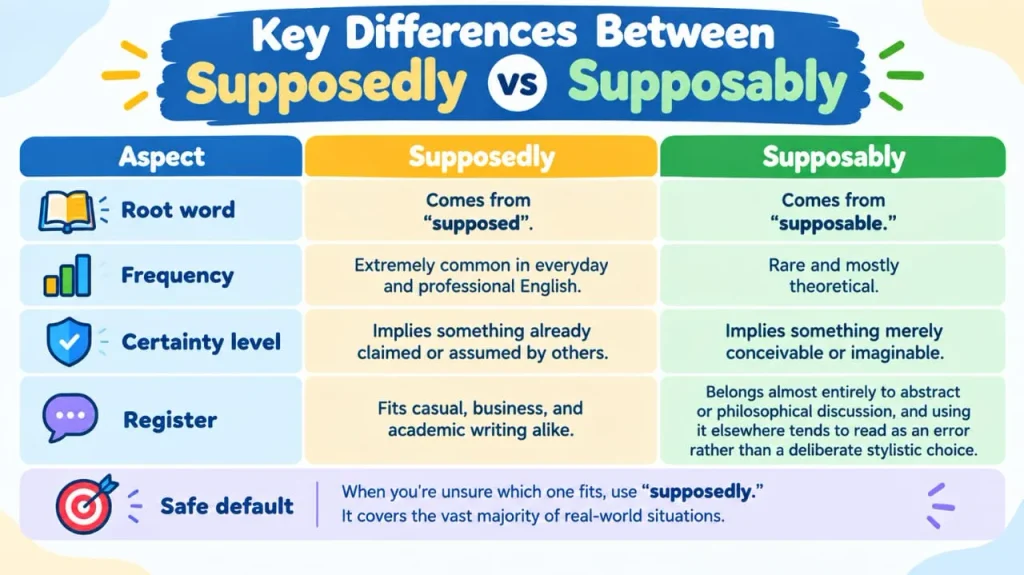
- Root word: “Supposedly” comes from “supposed”; “supposably” comes from “supposable.”
- Frequency: “Supposedly” is extremely common in everyday and professional English; “supposably” is rare and mostly theoretical.
- Certainty level: “Supposedly” implies something already claimed or assumed by others; “supposably” implies something merely conceivable or imaginable.
- Register: “Supposedly” fits casual, business, and academic writing alike. “Supposably” belongs almost entirely to abstract or philosophical discussion, and using it elsewhere tends to read as an error rather than a deliberate stylistic choice.
- Safe default: When you’re unsure which one fits, use “supposedly.” It covers the vast majority of real world situations.
Memory Trick to Remember the Difference
One trick makes this easy: “Supposedly” has a D, like “Default.” It’s the word you default to.
Think of the word family as two branches. Suppose leads to supposed, which leads to supposedly, describing something already assumed or claimed. Suppose also leads to supposable, which leads to supposably, describing something merely possible to imagine. Since most everyday writing involves passing along a claim rather than musing about pure hypotheticals, the “ed” branch wins almost every time.
A quick gut check: if you could just as easily swap in “allegedly” or “apparently,” you want “supposedly.” If you’d need to swap in “conceivably” or “in theory,” you’re in “supposably” territory, which is rare enough that you’ll know it when you see it.
Why Even Careful Writers Get This Wrong
Most explainers skip this part, but it’s really the heart of the supposedly vs supposably confusion: this isn’t primarily a spelling problem, and it isn’t primarily an English learner problem either. It’s a pronunciation problem that trips up native speakers constantly.
Say “supposedly” quickly in casual speech, and the “d” sound tends to soften or vanish entirely. What comes out sounds a lot like “supposably.” Transcribe that sentence without thinking twice, and the wrong spelling lands on the page.
This is the same mechanism behind other common slips, like “probly” for “probably.” Fast, casual speech erodes a sound that formal writing still requires, and the eye and ear don’t always catch the difference until it’s already in print.
Linguists sometimes call this kind of substitution an eggcorn: a mishearing that gets reproduced because it still sounds plausible and roughly makes sense in context. “Supposably” fits that pattern almost perfectly, since it borrows a real word’s shape and sound without carrying its meaning.
Even experienced writers slip here under deadline pressure, especially in quick Slack messages or first draft emails where nobody reads each word aloud before hitting send. One longtime copyeditor admits she still catches herself typing “supposably” in text messages to friends, purely out of habit from how she talks, and has to correct it before sending.
The mistake isn’t a sign of poor vocabulary. It’s a sign of writing at the speed of speech, and knowing that should take some of the sting out of catching it in your own work.
Common Mistakes with Supposedly vs Supposably
| ❌ Wrong | ✅ Correct |
| “He’s supposably coming to the client call.” | “He’s supposedly coming to the client call.” |
| “The results are supposibly accurate.” | “The results are supposedly accurate.” |
| “I just use ‘supposably’, it sounds more natural.” | “‘Supposedly’ works fine in both casual and formal writing.” |
| “Supposedly and supposably basically mean the same thing.” | “They share a root but differ in meaning and how often you’d use them.” |
One more mix up worth flagging: “supposed to” versus “suppose to.” If you’re describing an obligation (“I’m supposed to submit this by Friday”), you need the “d,” just as with “supposedly.”
And if what you actually mean is “possible to assume” rather than “allegedly true,” the more natural word choice is often plausibly, not “supposably.” Plausibly does the conceivability job in a way that reads more naturally in standard, modern English, without inviting a second look from your reader.
Quick Quiz, Test Yourself
- “She ___ won the office lottery pool, but nobody’s confirmed it yet.” (supposedly / supposably)
- “___, a fully automated kitchen could run a restaurant with zero staff.” (Supposedly / Supposably)
- True or false: “Supposably” is not a real English word.
- Which word belongs in a business email passing along an unconfirmed rumor about a merger?
- Fill in the blank: “He’s ___ finishing the quarterly report by Friday.” (supposedly / supposably)
Answers: 1. supposedly, 2. supposably (pure hypothetical), 3. False; it’s real but rare, 4. supposedly, 5. supposedly
Frequently Asked Questions
Is “supposably” a real word?
Yes. “Supposably” is a legitimate adverb built from “supposable,” meaning “conceivable” or “able to be assumed.” It’s just rarely the word people actually mean to use.
Why do people say “supposably” instead of “supposedly”?
Mostly pronunciation. Fast, casual speech softens the “d” sound in “supposedly,” making it sound like “supposably.” Writers who transcribe speech quickly sometimes carry that mispronunciation onto the page.
Is it grammatically correct to say “supposably”?
Within the supposedly vs supposably comparison, “supposably” is grammatically valid on its own, but it’s usually the wrong choice for what the speaker intends. If you mean “allegedly” or “as people claim,” you want “supposedly” instead.
What’s the difference between “supposed to” and “supposedly”?
“Supposed to” describes an obligation or expectation, as in “I’m supposed to call her back.” “Supposedly” describes an unconfirmed claim, as in “She’s supposedly moving to Denver.” Both need that “d.” Dropping it is a related but separate mistake.
Will spellcheck or Grammarly catch “supposably” as an error?
Most modern grammar tools will flag “supposably” or suggest “supposedly,” since it’s uncommon enough to trigger a usage warning even though it’s a real word.
What should I say if I mean “possibly true” rather than “allegedly true”?
Reach for “plausibly” or “conceivably” instead of “supposably.” They convey pure possibility more naturally and won’t read as a typo to your audience.
Final Thoughts
The supposedly vs supposably question isn’t really about memorizing a rule. It’s about recognizing that your ear can betray your writing. In almost every situation you’ll encounter, at work, in school, in a text to a friend, the correct word is supposedly.
Reach for supposedly only in the rare moment you’re genuinely discussing what’s conceivable, not what’s claimed. If you remember nothing else from this guide, remember the D: supposedly has one, and so does default, and that’s the word you should default to whenever you’re unsure.
To read more: “Suite vs Suit: The Shocking Difference? 2026”

Marcus is a former product manager turned comparison writer who spent eight years testing tools and gadgets before quitting to write full-time. He specializes in breaking down tech and software matchups into plain-English verdicts, with a soft spot for buying guides nobody else wants to write.