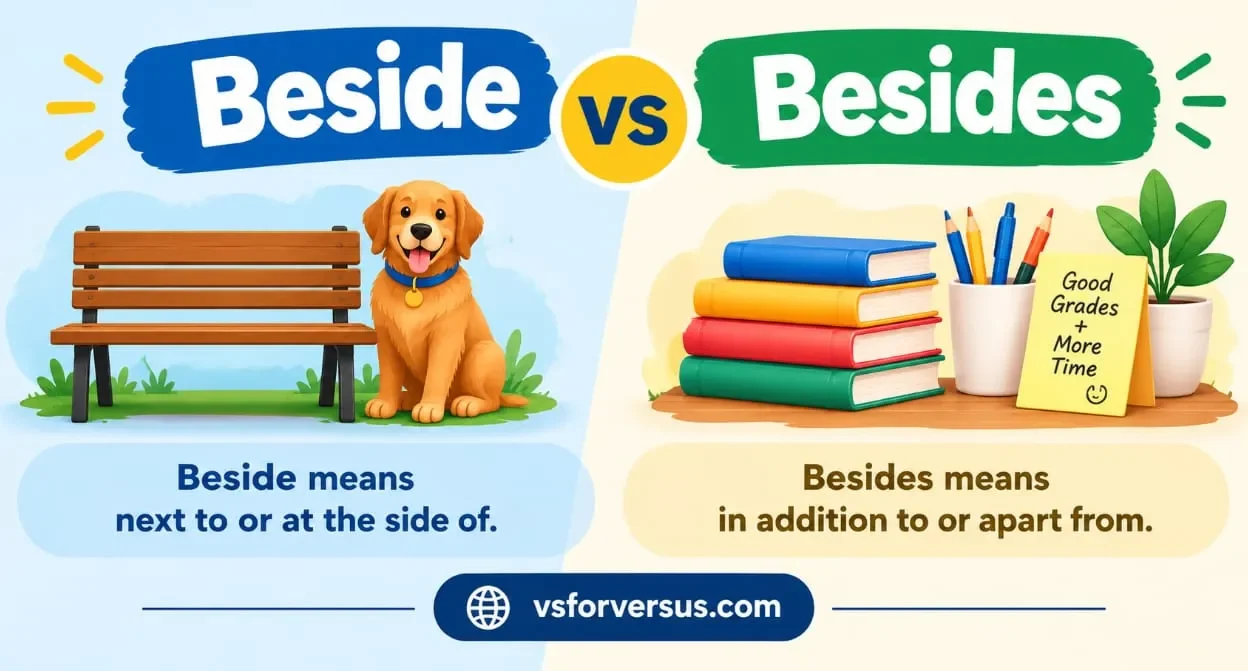
Beside vs Besides is a pair of words that frequently trips up English learners, mainly because they look almost identical but function quite differently in a sentence. Beside is a preposition of place, used to show that something or someone is physically next to or close to another object or person.
Besides, however, is used to mean “in addition to” or “apart from,” often introducing extra information or another point in a discussion. Even a single missing letter can completely change the meaning of a sentence, which is why many writers accidentally misuse these two words.
In this article, we’ll clearly explain the difference between Beside vs Besides, along with practical examples to help you use them correctly.
Quick Answer
Beside is a preposition meaning “next to,” used to describe physical location, as in “the lamp sits beside the bed.” Besides means “in addition to” or “furthermore,” and it adds information rather than describing position, as in “besides tea, she also drinks coffee.” The quickest test for beside vs besides is substitution: if “next to” fits the sentence, use beside; if “also” or “in addition” fits, use besides.
Beside vs Besides? A Quick Comparison
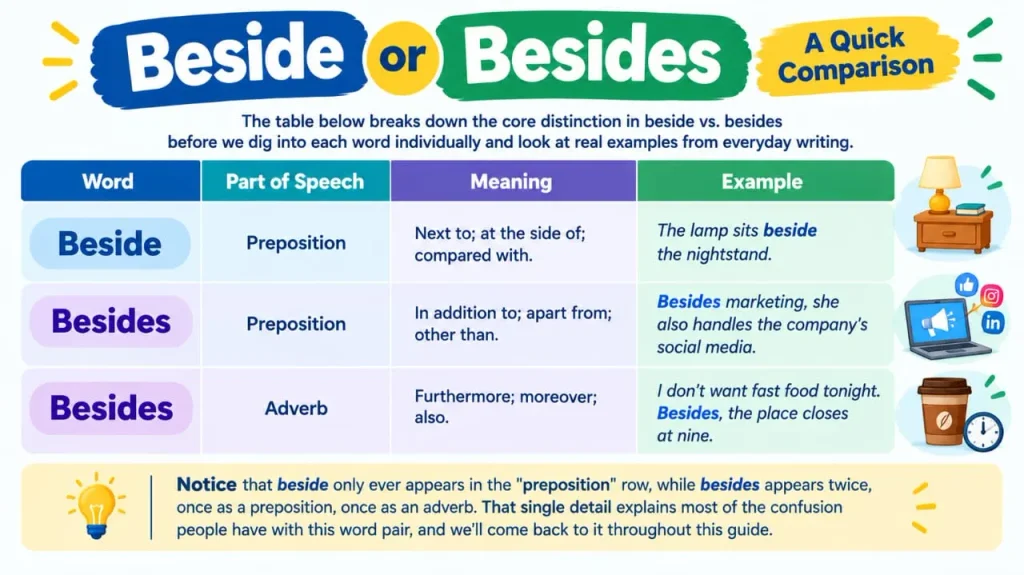
The table below breaks down the core distinction in beside vs besides before we dig into each word individually and look at real examples from everyday writing.
| Word | Part of Speech | Meaning | Example |
| Beside | Preposition | Next to; at the side of; compared with | The lamp sits beside the nightstand. |
| Besides | Preposition | In addition to; apart from; other than | Besides marketing, she also handles the company’s social media. |
| Besides | Adverb | Furthermore; moreover; also | I don’t want fast food tonight. Besides, the place closes at nine. |
Notice that beside only ever appears in the “preposition” row, while besides appears twice, once as a preposition, once as an adverb. That single detail explains most of the confusion people have with this word pair, and we’ll come back to it throughout this guide.
What Does “Beside” Mean?
Beside is a preposition that places one thing next to another. It’s about physical position, though it also stretches to cover comparisons, two things measured side by side, whether that’s furniture in a room or two ideas being weighed against each other.
- “Park the stroller beside the front door so we don’t forget it on the way out.”
- “My laptop looks ancient beside my coworker’s brand new one.”
- “She’s had the same desk beside the window for six years.”
- “The dog curled up beside the fireplace and didn’t move all evening.”
- “The new café sits beside the old bookstore on Fifth Street.”
- “His handwriting looks messy beside hers.”
You’ll see beside most often in descriptive and narrative writing, in directions or instructions (“place the sensor beside the thermostat”), and in everyday comparisons where one person or object is being sized up against another.
It’s also common in workplace writing when describing physical layouts, seating arrangements, or where an item belongs in a shared space; think office floor plans, moving instructions, or wedding seating charts. In fiction and personal essays, beside frequently appears in quiet, intimate scenes: someone sitting beside a hospital bed, walking beside a friend, or standing beside a window watching the rain.
Struggling with prepositions of place elsewhere? Our guide to alongside vs beside covers a closely related mix up, since both words describe physical closeness but carry slightly different shades of meaning.
What Does “Besides” Mean?
Besides does double duty. As a preposition, it means “in addition to,” “apart from,” or “other than.” As an adverb, it means “furthermore” or “moreover,” usually opening a sentence and followed by a comma.
- “Besides freelance writing, he teaches a night class at the community college.”
- “Is there anyone in the office besides Priya who knows this software?”
- “I really don’t feel like going to the gym today. Besides, my back is still sore from yesterday.”
- “We can’t afford the upgrade right now. Besides, the reviews weren’t even that impressive.”
- “Besides being late, he also forgot the slides.”
- “Nobody else applied for the role besides the two internal candidates.”
Besides shows up constantly in professional emails when someone adds a point or a reason, in academic essays as a transitional adverb introducing supporting evidence, and in casual conversation to reinforce an opinion after the fact.
On social media and in texting, it often opens a follow up thought or justification, which is part of why it feels more conversational than formal synonyms like “moreover” or “furthermore.” You’ll also notice that, besides doing heavy lifting in persuasive writing, cover letters, opinion pieces, and debate style essays, it lets a writer stack a second reason onto a first one without sounding repetitive.
Curious how besides compares to its stiffer formal cousins? See our breakdown of moreover vs. furthermore vs besides for a closer look at register and tone.
Key Differences Between Beside vs Besides
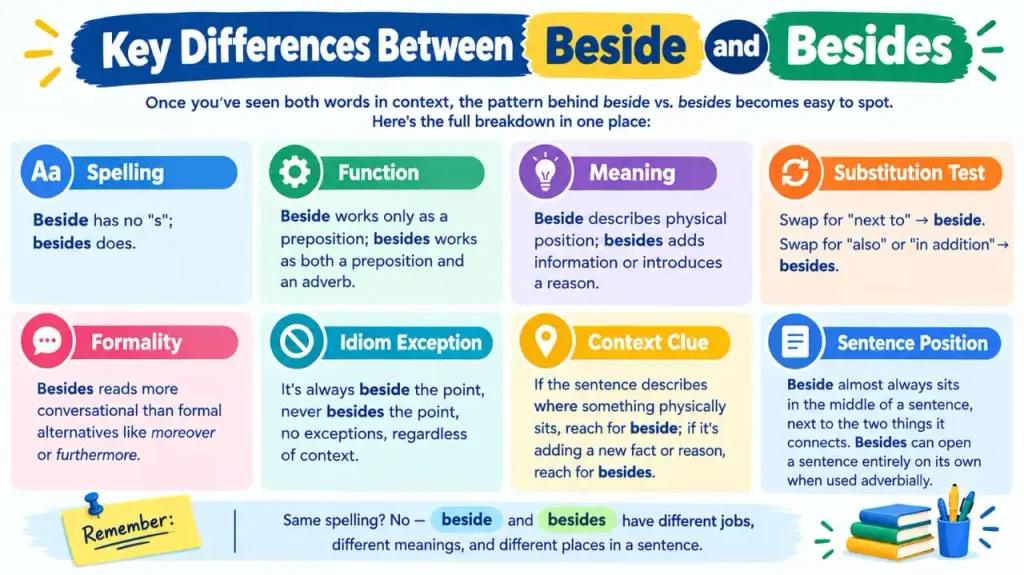
Once you’ve seen both words in context, the pattern behind beside vs besides becomes easy to spot. Here’s the full breakdown in one place:
- Spelling: Beside has no “s”; besides does.
- Function: Beside works only as a preposition; besides works as both a preposition and an adverb.
- Meaning: Beside describes physical position; besides adds information or introduces a reason.
- Substitution test: Swap for “next to” → beside. Swap for “also” or “in addition” → besides.
- Formality: Besides reads more conversational than formal alternatives like moreover or furthermore.
- Idiom exception: It’s always beside the point, never besides the point, no exceptions, regardless of context.
- Context clue: If the sentence describes where something physically sits, reach for beside; if it’s adding a new fact or reason, reach for besides.
- Sentence position: Beside almost always sits in the middle of a sentence, next to the two things it connects. Besides can open a sentence entirely on its own when used adverbially.
How to Remember the Difference
Here’s a simple hook: besideS = one more thing addS to the list. That extra “s” signals extra information, not extra emphasis on location.
If you’ve ever wondered why besides has that trailing “s” in the first place, it’s not random decoration. It’s a leftover from an old adverbial ending, the same historical pattern behind words like always and towards.
That’s also why people sometimes assume the “s” is optional, much like they assume toward and towards, or anyway and anyways, are just interchangeable spelling variants. With beside vs besides, though, the “s” isn’t stylistic; it shifts the word’s entire job, from marking a location to adding a point.
A second way to lock it in: picture two chairs sitting “beside” each other at a table, then imagine someone pulling up a third chair “besides” those two; the extra “s” literally brings something extra into the scene. If it helps, say the sentence out loud and picture the visual: beside is two things touching sides; besides is a pile that just got bigger.
Words like toward vs towards follow this same pattern; worth a look if the “s” question interests you, since the logic behind the mnemonic works almost identically for both pairs.
Common Mistakes With Beside vs Besides
Even experienced writers slip here with beside vs besides, especially around the idiom beside the point, which picks up an unnecessary “s” far more often than you’d expect, likely because besides shows up so often in arguments and discussions in the first place, so the ear gets used to hearing that extra syllable nearby.
| ❌ Incorrect | ✅ Correct |
| That’s besides the point. | That’s beside the point. |
| She sat besides me at the meeting. | She sat beside me at the meeting. |
| Beside the cost, we should check the timeline. | Besides the cost, we should check the timeline. |
| I don’t feel like cooking tonight. Beside, we’re out of groceries. | I don’t feel like cooking tonight. Besides, we’re out of groceries. |
| Who else knows about this beside you? | Who else knows about this besides you? |
| The chair was placed besides the desk. | The chair was placed beside the desk. |
There are a handful of genuine overlap cases worth knowing. “He has ten chairs and five extra besides/beside” works either way, because both words can function as an adverb meaning “in addition” tacked onto the end of a sentence. These cases are rare and mostly appear in older or more formal writing, so when in doubt, besides is the safer, more modern sounding default.
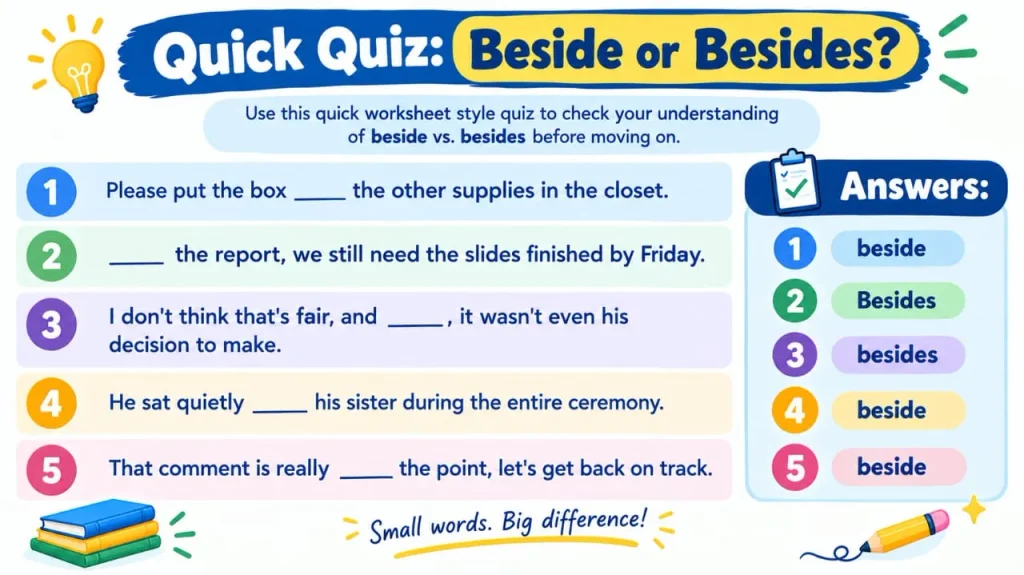
Quick Quiz: Beside or Besides?
Use this quick worksheet style quiz to check your understanding of beside vs besides before moving on.
- Please put the box ___ the other supplies in the closet.
- ___ the report, we still need the slides finished by Friday.
- I don’t think that’s fair, and ___, it wasn’t even his decision to make.
- He sat quietly ___ his sister during the entire ceremony.
- That comment is really ___ the point, let’s get back on track.
Answers: 1. beside 2. Besides 3. besides 4. beside 5. beside
Frequently Asked Questions
What is the difference between beside and besides?
Beside vs besides comes down to physical position versus addition: beside means “next to,” while besides means “in addition to” or “furthermore.”
Is it “sit beside me” or “sit besides me”?
“Sit beside me” is correct when you’re describing where someone is sitting. Besides doesn’t describe physical position, so it can’t substitute here.
Is it “beside the point” or “besides the point”?
The correct idiom is always beside the point. “Besides the point” is one of the most common versions of this mix up, likely because besides shows up so often in the middle of a disagreement.
Can besides mean beside?
Only in a narrow, older adverbial sense meaning “in addition.” In everyday writing, the two aren’t interchangeable; besides never describes physical location.
Why does besides have an “s” at the end?
The final ” s” is a historical adverbial ending, the same pattern found in words like “always” and “towards,” not a random or optional addition.
Is besides formal or informal?
Besides is generally more conversational than formal alternatives like moreover or furthermore, though it appears comfortably in both academic and everyday writing.
Final Thoughts
Getting beside vs besides right mostly comes down to remembering what each word actually does: beside places things, and besides adds to them. Once that distinction clicks, the mistakes above become easy to catch, even the ones that slip past experienced writers.
Keep the mnemonic in mind (besideS = one more thing addS), run the quick substitution test whenever you’re unsure, and you’ll rarely mix these two up again.
To read more: Award vs Reward: What’s the Difference 2026

Marcus is a former product manager turned comparison writer who spent eight years testing tools and gadgets before quitting to write full-time. He specializes in breaking down tech and software matchups into plain-English verdicts, with a soft spot for buying guides nobody else wants to write.