

Comradery vs Camaraderie is a pair that often puzzles people, not because their meanings differ, but because their spellings create confusion about which one is actually correct. Both words are meant to describe the same feeling: a sense of trust, friendship, and mutual support shared among a group of people, such as coworkers, teammates, or soldiers.
However, Camaraderie is the standard and widely accepted spelling, rooted in French origin, while Comradery is considered a variant spelling that developed later and is used less formally. Many writers unknowingly use the two interchangeably, unaware that one is preferred in formal and professional writing. In this article, we’ll clarify which spelling to use and when.
Quick Answer
When it comes to comradery vs camaraderie, camaraderie is the standard, widely accepted spelling of the word describing friendship, trust, and mutual goodwill among a group of people. Comradery is a recognized variant spelling that developed independently from the word “comrade” over 150 years ago; it is not simply a typo. Both spellings mean the same thing, but camaraderie is the safer choice for professional, academic, or international writing.
Comradery vs Camaraderie at a Glance
Before going any further, the table below lays out the full picture in one place. The debate over comradery vs. camaraderie isn’t really about right and wrong; it’s about which form is more widely recognized and expected by readers.
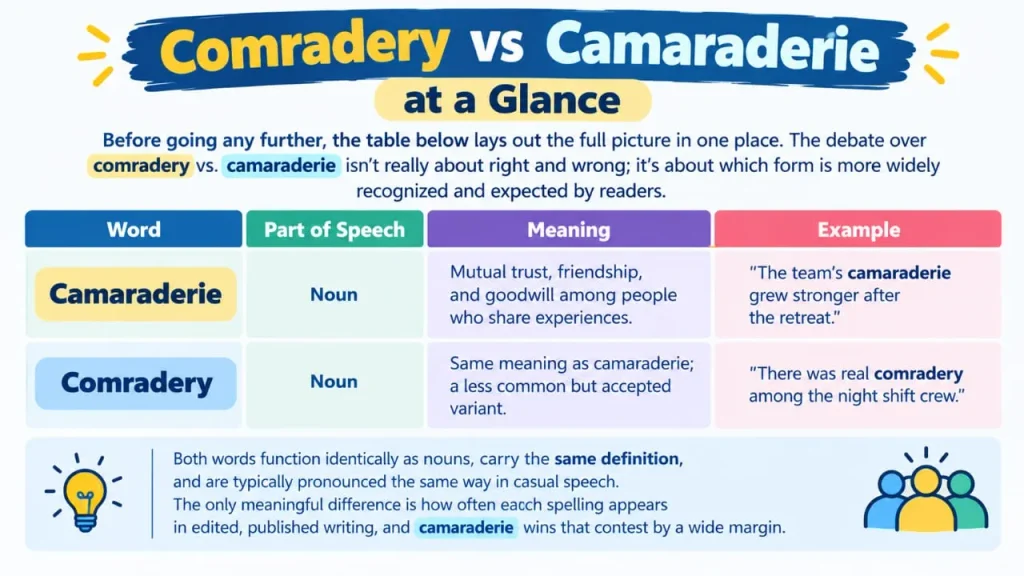
| Word | Part of Speech | Meaning | Example |
| Camaraderie | Noun | Mutual trust, friendship, and goodwill among people who share experiences | “The team’s camaraderie grew stronger after the retreat.” |
| Comradery | Noun | Same meaning as camaraderie; a less common but accepted variant | “There was real comradery among the night shift crew.” |
Both words function identically as nouns, carry the same definition, and are typically pronounced the same way in casual speech. The only meaningful difference is how often each spelling appears in edited, published writing, and camaraderie wins that contest by a wide margin.
What Does “Camaraderie” Mean?
Camaraderie is a noun borrowed directly from French, tracing back to camarade, meaning companion or roommate, which itself descends from the Latin word for “chamber,” much like other French loanwords in English that entered the language the same way. It entered English in the 1830s and has remained the dominant spelling ever since.
You’ll find it most often in sentences like these:
- “After six months on the same project, the camaraderie between the developers was obvious; they finished each other’s sentences in stand up meetings.”
- “One thing I’ll never forget about grad school is the camaraderie in our cohort; we survived finals week together more times than I can count.”
- “The coach credited the team’s late season win streak to camaraderie built during preseason training camp.”
- “Nothing beats the camaraderie of a Sunday morning trail run with the same group of neighbors.”
Camaraderie shows up most often in workplace culture writing, sports journalism, military memoirs, and personal essays describing shared struggle or achievement. It’s the version style guides recommend, the version dictionaries universally list, and the version your readers are least likely to question.
What Does “Comradery” Mean?
Comradery carries the identical meaning friendship and trust within a group but it formed differently. Rather than being borrowed whole from French, it was built in English from “comrade” plus the suffix ” ry,” the same pattern that gave us words like wizardry and citizenry (see our guide to English suffix patterns for more examples). It first appeared in print around 1862, roughly two decades after camaraderie was already established.
A few examples of comradery used naturally:
- “The volunteers who showed up every weekend for the food drive developed a comradery you don’t find in a typical office job.”
- “There’s a comradery among long haul truckers that outsiders rarely understand.”
- “I’ve read veteran memoirs that use comradery instead of camaraderie, and the meaning lands the same.”
Merriam Webster and American Heritage both list comradery as a legitimate variant, which is why you’ll occasionally spot it in North American publications. Cambridge and Oxford’s learner dictionaries, however, don’t include it at all, a gap that partly explains why it feels less “official” to many readers, even when it isn’t technically wrong.
Key Differences: Comradery vs Camaraderie
- Origin: Camaraderie comes directly from French; comradery was built later in English from “comrade” plus the suffix ” ry.”
- First recorded use: Camaraderie dates to around 1838; comradery follows in 1862.
- Frequency: Camaraderie appears more than 40 times as often as comradery in published writing.
- Not a regional split: Unlike color/colour, this isn’t simply American versus British spelling; both forms appear in American and British dictionaries.
- Formality: Camaraderie is the expected choice in academic papers, business writing, and journalism.
- Dictionary coverage: Camaraderie is listed everywhere; comradery appears in some major dictionaries but not others.
Memory Trick to Remember the Difference
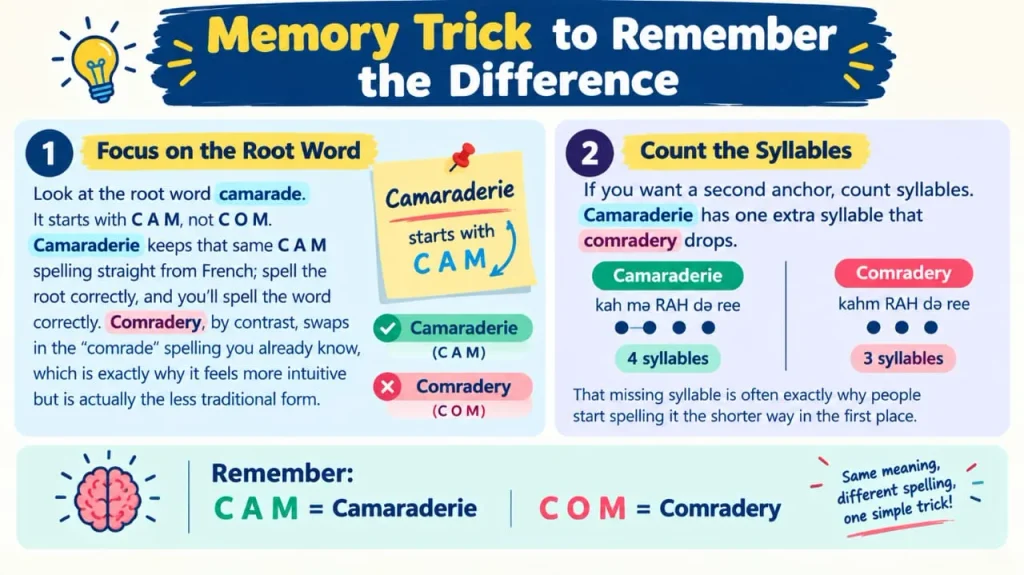
One trick that sticks: look at the root word camarade. It starts with C A M, not C O M. Camaraderie keeps that same C A M spelling straight from French; spell the root correctly, and you’ll spell the word correctly. Comradery, by contrast, swaps in the “comrade” spelling you already know, which is exactly why it feels more intuitive but is actually the less traditional form.
If you want a second anchor, count syllables. Camaraderie has one extra syllable that comradery drops, kah mə RAH də ree versus kahm RAH də ree. That missing syllable is often exactly why people start spelling it the shorter way in the first place.
Will Spellcheck or Autocorrect Flag “Comradery”?
Usually not, which is part of why the confusion persists. Most modern spellcheckers, including Microsoft Word and Google Docs, recognize comradery as a valid dictionary word and won’t underline it in red.
In other words, you can’t rely on autocorrect to steer you toward the more standard spelling; the choice is entirely on you. If you’re writing for a broad or international audience and want zero risk of a reader second guessing you, default to camaraderie.
Common Mistakes: Comradery vs Camaraderie
- Common Mistakes: Comradery vs Camaraderie
- Even experienced writers slip here it’s an easy word to mangle under deadline pressure, since the syllables blur together when you’re typing fast.
| ❌ Wrong | ✅ Correct |
| Comaraderie | Camaraderie |
| Comraderie | Camaraderie |
| Cameradery | Camaraderie (or Comradery) |
| “The report showed camraderie among staff” | “The report showed camaraderie among staff” |
| Using both spellings inconsistently in the same document | Pick one spelling and stay consistent throughout |
A hiring manager or professor may never notice comradery on its own, but switching between comradery and camaraderie within the same piece reads as careless, even when both spellings are technically defensible.
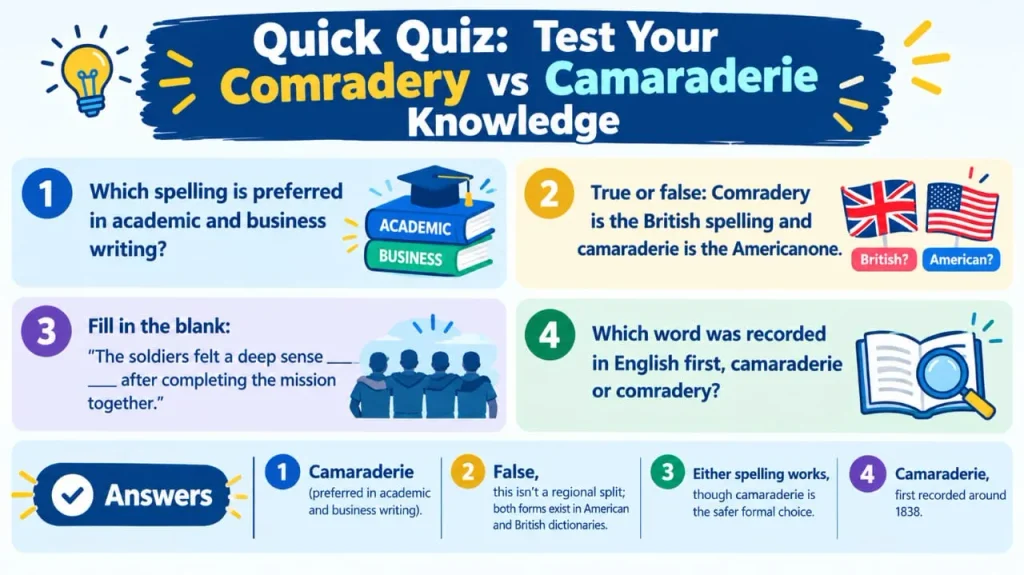
Quick Quiz: Test Your Comradery vs Camaraderie Knowledge
- Which spelling is preferred in academic and business writing?
- True or false: Comradery is the British spelling and camaraderie is the American one.
- Fill in the blank: “The soldiers felt a deep sense of after completing the mission together.”
- Which word was recorded in English first, camaraderie or comradery?
(Answers: 1. Camaraderie; 2. False, this isn’t a regional split; both forms exist in American and British dictionaries; 3. Either spelling works, though camaraderie is the safer formal choice; 4. Camaraderie, first recorded around 1838.)
Frequently Asked Questions
Is comradery a real word?
Yes. It’s a recognized variant of camaraderie, listed in Merriam Webster and American Heritage, though it’s used far less often in published writing.
Is comradery a misspelling of camaraderie?
Not exactly. It’s a separate, later formed word built from “comrade” plus ” ry,” even though many readers assume it’s simply an error.
Which is more common: camaraderie or comradery?
Camaraderie is dramatically more common; it appears roughly 40 times as often as comradery in edited, published English.
Is comradery American English?
Not exclusively. Some dictionaries associate it with North American usage, but it isn’t a strict American versus British split the way color/colour is.
How do you pronounce camaraderie?
Most speakers say it with five syllables, roughly “kah mə RAH də ree,” though the second syllable is often softened or dropped in casual speech.
Do camaraderie and comradery mean the same thing?
Yes. Both describe friendship, trust, and goodwill among people who share experiences; the comradery vs. camaraderie choice really just comes down to formality, not meaning.
Comradery, Camaraderie, or Comradeship? A Related Word Worth Knowing
There’s a third word that occasionally enters this conversation: comradeship. It carries a more formal, often military flavored tone; “the comradeship of soldiers who served together” reads slightly more traditional than “the camaraderie of soldiers who served together,” even though the core meaning overlaps heavily.
Other close synonyms worth knowing include fellowship, solidarity, and esprit de corps, each leaning slightly more formal or ceremonial than camaraderie. If you’re writing something historical or ceremonial, comradeship is worth keeping in your back pocket alongside camaraderie and comradery.
If this kind of spelling puzzle interests you, our guides to affect vs effect and advice vs advise cover similarly confusing pairs, or browse the full commonly confused words hub for more.
The Bottom Line
The debate over comradery vs camaraderie isn’t a case of one correct word and one wrong one; it’s a case of one dominant spelling and one accepted but rarer alternative. Both words describe the same feeling: trust, friendship, and goodwill shared between people who’ve been through something together. The only real question is which spelling your reader expects, and in almost every formal setting, that answer is camaraderie, and readers rarely question it.
When in doubt, choose camaraderie for anything formal, essays, reports, emails to a boss, or writing for an international audience. Save camaraderie for the moments when its shorter, more familiar shape feels natural, like a casual note to a close knit team.
To read more: Biannual vs Semiannual: The Ultimate Guide to Avoid Confusion (2026)

Marcus is a former product manager turned comparison writer who spent eight years testing tools and gadgets before quitting to write full-time. He specializes in breaking down tech and software matchups into plain-English verdicts, with a soft spot for buying guides nobody else wants to write.