

Elude vs Allude this pair is a classic example of how just a couple of letters can completely change a word’s meaning, leaving even confident writers second guessing themselves. Despite their similar spelling, these two words belong to entirely different contexts.
Elude means to skillfully escape, avoid, or evade something or someone, often used when talking about slipping away from danger, capture, or even a memory that won’t quite surface. Allude, on the other hand, means to indirectly refer to or hint at something without stating it outright, commonly used in conversations, writing, and literature to suggest a connection.
Mixing these two up can completely alter the meaning of a sentence, especially in academic or professional writing. Below, we’ll explore both words in detail, covering their origins, correct usage, and practical examples to help you use them with total confidence.
Quick Answer
Elude means to escape, avoid, or evade something, usually skillfully or cleverly, as in “The suspect eluded police for three days.” Allude means to refer to something indirectly or hint at it, almost always followed by “to,” as in “She alluded to the delay without giving details.”
Both words are verbs, both trace back to the Latin ludere (“to play”), and their nearly identical sound is the main reason people confuse elude vs allude in everyday writing. If you remember nothing else: elude = escape, allude = hint at.
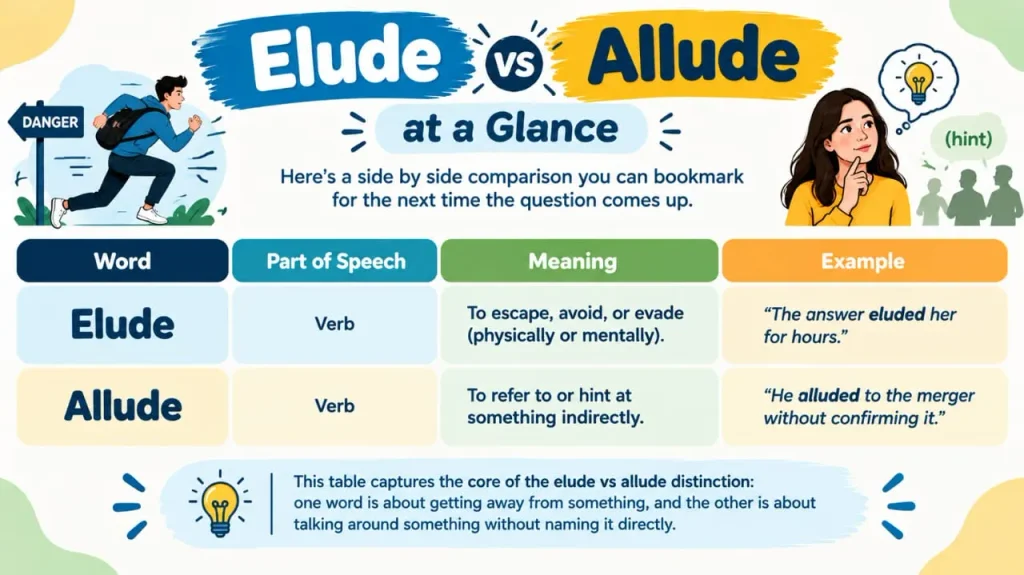
Elude vs Allude at a Glance
Here’s a side by side comparison you can bookmark for the next time the question comes up.
| Word | Part of Speech | Meaning | Example |
| Elude | Verb | To escape, avoid, or evade (physically or mentally) | “The answer eluded her for hours.” |
| Allude | Verb | To refer to or hint at something indirectly | “He alluded to the merger without confirming it.” |
This table captures the core of the elude vs allude distinction: one word is about getting away from something, and the other is about talking around something without naming it directly.
What Does “Elude” Mean?
At its core, elude means to escape from, avoid, or evade, often through skill, cleverness, or sheer luck. It’s a word of motion and escape, whether that escape is physical, mental, or entirely figurative.
Elude commonly shows up in a few distinct senses:
- Physical escape: “The cyclist eluded the pack on the final climb and took the stage win by a wheel’s length.”
- Mental or intellectual escape: “No matter how many times I read the instructions, the assembly steps eluded me completely.”
- Failure to achieve something desired: “A championship title has eluded this team for over a decade, despite three trips to the finals.”
- Workplace or professional context: “Despite three rounds of interviews, a clear answer from HR continued to elude the candidate, and she eventually withdrew her application.”
- Everyday frustration: “The reason my printer keeps disconnecting from Wi Fi honestly eludes me at this point.”
Elude always takes a direct object; you elude something or someone. You don’t just “elude” in the abstract; there’s always a pursuer, a problem, a memory, or a goal being dodged. The word shows up constantly in law enforcement stories, sports commentary, and everyday complaints about things that refuse to make sense.
A fugitive doesn’t simply fail to get caught; they actively slip past pursuers, often through timing, skill, or luck. That flavor of narrowly getting away is what separates elude from a plainer word like “avoid.”
What Does “Allude” Mean?
Allude means to refer to something indirectly, to hint at it without stating it outright. It’s a word of suggestion rather than confrontation; you allude to something when you want the listener or reader to pick up on a meaning without you spelling it out.
A usage note that trips up a lot of writers: allude is almost always followed by the preposition “to.” You don’t “allude something”; you “allude to something.” Keeping that small preposition attached is often the fastest way to catch yourself before making the wrong choice.
A few natural examples across different registers:
- Workplace email: “In her message, she alluded to some upcoming changes to the team structure, though nothing was officially confirmed yet.”
- Academic writing: “The novel repeatedly alludes to Greek mythology, particularly in its treatment of fate and inevitability.”
- Social/conversational: “My roommate kept alluding to a surprise party all week, but she never once said the actual word ‘party.'”
- Legal or professional context: “The witness alluded to a prior conversation with the defendant without describing its contents in detail.”
- Journalism: “The senator alluded to potential policy changes without confirming any specific timeline.”
Allude shows up most in academic writing, literary analysis, journalism, and professional communication, anywhere a writer wants to gesture at something without committing to a fully direct statement. Its noun form, allusion, is common in literature classes for exactly this reason: an allusion is a brief, indirect reference to another work, event, or idea, and recognizing allusions is a core reading comprehension skill.
Choosing to allude to a sensitive topic, rather than stating it outright, often signals tact; you’re acknowledging something exists without forcing it into the open. That’s part of why the word shows up so often in workplace communication, where a manager or colleague might want to raise an issue gently rather than head on.
Key Differences Between Elude vs Allude
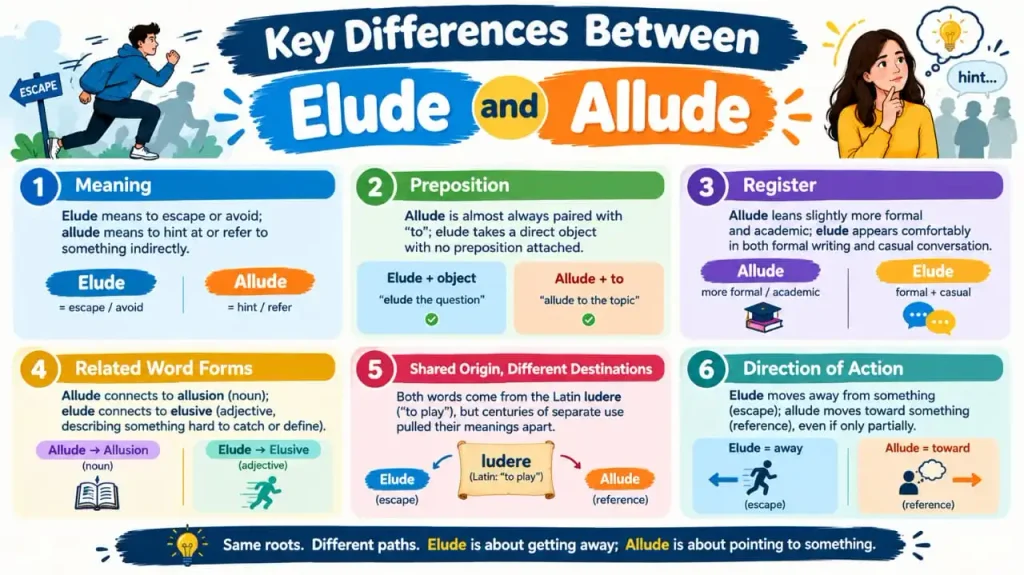
If you’re still sorting through the elude vs allude confusion, these distinctions should help lock it in for good:
- Meaning: Elude means to escape or avoid; allude means to hint at or refer to something indirectly.
- Preposition: Allude is almost always paired with “to”; elude takes a direct object with no preposition attached.
- Register: Allude leans slightly more formal and academic; elude appears comfortably in both formal writing and casual conversation.
- Related word forms: Allude connects to allusion (noun); elude connects to elusive (adjective, describing something hard to catch or define).
- Shared origin, different destinations: Both words come from the Latin ludere (“to play”), but centuries of separate use pulled their meanings apart.
- Direction of action: Elude moves away from something (escape); allude moves toward something (reference), even if only partially.
How to Remember the Difference
Allude has an A, think “At a distance.” When you allude to something, you’re talking about it from a distance, circling it without landing on it directly. Elude has an E; think “Escape.” When something eludes you, it escapes your grasp, your understanding, or your pursuit.
A second quick test: swap the word for “hint at.” If the sentence still makes sense, you want allude. Swap it for “escape” or “get away from” instead, and if that works, you want elude. Run this test on your own sentence before you hit send; it takes about three seconds, and it’s saved more than a few writers from an awkward correction email the next morning.
Why Even Careful Writers Mix These Up
Even experienced writers slip here, and there’s a genuine linguistic reason for it, not just carelessness. Elude and allude share that same Latin root, and they land on the same stressed second syllable when spoken aloud: “uh LOOD” for allude, “ee LOOD” for elude. In fast, casual speech, the difference in that first sound practically disappears.
Both words also frequently show up right before “to” in everyday conversation (“I was trying to allude to…” or “trying to elude to…”), which trains the ear to expect the same sentence shape every time, regardless of which word actually belongs there. The resulting error has nothing to do with intelligence, vocabulary size, or writing skill; it comes down to how similar these two words sound when spoken quickly.
That’s also why the elude vs allude mix up tends to surface most in first drafts and quick messages, the moments when writing happens at the speed of speech rather than under careful proofreading. Reading a sentence back out loud, slowly, is often enough to catch it before it goes out the door.
Common Mistakes with Elude vs Allude
The single most common real world error is writing “eluding to” when “alluding to” is meant. It shows up constantly in emails, social media captions, comment sections, and occasionally even in published articles that skipped a careful edit. (If this kind of slip up interests you, our roundup of covers several more like it.)
| ❌ Incorrect | ✅ Correct |
| She eluded to the problem during the meeting. | She alluded to the problem during the meeting. |
| The thief alluded the police for several blocks. | The thief eluded the police for several blocks. |
| He kept eluding to his past without ever explaining it. | He kept alluding to his past without ever explaining it. |
There’s no British vs. American English difference here. Some learners assume “elude to” might be a regional variant they simply haven’t encountered yet, but it isn’t; it’s an error everywhere English is written, formal or informal.
Quick Quiz: Test Yourself
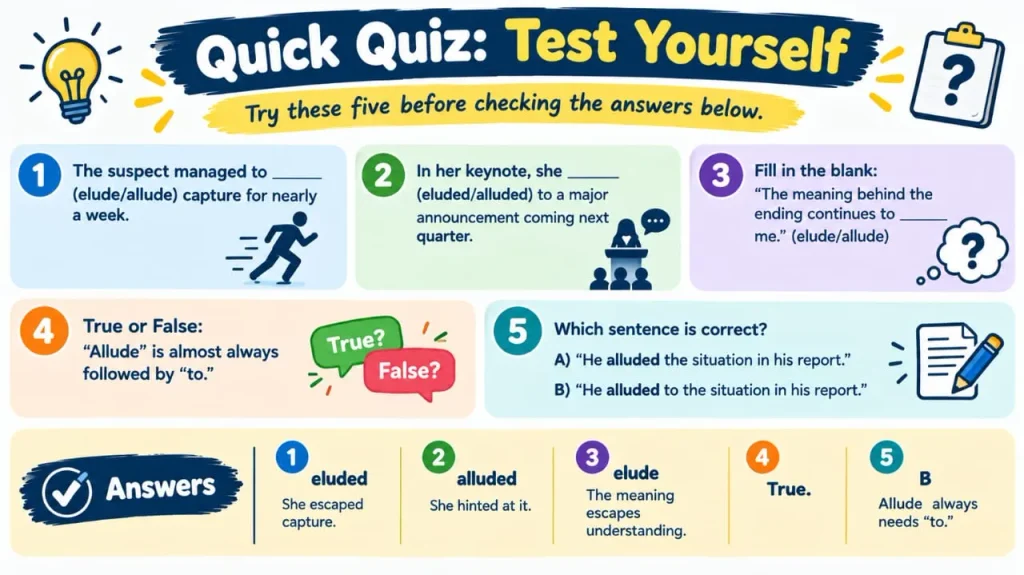
Try these five before checking the answers below.
- The suspect managed to ______ (elude/allude) capture for nearly a week.
- In her keynote, she ______ (eluded/alluded) to a major announcement coming next quarter.
- Fill in the blank: “The meaning behind the ending continues to ______ me.” (elude/allude)
- True or False: “Allude” is almost always followed by “to.”
- Which sentence is correct? A) “He alluded the situation in his report.” B) “He alluded to the situation in his report.”
Answers: 1. eluded, she escaped capture. 2. alluded, she hinted at it. 3. elude, the meaning escapes understanding. 4. True. 5. B, allude always needs “to.”
Frequently Asked Questions
Is it “elude to” or “allude to”? “Allude to” is correct. Elude never takes the preposition “to”; you elude something directly, with no preposition attached, because elude is a transitive verb that connects straight to its object.
What is the difference between elude and allude? Elude means to escape or avoid something; allude means to refer to something indirectly. They’re both verbs, but they describe opposite kinds of actions: one moves away from a thing, the other points toward it without ever quite touching it.
Is allude or elude more formal? Allude tends to appear more often in academic, literary, and professional writing, especially when discussing texts, speeches, or sensitive topics. Elude is comfortable in both formal and everyday contexts, from news reports about fugitives to casual conversation about a forgotten name.
Is there a British vs. American English difference between elude and allude? No. Spelling, meaning, and usage are identical across British and American English. The confusion here is about meaning and sound, not regional variation, so the same rules apply no matter where your reader is based.
What is the noun form of allude? The noun form is allusion. Elude’s related word is the adjective elusive, used to describe something or someone hard to catch, define, or pin down, a fittingly slippery word for a word about escaping.
Can elude and allude appear in the same sentence? Yes, it’s actually a great way to test your understanding. For example: “The suspect managed to elude police for hours, while witnesses could only allude to which direction he’d gone.” Using both correctly in one sentence is a solid final check that you’ve got the distinction down.
Final Thoughts
The elude vs allude mix up isn’t a sign of careless writing; it’s a sign of two words that sound almost identical but point in opposite directions. Elude is about escape: a suspect eludes police, an answer eludes your memory, a solution eludes a whole team for years. Allude is about suggestion: you allude to something when you want to hint at it rather than say it outright.
The fastest way to keep them straight is the preposition test: if “to” naturally follows the word, you want allude; if not, you want elude. Keep that one rule in mind and the elude vs allude choice stops being a coin flip.
To read more:Eatable vs Edible: What’s the Shocking Difference? 2026

Marcus is a former product manager turned comparison writer who spent eight years testing tools and gadgets before quitting to write full-time. He specializes in breaking down tech and software matchups into plain-English verdicts, with a soft spot for buying guides nobody else wants to write.