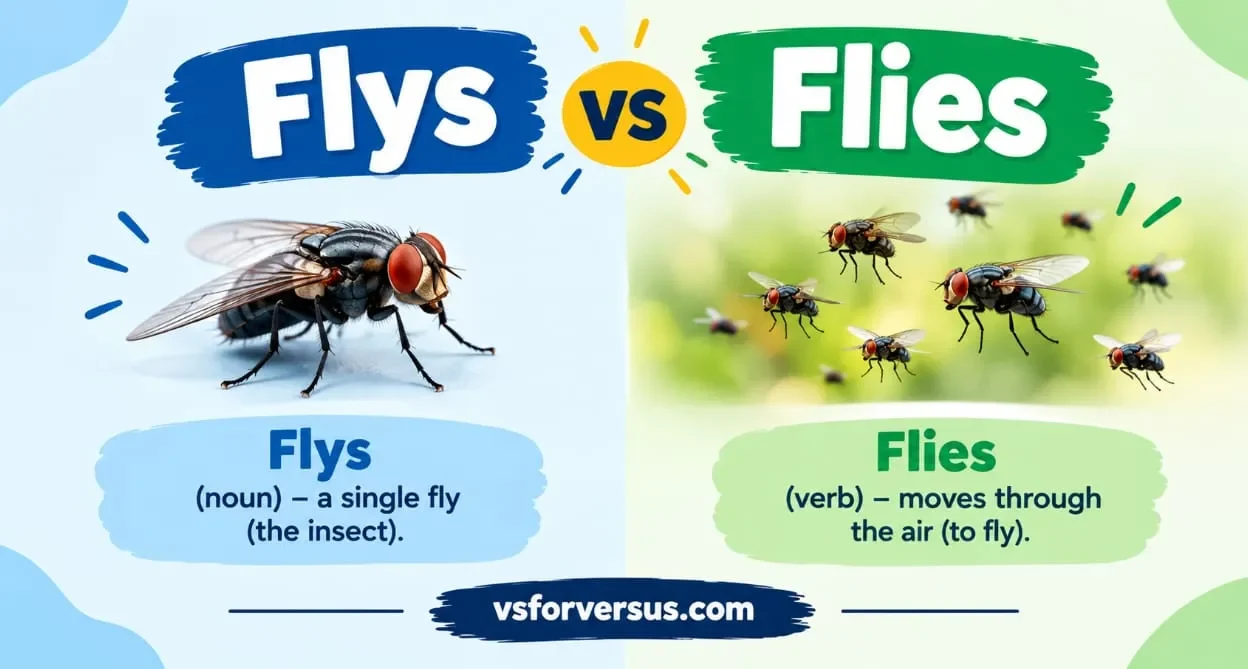
Flys vs Flies at first glance, this might seem like a simple case of a spelling mistake, but the truth is a little more interesting than that. Many people assume “flys” is just an alternate way to write the plural of “fly,” but in standard English, it’s actually incorrect.
Flies is the correct and only accepted plural form of “fly,” whether you’re talking about the insect buzzing around your kitchen or the action of an object moving through the air, like a ball that flies over a fence. Flys, on the other hand, is a common misspelling that has no real grammatical standing, though it sometimes appears informally or as a brand name.
Understanding why English pluralizes words ending in “y” the way it does can clear up a lot of confusion. In this article, we’ll dig into the grammar rule behind this transformation and show you exactly how to use “flies” correctly every time.
Quick Answer
“Flies” is always correct; “flys” is a common misspelling with no standard use in modern English. “Flies” covers three jobs at once: it’s the plural of the noun “fly” (a winged insect), the third person singular form of the verb “to fly” (as in “time flies”), and the informal plural for the zippered opening on trousers (“your flies are undone”). No matter which meaning you intend, the spelling with “ies” is the one to use.
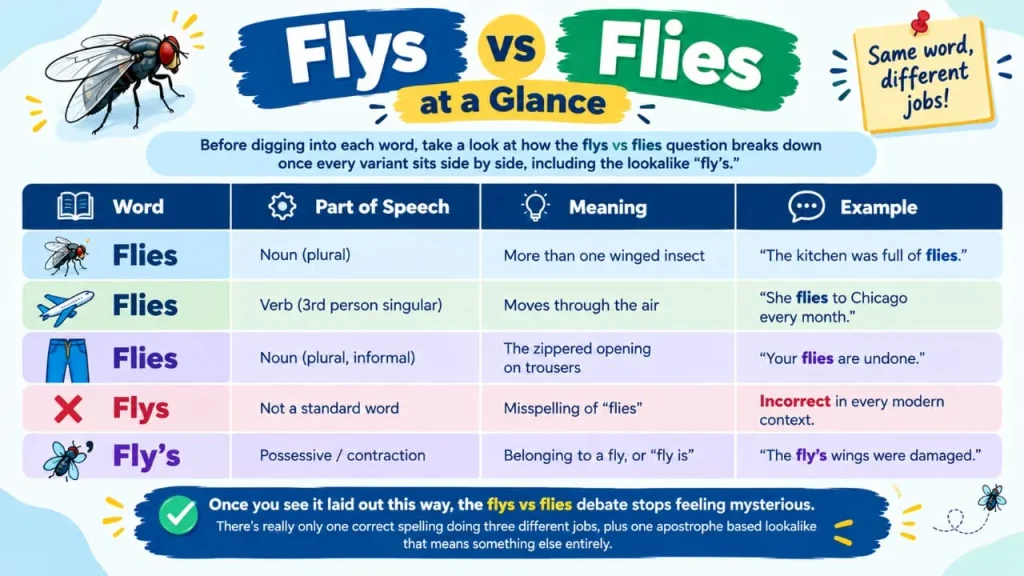
Flys vs Flies at a Glance
Before digging into each word, take a look at how the flys vs flies question breaks down once every variant sits side by side, including the lookalike “fly’s.”
| Word | Part of Speech | Meaning | Example |
| Flies | Noun (plural) | More than one winged insect | “The kitchen was full of flies.” |
| Flies | Verb (3rd person singular) | Moves through the air | “She flies to Chicago every month.” |
| Flies | Noun (plural, informal) | The zippered opening on trousers | “Your flies are undone.” |
| Flys | Not a standard word | Misspelling of “flies” | Incorrect in every modern context |
| Fly’s | Possessive / contraction | Belonging to a fly, or “fly is” | “The fly’s wings were damaged.” |
Once you see it laid out this way, the flys vs flies debate stops feeling mysterious. There’s really only one correct spelling doing three different jobs, plus one apostrophe based lookalike that means something else entirely.
What Does “Flies” Mean?
One correct spelling, three different jobs that’s the whole story behind the flys vs flies confusion. As a noun, “flies” is simply the plural of “fly,” the small winged insect that shows up uninvited at every summer barbecue.
As a verb, it’s the third person singular present tense form of “to fly,” used whenever the subject is he, she, or it. And in casual, everyday English, “flies” also refers to the zippered opening on a pair of trousers, a meaning that catches a lot of people off guard the first time they hear it, especially outside the US, where the term shows up more often in everyday speech.
Real writing puts “flies” to work in several different ways:
“Fruit flies had taken over the compost bin by the time we noticed.”
“The pilot flies this same route to Denver twice a week.”
“Time flies when you’re finally enjoying your job instead of dreading it.”
“Double check that your flies are zipped before you walk into the interview.”
You’ll see this word constantly in pest control and gardening content, travel and aviation writing, everyday idioms, and, perhaps unexpectedly, in wardrobe related small talk. It’s a genuinely versatile word, and that versatility is exactly why the spelling matters: get it wrong, and you risk muddling a sentence that was otherwise clear. A recruiter skimming a résumé cover note, for instance, will read “flys” as a red flag before they even register what you meant to say.
What Does “Flys” Mean?
Here’s where most people go wrong, and it’s an easy mistake to make: “flys” looks like it follows the standard “just add an s” pluralization pattern that works for hundreds of other English nouns. Cats, dogs, tables, chairs: add an s and move on. Fly doesn’t play by that rule, and “flys” isn’t a standard word in contemporary English. It’s a misspelling, plain and simple.
There’s one small historical wrinkle worth knowing, mostly because it makes a great trivia fact. In 19th century England, a “fly” referred to a type of lightweight, horse drawn (or occasionally human powered) carriage. The plural of that specific noun really was spelled “flys.” That usage has been extinct for well over a century, though, so unless you’re writing historical fiction set in Victorian London, you won’t need it.
In modern writing, the mistake typically looks like this, along with the fix:
Incorrect: “The airplane flys overhead every evening at six.”
Correct: “The airplane flies overhead every evening at six.”
Incorrect: “There were so many flys at the picnic we had to move tables.”
Correct: “There were so many flies at the picnic we had to move tables.”
This misspelling shows up most often in casual emails, social captions, hand lettered signs, and product listings. You’ll occasionally spot “fishing flys” on outdoor gear sites too, which only reinforces the confusion for anyone learning the rule. Even some longtime anglers write it that way out of habit, despite “flies” being the accepted spelling in tackle catalogs and fly fishing guides alike.
What Does “Fly’s” Mean?
Add an apostrophe and the whole word changes jobs. “Fly’s” is either possessive, showing something belongs to a fly, or a contraction of “fly is.” It looks like a simple typo, but it’s actually a completely different grammatical tool, and confusing it with the plural is one of the more common near miss errors even confident writers make.
Possessive: “The fly’s compound eyes let it see in almost every direction at once.”
Contraction: “The fly’s back in the kitchen; can someone deal with it?”
A quick test: if you can naturally swap in “fly is” and the sentence still makes sense, the apostrophe belongs there. If you’re talking about more than one insect, or conjugating the verb, the apostrophe should disappear entirely. Apostrophes are sneaky that way: English gives them double duty across possession and contraction, and that dual role is enough to make anyone pause mid sentence, even in a sentence about something as small as a fly.
Key Differences Between Flys, Flies, and Fly’s
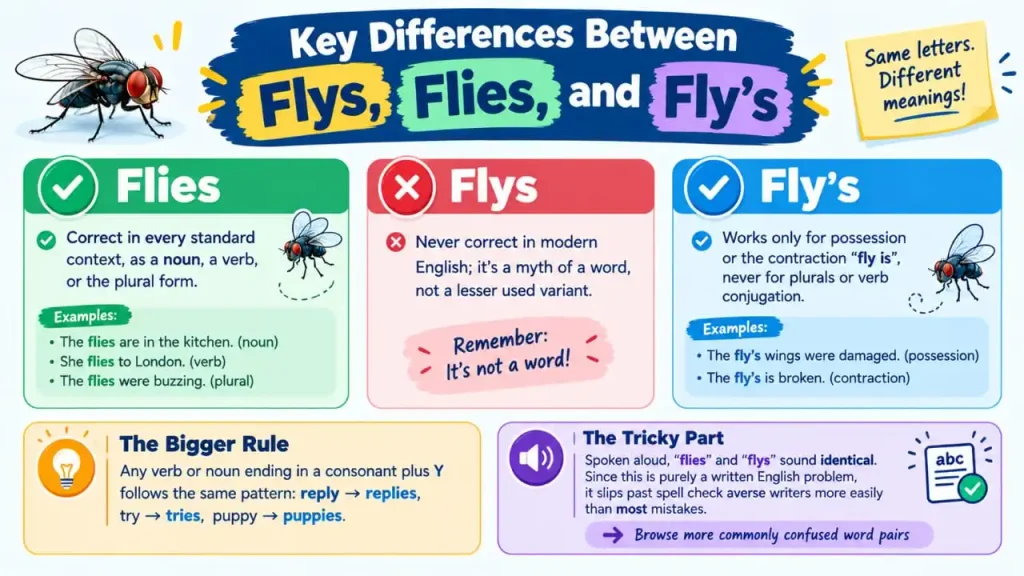
- Flies is correct in every standard context, as a noun, a verb, or the plural form.
- Flys is never correct in modern English; it’s a myth of a word, not a lesser used variant.
- Fly’s works only for possession or the contraction “fly is”, never for plurals or verb conjugation.
- The underlying rule extends far beyond this one word: any verb or noun ending in a consonant plus Y follows the same pattern (reply becomes replies, try becomes tries, puppy becomes puppies).
- Spoken aloud, “flies” and “flys” sound identical. Since this is purely a written English problem, it slips past spell check averse writers more easily than most mistakes. [LINK: Browse more commonly confused word pairs] if this is the kind of slip you catch yourself making often.
Memory Trick to Never Confuse Flys vs Flies Again
One rule here extends well beyond this single word: when a word ends in a consonant plus Y, kick out the Y and call in I E S.
Picture it visually: F L Y loses its Y, and I E S steps in to take over: FLIES. The same swap happens with reply, apply, and spy the moment you conjugate them for he, she, or it, or pluralize the related noun. Try it with a few more: city becomes cities, story becomes stories, family becomes families. The pattern holds every single time a consonant sits right before the Y.
If you want a second, sillier anchor: notice that “flies” has the word “lie” hidden right in the middle of it, a nice reminder not to lie to yourself about which spelling is correct.
Common Mistakes with Flys vs Flies
| Incorrect | Correct |
| “There were flys on the food.” | “There were flies on the food.” |
| “My new drone flys really well in the wind.” | “My new drone flies really well in the wind.” |
| “Zip up your flys before the meeting.” | “Zip up your flies before the meeting.” |
| “The flys are all over the picnic table.” | “The flies are all over the picnic table.” |
| “I do dumbbell flys at the gym.” | “I do dumbbell flyes (or flies) at the gym.” |
One quick fitness note, since it comes up more than you’d think: in weightlifting circles, “flyes” is a widely accepted alternate spelling for the chest exercise, used partly to visually separate it from the insect. Both “flyes” and “flies” appear in gym contexts and reputable fitness writing.
“Flys” is still wrong either way, so it’s worth remembering even inside a niche where spelling conventions bend slightly.
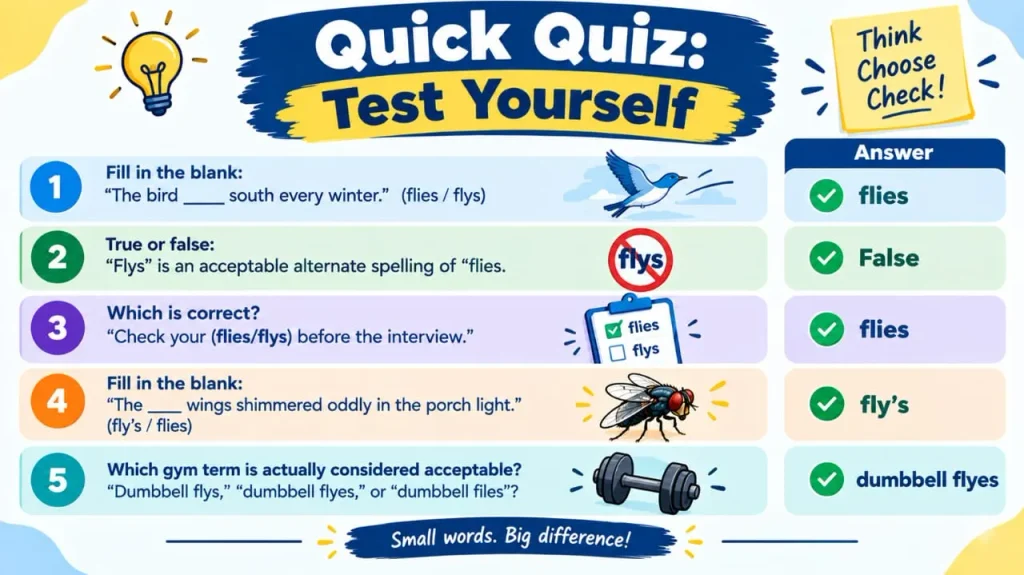
Quick Quiz: Test Yourself
- Fill in the blank: “The bird ___ south every winter.” (flies / flys)
- True or false: “Flys” is an acceptable alternate spelling of “flies.”
- Which is correct? “Check your (flies/flys) before the interview.”
- Fill in the blank: “The ___ wings shimmered oddly in the porch light.” (fly’s / flies)
- Which gym term is actually considered acceptable? “Dumbbell flys,” “dumbbell flyes,” or “dumbbell files”?
(Answers: 1. flies, 2. false, 3. flies, 4. fly’s, 5. dumbbell flyes)
Frequently Asked Questions
Is “flys” ever correct?
No. In the flys vs flies comparison, “flys” never wins: it has no standard use in modern English. It technically referred to a type of horse drawn carriage in 19th century England, but that usage is long obsolete.
What is the plural of “fly”?
The plural of “fly,” meaning the winged insect, is “flies”, never “flys.”
Is it “flys” or “flies” on pants?
It’s “flies.” It’s correctly called “your flies,” a phrasing that surprises a lot of people the first time they encounter it.
Why do people write “fly’s” instead of “flies”?
People often reach for the apostrophe out of habit, assuming it signals a plural. In reality, “fly’s” should only appear for possession (“the fly’s wings”) or as a contraction (“the fly’s in the room,” meaning “the fly is in the room”).
Is it “dumbbell flys” or “dumbbell flyes”?
“Flyes” is the commonly accepted spelling for the exercise within fitness writing, and “flies” also appears. “Flys” is incorrect in this context too; the flys vs flies rule doesn’t bend for gym terminology.
What’s the general rule for words ending in Y?
When a word ends in a consonant followed by Y, drop the Y and add ” ies” to form the plural noun or the third person verb form: fly becomes flies, reply becomes replies, and puppy becomes puppies.
Does British English spell it differently than American English?
No. Unlike some spelling pairs that split along US/UK lines (color vs colour, organize vs organise), “flies” is the standard spelling on both sides of the Atlantic. There’s no regional variant where “flys” becomes acceptable.
Final Thought
Getting flys vs flies right comes down to one small, permanent rule: drop the Y, add “ies,” and it applies whether you’re writing a client email, a lab report, or a caption for a photo of your dog chasing something in the yard.
“Flies” is the only correct spelling, no matter which of its three jobs it’s doing, and “flys” is never correct outside of a Victorian carriage reference nobody will ever ask you to write. Once the consonant plus Y pattern clicks, you’ll spot the correct spelling automatically, and that one habit will carry over to reply, try, spy, and every other word built the same way, with no more hovering over the send button wondering if you got it right.
To read more: Filed vs Filled: What’s the Shocking Difference? 2026

Marcus is a former product manager turned comparison writer who spent eight years testing tools and gadgets before quitting to write full-time. He specializes in breaking down tech and software matchups into plain-English verdicts, with a soft spot for buying guides nobody else wants to write.