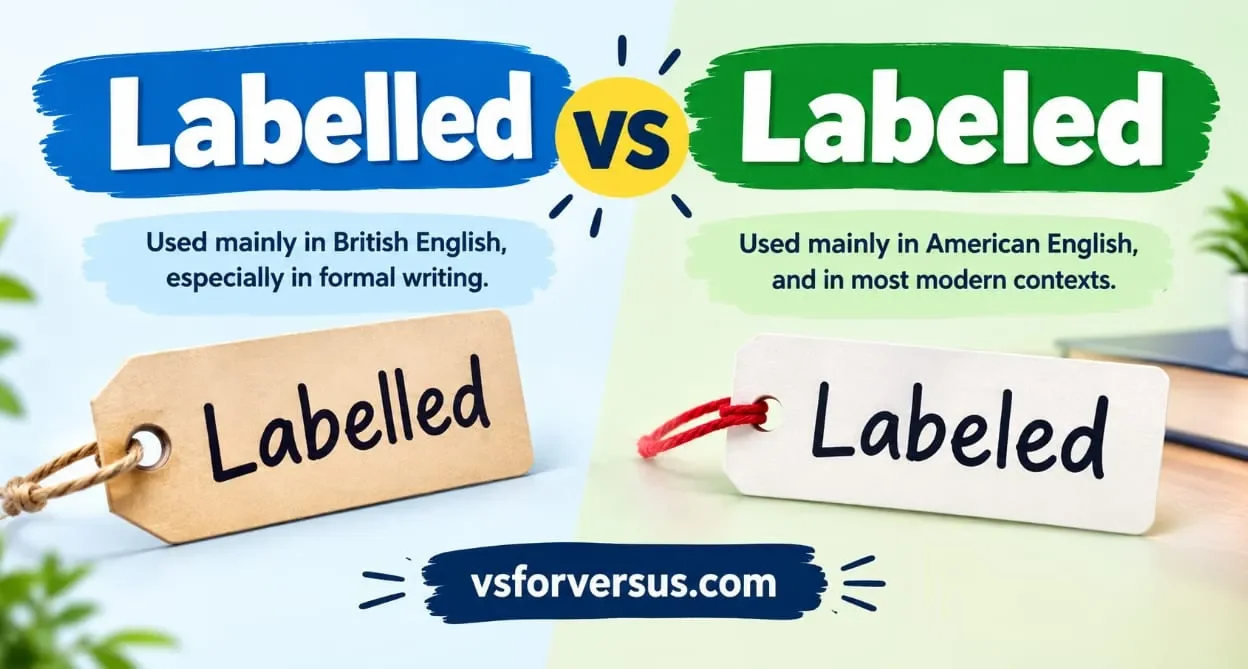
Labelled vs Labeled this word pair proves that even a single extra letter can spark years of confusion among writers worldwide. Unlike many mix ups where one spelling is simply wrong, both “labelled” vs “labeled” are entirely correct; the real difference lies in geography, not grammar.
American English keeps things streamlined with a single “L,” giving us “labeled,” while British and Australian English double the consonant, producing “labelled.” This pattern isn’t random; it follows a specific spelling convention tied to how English handles words ending in “L.”
The real challenge isn’t picking the “right” one, but staying consistent once you’ve chosen. In this article, we’ll explore the origin of this split, break down regional preferences, and share practical tips to keep your writing polished and uniform.
Quick Answer
Labelled vs labeled is a spelling difference, not a difference in meaning; both are correct past tense forms of the verb “label.” American English uses “labeled” (one L), while British and Australian English use “labelled” (two Ls). The safest rule of thumb: pick the spelling that matches your reader’s region, and keep it consistent throughout the entire document.
Labelled vs Labeled at a Glance
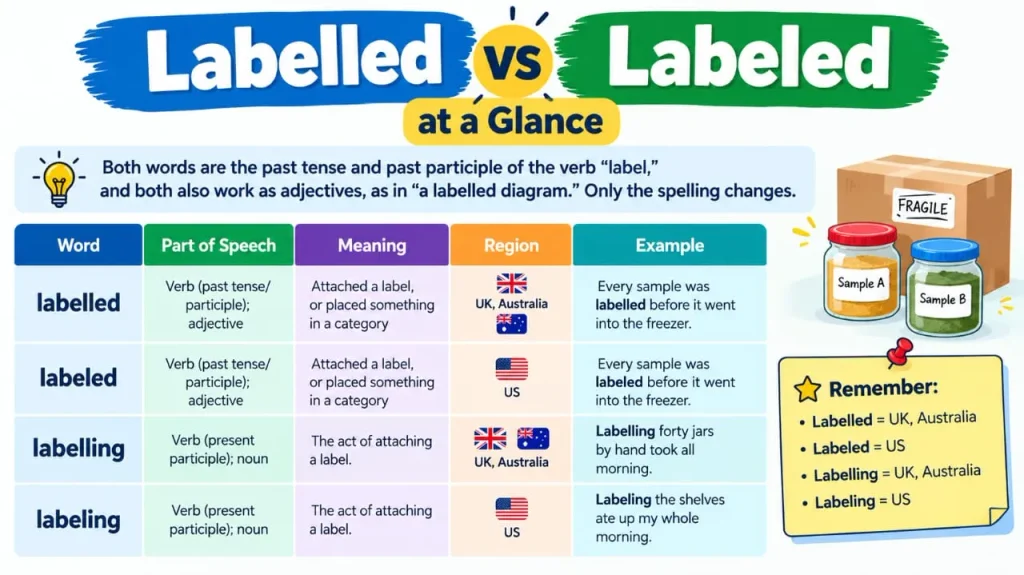
Both words are the past tense and past participle of the verb “label,” and both also work as adjectives, as in “a labelled diagram.” Only the spelling changes.
| Word | Part of Speech | Meaning | Region | Example |
| labelled | Verb (past tense/participle); adjective | Attached a label, or placed something in a category | UK, Australia | Every sample was labelled before it went into the freezer. |
| labeled | Verb (past tense/participle); adjective | Attached a label, or placed something in a category | US | Every sample was labeled before it went into the freezer. |
| labelling | Verb (present participle); noun | The act of attaching a label | UK, Australia | Labelling forty jars by hand took all morning. |
| labeling | Verb (present participle); noun | The act of attaching a label | US | Labeling the shelves ate up my whole morning. |
Labelled: British and Australian English
“Labelled” is the standard spelling across British and Australian English, and much of Commonwealth writing follows the same pattern. It carries two main senses: physically attaching a label to something, and placing a person or thing into a category, often unfairly.
- “Please make sure every box is labelled before the courier arrives at four.”
- “After one bad season, the tabloids labelled him a flop.”
- “Our lab manager labelled the freezer shelves by colour, and nobody has lost a sample since.”
- “Could you check that the diagram in Figure 3 is clearly labelled? The examiner will look for that.”
You’ll spot it in school science diagrams, food and product packaging, newspaper headlines, and academic writing at British and Australian universities.
Labeled: American English
“Labeled” is the American spelling, carrying the same meanings and uses. It’s the default across US newspapers, textbooks, workplace documents, and software.
- “I labeled every moving box by room, and the movers still needed three tries to find the kitchen.”
- “The vendor’s invoice labeled the charge ‘miscellaneous,’ which told us nothing.”
- “Our team trained the model on a labeled dataset of ten thousand support tickets.”
- “Was that jar labeled? I think I just put cinnamon in the chilli.”
It appears throughout US academic papers, business emails, product packaging, user interface text, and especially in machine learning, where “labeled data” is the standard term. British
Which Spelling Should You Use: Labelled vs Labeled?
The decision depends on your reader, not on a grammar rule. Three questions settle it almost every time:
- Who is reading? American readers expect “labeled.” British and Australian readers expect “labelled.”
- Is there a style guide? If your university, publisher, or employer has a house style, it overrides everything else.
- What is your software set to? Spellcheck language settings quietly rewrite your spelling, so check them before you start typing.
| Region | Standard Spelling | Note |
| United States | labeled | Standard in US writing; some dictionaries list the double L form as a variant |
| United Kingdom | labelled | Standard in British writing |
| Australia | labelled | Follows the British convention |
| Canada | Both in use | Usage is mixed, follow your publisher’s or institution’s style guide |
This isn’t as tidy as colour vs colour. Some American writers reach for the double L by instinct, and US dictionaries acknowledge it as a variant. The single L form remains the American standard, but real world usage is messier than a simple chart suggests. Consistency matters more than nationality.
Key Differences Between Labelled vs Labeled
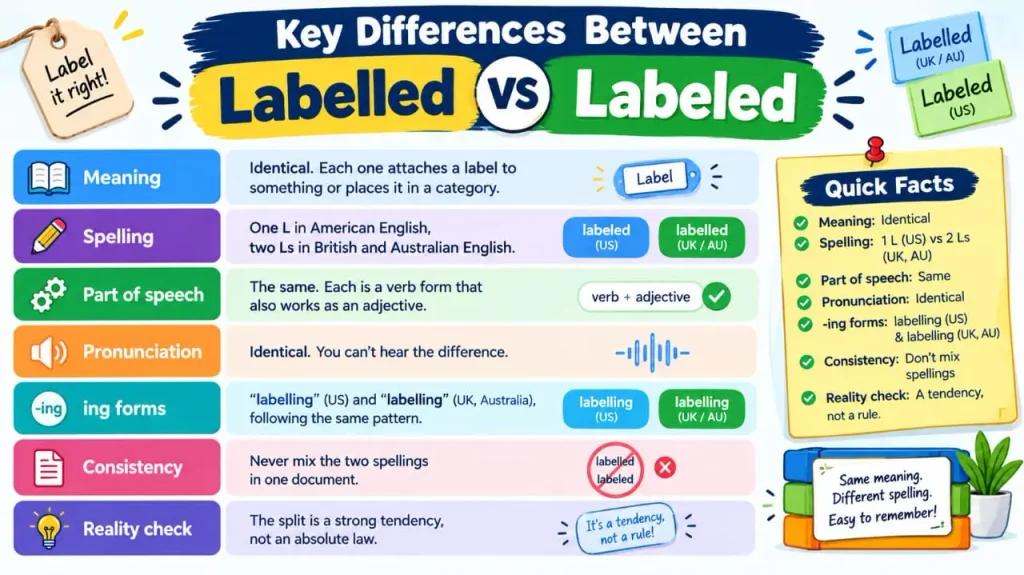
- Meaning: Identical. Each one attaches a label to something or places it in a category.
- Spelling: One L in American English, two Ls in British and Australian English.
- Part of speech: The same. Each is a verb form that also works as an adjective.
- Pronunciation: Identical. You can’t hear the difference.
- ing forms: “labelling” (US) and “labelling” (UK, Australia), following the same pattern.
- Consistency: Never mix the two spellings in one document.
- Reality check: The split is a strong tendency, not an absolute law.
Why Does British English Double the L?
Most guides skip the reasoning, but it comes down to a spelling habit called consonant doubling: when a verb ends in a single vowel plus a single consonant, and the stress falls on the last syllable, the final consonant doubles before ed or ing. “Prefer” becomes “preferred,” and “forget” becomes “forgetting.” When the stress falls earlier, as in “happen” or “target,” the consonant stays single: “happened,” “targeted.”
“Label” stresses its first syllable, so the general rule predicts a single L, giving “labeled.” American English follows that prediction exactly. British English, however, makes a specific exception for a final L, doubling it regardless of stress, which produces “labelled,” “travelled,” and “levelled.” This exception is best understood as an established convention, not a logical rule.
The Same Pattern in Other Words
British English applies this exception to many verbs ending in L, so learning one pair helps you with the rest. Prefixed forms follow their base word too: “mislabelled” and “unlabelled” in British English, “mislabeled” and “unlabeled” in American English.
Labelled vs Labeled in Real Writing
| Context | British or Australian | American |
| Academic essay | “The figures in Chapter 3 need to be clearly labelled, or the external examiner will send them back.” | “Make sure every axis on the chart is labeled, or the reviewers will ask for a revision.” |
| Business email | “Hi Priya, the invoice was labelled ‘consulting’, but the amount looks like it covers the whole project. Can you confirm?” | “Hi Dana, the shipment was labeled ‘fragile,’ but the box arrived crushed. Can you file a claim?” |
| Packaging | “Our supplier mislabelled the batch, so we’re holding the whole pallet.” | “The pharmacy mislabeled my prescription, so I’m double checking every bottle now.” |
| Data and machine learning | “We hired annotators to produce labelled data for the classifier.” | “The model performs well on labeled data but falls apart on anything new.” |
| Social media and UI | “Shelf tidying day: every jar labelled, every tin in a row. Deeply satisfying.” | “Meal prep Sunday: everything labeled and stacked. Future me says thanks.” |
A Simple Memory Trick
British spellings often run longer: “colour,” “programme,” “labelled,” “travelled.” American spellings trim the extra letters. So the trick is simple: the UK keeps the extra letter. It’s not a perfect law, but it works for this pair and the whole elled family. If you’re still unsure which audience you’re writing for, go back to the three questions above.
Common Mistakes (Wrong vs Correct)
A labelled vs labeled mix up rarely gets flagged by a spellchecker, since each spelling is valid on its own, but readers catch it anyway, even when they can’t say exactly what feels off.
| Wrong | Correct | Why |
| The jars are labelled, and the boxes are labeled. | The jars are labelled, and the boxes are labelled. | Two spelling styles in one document |
| Please check the lable on the package. | Please check the label on the package. | Common typo: the last two letters swap |
| Labeling took an hour, and once we’d labelled everything, we left. | Labelling took an hour, and once we’d labelled everything, we left. | The ing and ed forms must match |
Even experienced writers slip here. A veteran copy editor can change every “colour” to “colour” and every “organize” to “organize” across a manuscript and still miss a “labeled” in a caption pasted from a US source. Software won’t always rescue you either, if your document is set to the wrong language, the spellchecker will confidently “correct” the right spelling.
In Word, set the proofing language under the Review tab; in Google Docs, use File > Language. Set it before you start typing, and check again after pasting from another source.
One myth to retire: a double L is not a typo. In a British or Australian document, it’s correct; “fixing” it to a single L is the real error.
Test Yourself: Mini Quiz
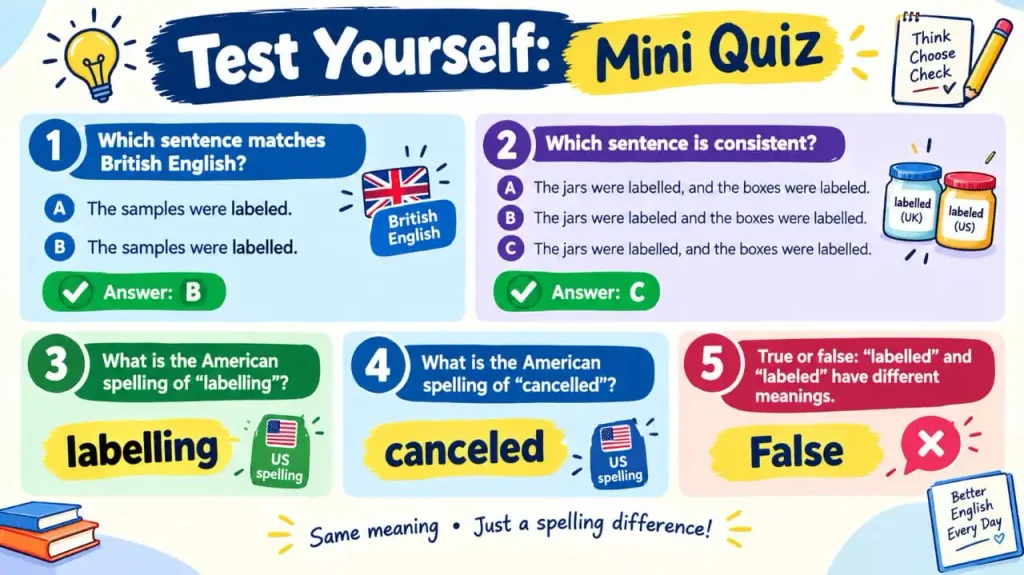
- Which sentence matches British English? A) The samples were labeled. B) The samples were labelled. Answer: B
- Which sentence is consistent? A) The jars were labelled, and the boxes were labeled. B) The jars were labeled and the boxes were labelled. C) The jars were labelled, and the boxes were labelled. Answer: C
- What is the American spelling of “labelling”? Answer: labelling
- What is the American spelling of “cancelled”? Answer: canceled
- True or false: “labelled” and “labeled” have different meanings. Answer: False
Frequently Asked Questions
Is it labelled or labeled?
Both spellings are correct. The choice depends on your audience: use “labeled” for American readers and “labelled” for British and Australian readers.
Is labelled correct in American English?
“Labelled” is the British form. American writing normally uses “labeled,” though some US dictionaries list the double L spelling as a variant.
Do Canadians use labelled or labeled?
Canadian writing uses both. Usage is mixed, so follow the style guide of your publisher, school, or employer.
Is it labeling or labelling?
The same split applies. “Labeling” (one L) is American; “labelling” (two Ls) is British and Australian.
What is the past tense of label?
“Labeled” in American English, “labelled” in British and Australian English. Each also serves as the past participle.
Can I use both spellings in the same document?
No. Choose one spelling and use it consistently from start to finish; a mixed document looks careless.
Conclusion
The verdict on labelled vs labeled: either is right, and the only real question is who’s reading. Use “labeled” for American audiences and “labelled” for British and Australian ones, and check your style guide and software language before you write a word. Then keep it consistent; that’s the part readers actually notice.
To read more: Lable vs Label: The Ultimate Guide to Which Spelling Is Correct? 2026

Marcus is a former product manager turned comparison writer who spent eight years testing tools and gadgets before quitting to write full-time. He specializes in breaking down tech and software matchups into plain-English verdicts, with a soft spot for buying guides nobody else wants to write.