

Pickup vs Pick Up this pair often confuses writers because the words look almost identical, yet the tiny difference between one word and two carries real grammatical weight. Pickup (written as a single word) functions as a noun or an adjective, referring to things like a pickup truck, a pickup in sales, or the act of collecting something, as in “the pickup is scheduled for noon.”
Pick up, written as two separate words, functions as a verb phrase, describing the action of lifting, collecting, or retrieving something, such as “please pick up your keys before leaving.” Mixing these forms up is one of the most common spacing errors in English writing, especially in business and casual communication.
In this article, we’ll explain when to use each form, show clear examples, and help you avoid this everyday mistake.
Quick Answer
Pickup (one word) is a noun or adjective, a truck, an increase in activity, or a collection point, as in “She drives a pickup” or “Your order is ready for pickup.” Pick up (two words) is a verb, the action of collecting, lifting, or retrieving something, as in “Can you pick up the kids after school?” A fast test: if a word fits between pick and up, like “pick them up,” you need the two word verb form.
Pickup vs Pick Up at a Glance
Before diving into the details, here’s the full breakdown in one place. This table captures every form you’re likely to encounter, including the fading hyphenated variant.
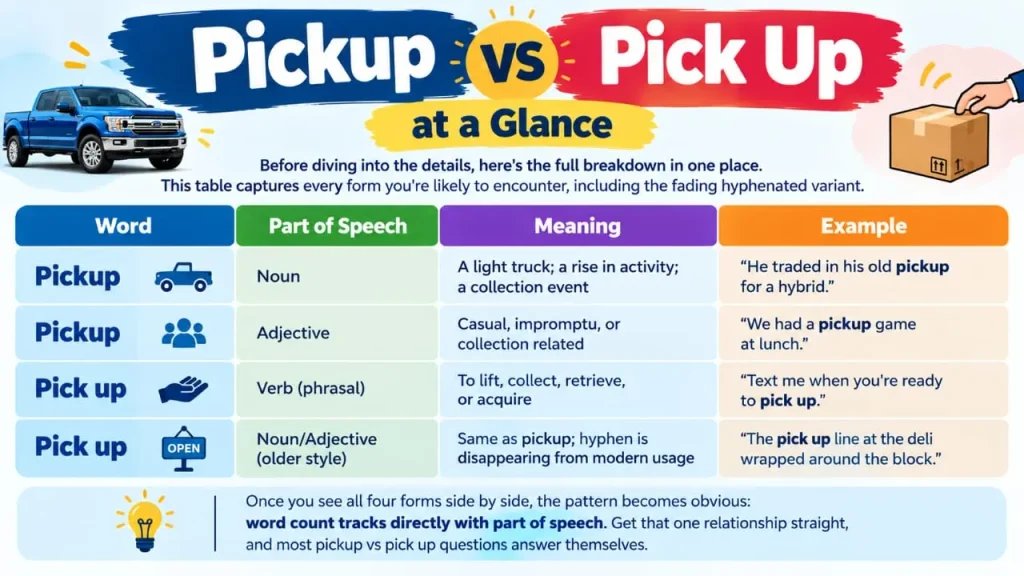
| Word | Part of Speech | Meaning | Example |
| Pickup | Noun | A light truck; a rise in activity; a collection event | “He traded in his old pickup for a hybrid.” |
| Pickup | Adjective | Casual, impromptu, or collection related | “We had a pickup game at lunch.” |
| Pick up | Verb (phrasal) | To lift, collect, retrieve, or acquire | “Text me when you’re ready to pick up.” |
| Pick up | Noun/Adjective (older style) | Same as pickup; hyphen is disappearing from modern usage | “The pick up line at the deli wrapped around the block.” |
Once you see all four forms side by side, the pattern becomes obvious: word count tracks directly with part of speech. Get that one relationship straight, and most pickup vs pick up questions answer themselves.
What Does “Pickup” Mean?
As a single, closed compound, pickup functions only as a noun or an adjective. It never carries the weight of an action, which is the core distinction underlying every pickup vs pick up decision you’ll ever face.
Most often, it names a vehicle: “Joe bought a new pickup last week, and it already needs an oil change.” It can also describe a general increase or improvement, especially in business writing: “There’s been a noticeable pickup in customer engagement since the redesign launched.” And it names the moment of collection itself: “Your prescription is ready for pickup at the west counter.”
The adjective form works the same way, just modifying a different noun. “A few of us threw together a pickup basketball game after the meeting ran long.” Retail and delivery apps lean on this heavily: “Select pickup instead of delivery to skip the $4 fee,” or “Our pickup location moved to the loading dock behind the building.”
Two lesser known senses round out the noun form. Musicians use pickup to describe the device on a guitar or record player that converts string or needle vibration into an electrical signal: “He swapped the bridge pickup on his Stratocaster before the show.”
And in older, more literary usage, pickup can describe a casual acquaintance made on the spot: “The novel’s narrator meets a pickup at the train station who changes the course of the whole story.” Both senses are still nouns, which keeps the underlying rule intact even as the meaning shifts.
You’ll see pickup constantly in business emails, e commerce checkouts, curbside signage, and casual conversation about impromptu plans anywhere a thing or a description is needed, not an action.
What Does “Pick Up” Mean?
Splitting into two words changes everything. Pick up is a phrasal verb: two parts working together to describe an action that neither word captures alone. This is where most pickup vs pick up mistakes actually happen, since the verb form shows up constantly in fast, casual writing.
Its most literal sense is lifting or retrieving: “Please pick up your room before your grandparents arrive.” In errands and scheduling, it means to go and get something: “Can you pick up milk and eggs on your way home tonight?” The verb also allows a pronoun or specific object to slot right between the two parts, a detail few guides explain clearly:
“I’ll pick them up at noon,” or “Don’t forget to pick it up before the store closes.” Figuratively, it extends to speed or intensity, as in “The car picked up speed as soon as we hit the highway.”
The verb also changes shape with tense, something the noun never does. In the past tense, it becomes picked up: “We picked up the rental car at nine and hit the road by ten.” In the present participle, it becomes picking up: “I’m picking up the dry cleaning on my lunch break.” No matter how the sentence is timed, pickup itself stays frozen in its single word form, because only actions conjugate, not things.
You’ll spot pick up everywhere in texting, workplace scheduling threads, delivery instructions, and casual social posts any sentence describing someone actively doing something, rather than naming a thing.
Key Differences Between Pickup vs Pick Up
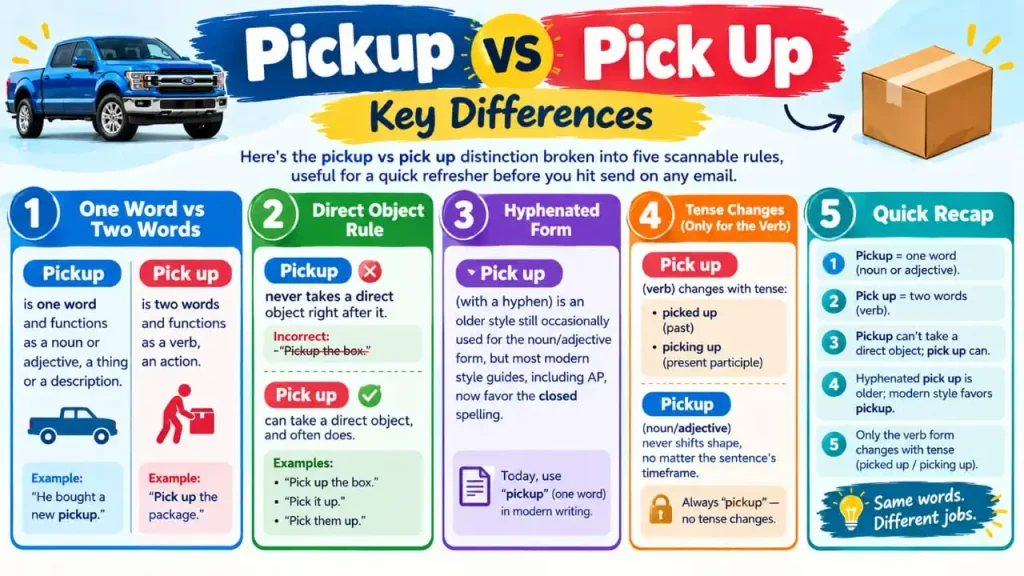
Here’s the pickup vs pick up distinction broken into five scannable rules, useful for a quick refresher before you hit send on any email.
- Pickup is one word and functions as a noun or adjective, a thing or a description.
- Pick up is two words and functions as a verb, an action.
- Pickup never takes a direct object right after it; pick up can, and often does (“pick up the box,” “pick it up,” “pick them up”).
- The hyphenated pick up is an older style still occasionally used for the noun/adjective form, but most modern style guides, including AP, now favor the closed spelling.
- Only the verb form changes with tense: picked up (past), picking up (present participle). Pickup itself never shifts shape, no matter the sentence’s timeframe.
How to Remember Pickup vs Pick Up (Memory Trick)
Try inserting a word between “pick” and “up.” If a word fits naturally, “pick it up,” “pick them up,” “pick the kids up”, you’re dealing with the two word verb. If nothing fits, and the word is standing in for a thing or a description, use the single word: pickup.
There’s a second way to anchor it, too. The noun is one solid word because it names one solid object, a truck, a location, a single event. The verb is two words because it describes a two part motion: reaching, then lifting. If you’re ever tempted to sketch this out, a simple printable reference chart mapping all three forms, pickup, pick up, and pick up, can make the distinction stick even faster during editing passes.
Common Mistakes with Pickup vs Pick Up
Even experienced writers slip here, usually while typing quickly on a phone or rushing through a work email before a meeting. Autocorrect doesn’t always catch it, because both forms are technically real words, just the wrong part of speech for the sentence. Below are five real patterns pulled from everyday writing, each paired with the corrected version so you can compare them side by side.
| ❌ Wrong | ✅ Correct |
| “I need to pickup the kids at 3.” | “I need to pick up the kids at 3.” |
| “What time is the pick up?” | “What time is the pickup?” |
| “Can you pick up some milk?” | “Can you pick up some milk?” |
| “The truck is a nice pick up.” | “The truck is a nice pickup.” |
| “We’ll pickup the pace before the deadline.” | “We’ll pick up the pace before the deadline.” |
Notice the pattern here: the error almost always runs one direction. Writers close up the verb form into one word far more often than they split the noun apart. Closed compounds like checkup, setup, and login are so common that the eye starts expecting one word by default, even when the sentence actually calls for an action.
Quick Quiz: Test What You’ve Learned
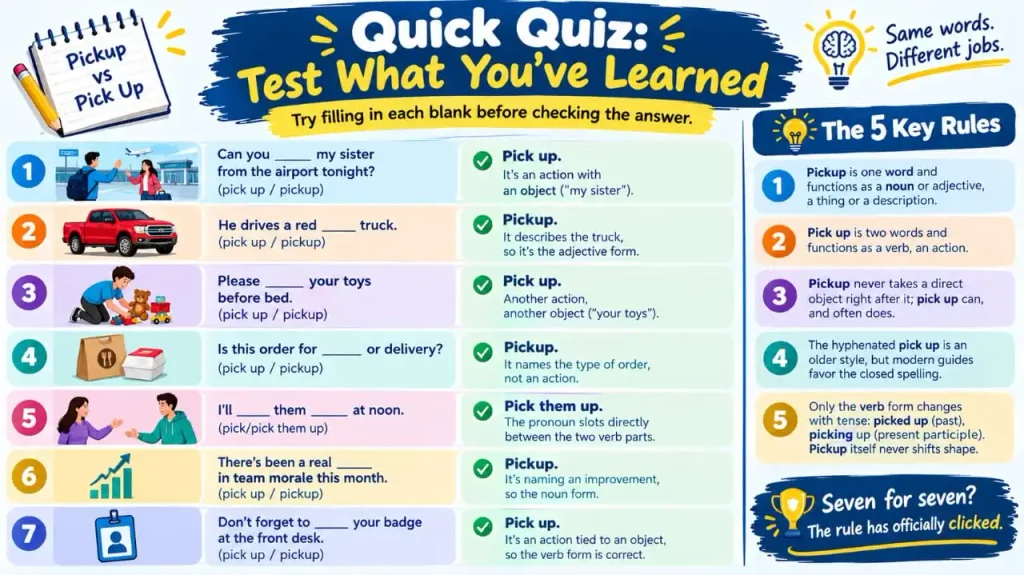
Try filling in each blank before checking the answer.
- “Can you ___ my sister from the airport tonight?” (pick up / pickup), Pick up. It’s an action with an object (“my sister”).
- “He drives a red ___ truck.” (pick up / pickup), Pickup. It describes the truck, so it’s the adjective form.
- “Please ___ your toys before bed.” (pick up / pickup), Pick up. Another action, another object (“your toys”).
- “Is this order for ___ or delivery?” (pick up / pickup), Pickup. It names the type of order, not an action.
- “I’ll ___ them ___ at noon.” (pick/pick them up), Pick them up. The pronoun slots directly between the two verb parts.
- “There’s been a real ___ in team morale this month.” (pick up / pickup), Pickup. It’s naming an improvement, so it’s the noun form.
- “Don’t forget to ___ your badge at the front desk.” (pick up / pickup), Pick up. It’s an action tied to an object, so the verb form is correct.
Seven for seven? The rule has officially clicked.
Frequently Asked Questions
Is pickup one word or two?
Pickup’s spelling depends entirely on the part of speech. As a noun or adjective, it’s one word: pickup. As a verb describing an action, it splits into two words: pick up.
Is “pick up” or “pick them up” correct?
Both are correct. Use “pick up” when the object is implied or comes later in the sentence, and “pick them up” (or “pick it up,” “pick the kids up”) when a specific object sits between the two verb parts.
Is “pick up” with a hyphen still correct?
You’ll still see it occasionally for the noun or adjective form, but it’s fading. Most current style guides, including AP style, now favor the closed spelling, pickup, over the hyphenated version.
What part of speech is “pickup”?
Pickup is a noun or an adjective, never a verb. If you’re describing an action, you need the two word form, pick up, instead.
How do I remember pickup vs. pick up?
Test whether a word fits between “pick” and “up.” If it does, as in “pick it up” or “pick them up,” you need the verb. If nothing fits and you’re naming a thing, use the single word, pickup.
Why do fluent, native English speakers still get pickup vs pick up wrong?
The error is invisible to the ear, since both forms sound identical when spoken. The mistake only shows up in writing, and it happens most often when typing quickly, since closed compounds like setup, checkup, and login have trained our eyes to default to one word even when the sentence needs the two word verb.
Final Thoughts
The whole pickup vs pick up rule comes down to one question: is the word naming a thing, or doing an action? If it’s a thing, a truck, a location, a description, keep it closed as pickup. If it’s an action, someone lifting, collecting, or retrieving something, open it up into pick up.
Run the insert a word test whenever you hesitate, and the correct choice will surface in seconds, not minutes. The same one word noun, two word verb pattern shows up across a whole family of English compounds, including setup vs. set up, checkup vs. check up, and login vs log in, so mastering this one pair gives you a shortcut for several others at once.
To read more: Mantel vs Mantle: What’s the Shocking Difference? 2026

Marcus is a former product manager turned comparison writer who spent eight years testing tools and gadgets before quitting to write full-time. He specializes in breaking down tech and software matchups into plain-English verdicts, with a soft spot for buying guides nobody else wants to write.