
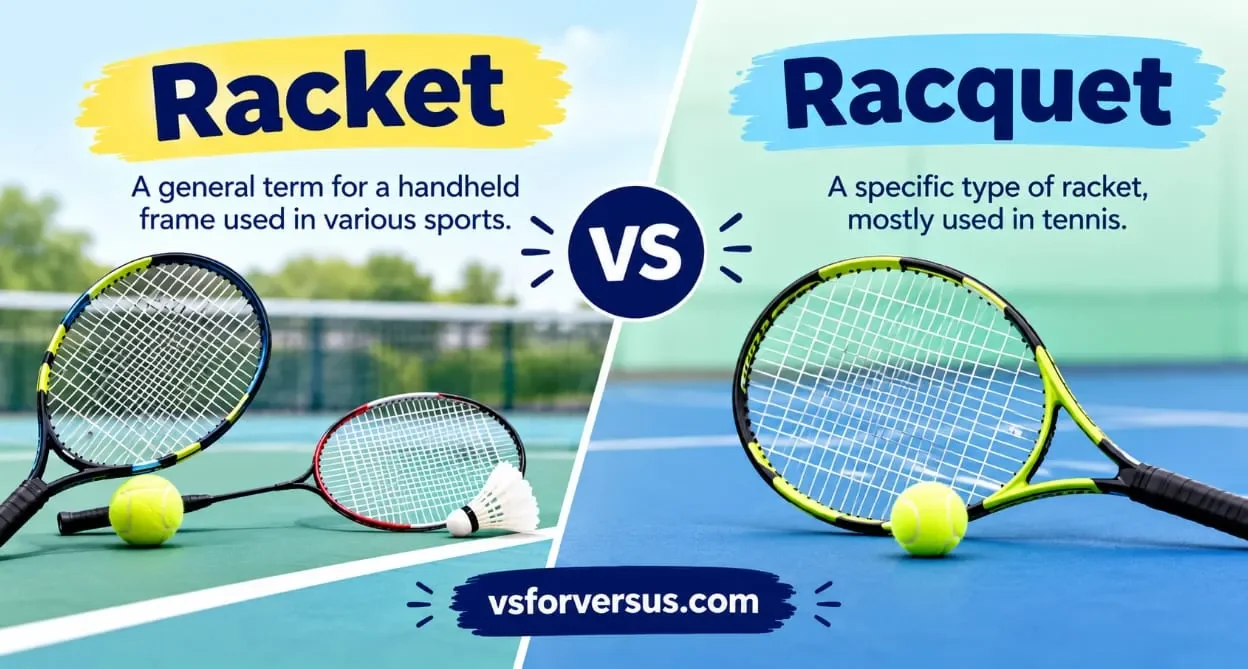
Racket vs Racquet this word pair often puzzles writers because both spellings seem to describe the same sporting equipment, yet only one carries additional meanings beyond the game.
Racquet is the more specialized spelling, almost exclusively referring to the strung, handheld equipment used in sports like tennis, badminton, and squash. Racket, on the other hand, is far more versatile; it can refer to the same piece of sports equipment, but it also means a loud, disturbing noise, or even an illegal, fraudulent scheme, such as a “criminal racket.”
This makes “racket” the more commonly used spelling overall, since it covers multiple contexts, while “racquet” is reserved specifically for sports. Understanding when to use each spelling can prevent confusion, especially in sports writing versus everyday conversation. In this article, we’ll break down the origins of both words, their correct usage across different contexts, and clear examples to help you choose confidently.
Quick Answer
Racket is the standard, all purpose spelling, correct for tennis, badminton, and squash equipment, and also for a loud noise or an illegal scheme. Racquet is an accepted variant spelling used only for sporting equipment, more common in formal club names and squash or racquetball contexts. Both words are pronounced identically. When unsure, default to “racket” in any racket vs racquet decision; it works in every context, while “racquet” works in only one.
Racket vs Racquet at a glance
Before going deeper, here’s the shape of the whole racket vs racquet question in one glance:
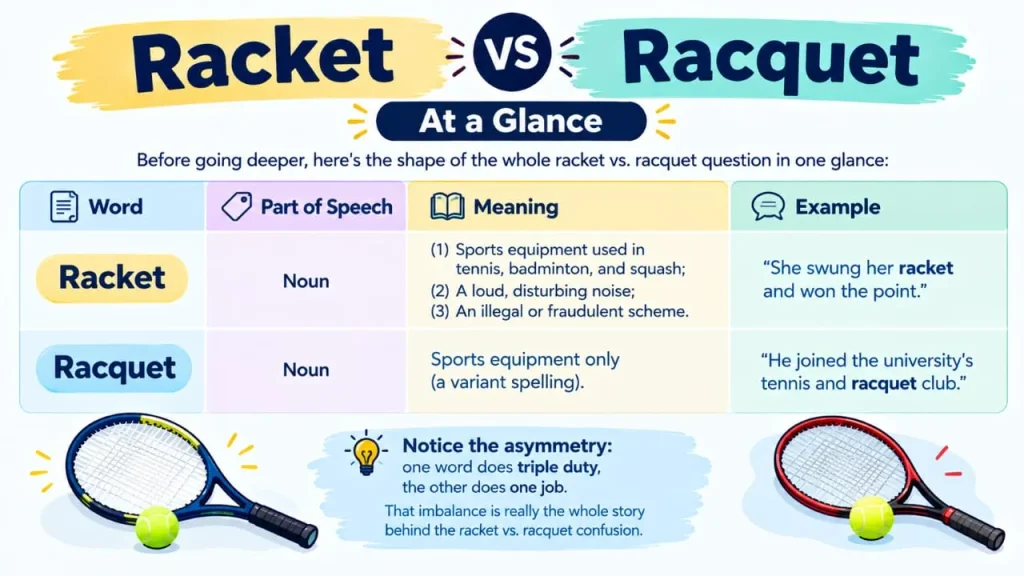
| Word | Part of Speech | Meaning | Example |
| Racket | Noun | (1) Sports equipment used in tennis, badminton, and squash; (2) A loud, disturbing noise; (3) An illegal or fraudulent scheme | “She swung her racket and won the point.” |
| Racquet | Noun | Sports equipment only (a variant spelling) | “He joined the university’s tennis and racquet club.” |
Notice the asymmetry: one word does triple duty, the other does one job. That imbalance is really the whole story behind the racket vs. racquet confusion.
What Does “Racket” Mean?
“Racket” is a noun with three distinct jobs, and native speakers move between them without even noticing.
The most familiar sense, at least for this comparison, is the piece of equipment used to hit a ball or shuttlecock: “Her tennis racket needs restringing before the tournament.”
There’s also the noise sense: “The upstairs neighbors were making a racket at 2 a.m., and I finally texted the building manager.” Several tennis players have admitted online that they instinctively feel “racket” looks wrong for sports equipment, simply because their brain files the word under “noise” first.
Then comes the scheme sense, a dishonest or illegal enterprise: “The internal audit revealed the vendor contract was basically a racket, inflated invoices nobody had questioned for years.” Legal writing and business journalism lean on this sense constantly, especially when describing fraud or price manipulation.
In a looser workplace tone, the same scheme meaning shows up too: “Honestly, the whole ‘mandatory team building retreat’ feels like a racket; someone’s just padding a budget line.” A law student summarizing a fraud case for a seminar paper might write something similarly direct:
“The court described the scheme as an organized racket built on falsified invoices.” That’s the word doing exactly what it does best: flexible, informal or formal depending on need, and unmistakably correct either way.
What Does “Racquet” Mean?
“Racquet” is narrower. It has exactly one job: naming the same piece of sporting equipment, nothing else. There’s no noise sense, no scheme sense, just the object in your hand.
Formal or traditional contexts favor it: “They’re longtime members of the Riverside Swim and Racquet Club.” Club names lean toward this spelling more than everyday speech does, likely because it looks a touch more polished on a brass plaque.
Squash and racquetball terminology relies on it heavily, too: “Squash racquets require tighter string tension than tennis rackets, so don’t swap them.” A pickleball player switching over from tennis might write: “My old racquet grip felt too thick for pickleball paddles,” showing how the spelling habit can carry across related racquet sports even when the equipment itself changes shape entirely.
Institutional paperwork is another common home for it: “Please list your racquet under the equipment section of the registration form.” Casual sports chatter uses it just as naturally: “I finally restrung my racquet before the club tournament; it feels like a completely different weapon now.”
Even experienced sports writers slip here. Equipment brands themselves don’t agree: Wilson uses “racket” across its product lines, while Head consistently uses “racquet” for the identical type of object. If professional copywriters at multimillion dollar sporting goods companies can’t reach consensus, nobody should feel embarrassed about hesitating.
Do “Racket” and “Racquet” Sound the Same?
Yes, completely. Both are pronounced /ˈrækɪt/, with identical stress and vowel sounds. Some writers call this pair a set of homophones, but that’s not quite precise: true homophones are separate words that happen to sound alike (like “know” and “no”).
Racket and racquet are more accurately variant spellings of the same word, same meaning, same pronunciation, different letters. Either way, the confusion is purely written, not spoken. Nobody has ever misheard someone say “racket” instead of “racquet” in conversation; the ambiguity lives entirely on the page.
Key Differences Between Racket vs Racquet
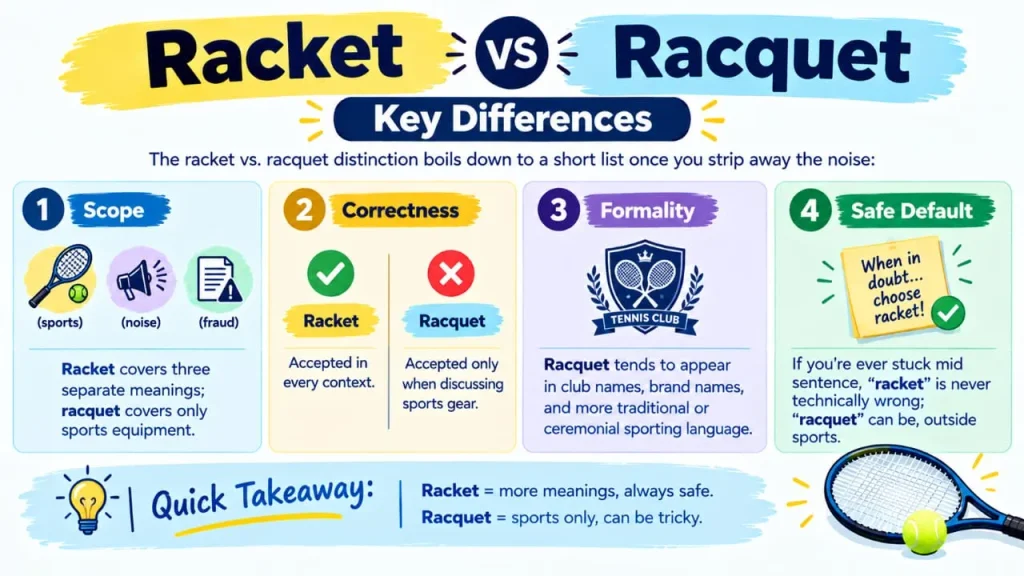
The racket vs. racquet distinction boils down to a short list once you strip away the noise:
- Scope: Racket covers three separate meanings; racquet covers only sports equipment.
- Correctness: Racket is accepted in every context; racquet is accepted only when discussing sports gear.
- Formality: Racquet tends to appear in club names, brand names, and more traditional or ceremonial sporting language.
- Safe default: If you’re ever stuck mid sentence, “racket” is never technically wrong; “racquet” can be, outside sports.
Regional Preference: US vs UK vs Australia
Dictionaries and style guides don’t always agree, so here’s how the spelling actually leans across major English speaking regions:
| Region | Preferred Spelling | Notes |
| United States | Racket | Dominant in general writing; Merriam Webster lists “racket” as the primary form. |
| United Kingdom | Racket (increasingly) | “Racquet” was once more common in club and brand names, but “racket” now leads in everyday and sports journalism usage. |
| Australia | Racket | Follows the broader global trend toward “racket,” even in tennis and squash reporting. |
The takeaway: this was never a strict American versus British split. “Racket” has simply become the majority spelling almost everywhere, with “racquet” surviving mainly in names and niche sporting contexts rather than by region.
Which Spelling Do Brands and Governing Bodies Use?
Part of the confusion is simple: no single authority has settled it. In a racket vs. racquet debate among manufacturers, here’s how a few recognizable names actually spell it:
| Brand / Organization | Spelling Used |
| Wilson | Racket |
| Head | Racquet |
| USA Racquetball | Racquet |
| World Squash Federation (official rules) | Racket |
| Professional Squash Association | Mixed usage |
If manufacturers and governing bodies can’t agree, there’s genuinely no universal “wrong answer” once you’re specifically talking about sports equipment.
A Memory Trick to Remember the Difference
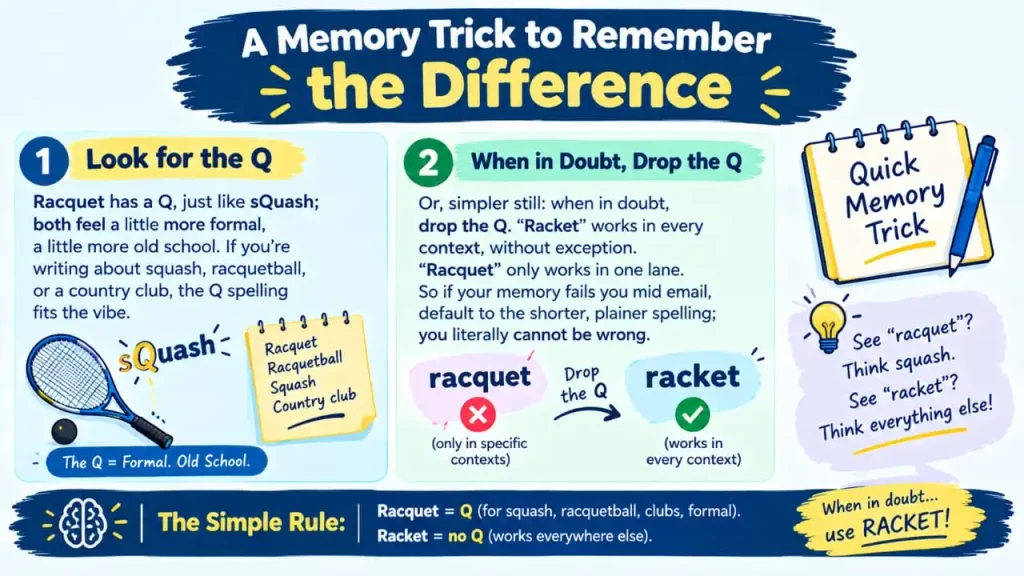
If you need something quicker than a dictionary, try this: racquet has a Q, just like sQuash; both feel a little more formal, a little more old school. If you’re writing about squash, racquetball, or a country club, the Q spelling fits the vibe.
Or, simpler still: when in doubt, drop the Q. “Racket” works in every context, without exception. “Racquet” only works in one lane. So if your memory fails you mid email, default to the shorter, plainer spelling; you literally cannot be wrong.
Racket vs Rocket: Don’t Mix These Up Either
While untangling this spelling confusion, it’s worth a quick note on a completely different but visually similar word: “rocket.” A rocket is a projectile or spacecraft, nothing to do with sports equipment at all.
It’s an easy typo (one online commenter accidentally wrote “rocket” mid discussion about tennis gear), not a meaning overlap, but worth a second glance before you hit send on that email about your new tennis racket.
Common Mistakes with Racket vs Racquet
A few patterns show up again and again in real writing:
| ❌ Inconsistent or Incorrect | ✅ Better Choice |
| “I bought a new racket for badminton, but my racquet bag is too small.” | Pick one spelling and stay consistent within the same document. |
| “The company ran a racquet targeting elderly customers.” | “The company ran a racket…”, racquet has no scheme or fraud meaning. |
| Using “racquet” to describe noise: “Stop making such a racquet!” | Always use “racket” for noise, racquet cannot fill this role. |
| Switching spelling mid essay or mid email without noticing | Decide early which spelling fits your context, then keep it uniform throughout. |
A resume, academic paper, or client email that flips between spellings reads as careless, even if both words are individually correct.
Quick Quiz: Racket or Racquet?
Test yourself before moving to the FAQ: a fast, practical gut check on the racket vs. racquet distinction.
- “She joined the tennis and ______ club downtown.”, racquet (club name convention)
- “The upstairs apartment made such a ______ last night.”, racket (noise; racquet is never correct here)
- “His ______ needs new strings before the match.”, either (both are accepted for sports equipment)
- “The pyramid scheme was exposed as a massive ______.”, racket (fraud sense; racquet has no equivalent)
- “Squash players often call their equipment a ______.”, either (both spellings appear in squash contexts)
If you got four or five right, you’ve already internalized the core rule better than most professional copywriters.
Frequently Asked Questions
Is it spelled racket or racquet?
Both spellings exist and are recognized by major dictionaries, but “racket” is the more common and versatile choice, correct in every context, including sports.
What is the difference between racket and racquet?
Racket has three meanings: sports equipment, loud noise, and illegal scheme, while racquet refers only to sports equipment, making it a narrower variant spelling.
Is racquet British or American spelling?
Neither, strictly speaking. Racquet appears in both American and British English, though “racket” has become the dominant spelling across most English speaking countries, including the UK.
Do racket and racquet mean the same thing?
In a sports context, yes, they’re interchangeable. Outside of sports, only “racket” applies, since racquet has no noise or fraud related meaning.
Why are there two spellings of racket?
“Racket” is the older English spelling, while “racquet” gained ground later, echoing the word’s French root, “raquette.” Merriam Webster lists “racket” as the standard spelling and “racquet” as a recognized variant.
Can you use racket for tennis?
Yes, “racket” is fully correct for tennis equipment and is, in fact, the more commonly used spelling among major brands, governing bodies, and everyday writers alike.
Related Word Confusions
The racket vs racquet pair isn’t the only spelling variant that trips up careful writers. If regional and historical spelling differences interest you, take a look at our guides to other commonly confused word pairs, including spelling variants shaped by the same American versus British split. For a broader refresher on nouns and how part of speech identification works, our grammar basics hub is a useful next stop.
Final Thoughts
At the end of the day, the racket vs racquet question isn’t really about right and wrong; it’s about consistency and context. Use “racket” when you want a spelling that works everywhere, without exception.
Reach for “racquet” only when you’re deliberately leaning into a formal, traditional, or club style tone. Whichever you choose, the golden rule stays the same: pick one spelling and stick with it throughout your writing, so your reader focuses on your ideas, not your spelling.
To read more: Proscribed vs Prescribed: 5 Shocking Differences You Need to Know

Marcus is a former product manager turned comparison writer who spent eight years testing tools and gadgets before quitting to write full-time. He specializes in breaking down tech and software matchups into plain-English verdicts, with a soft spot for buying guides nobody else wants to write.