Proscribed vs Prescribed few word pairs show the power of a single letter like this, where swapping one vowel can flip a sentence’s meaning. These words look like near twins on the page, but their meanings sit at opposite ends of the spectrum.
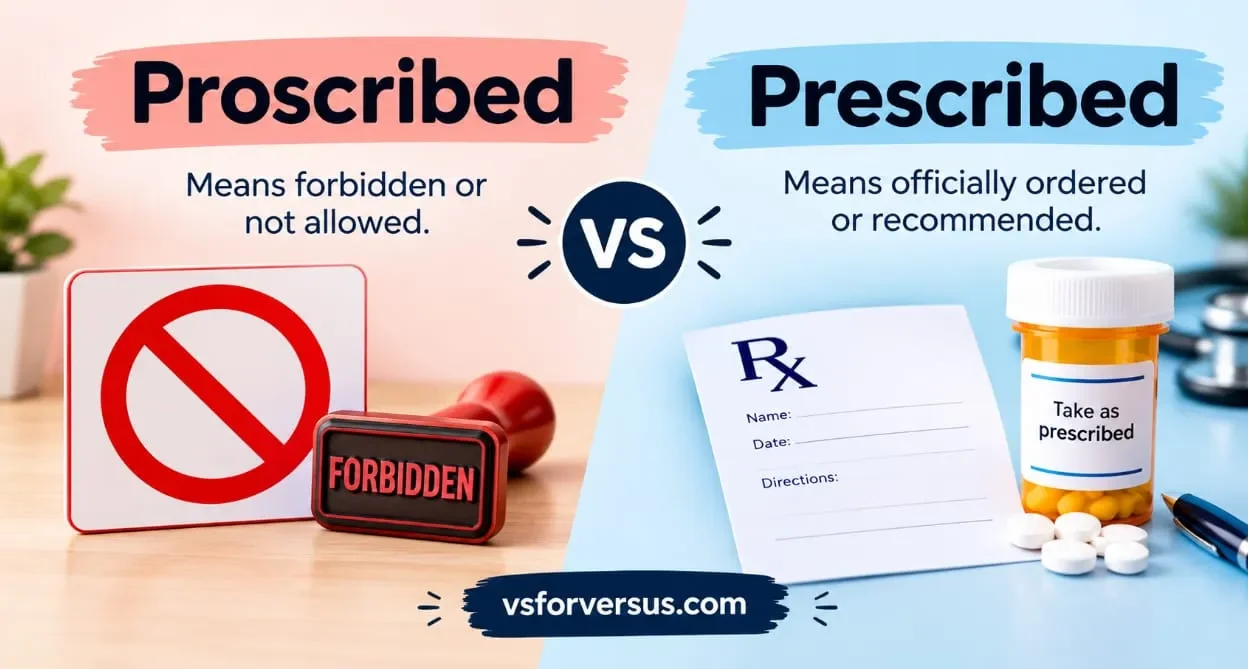
Proscribed means to forbid, ban, or condemn something, often used in legal, medical, or formal contexts to describe practices, substances, or actions that are officially outlawed. Prescribed, on the other hand, means to officially recommend, authorize, or specify something, most commonly used when a doctor prescribes medication or a set of rules is prescribed for a particular task.
Confusing the two can completely reverse the intended meaning of a sentence, which makes this distinction critical in legal, medical, and academic writing. In this article, we’ll explore both terms in depth, covering their origins, correct usage, and real world examples.
Quick Answer
Proscribed means forbidden or banned, something a person is not allowed to do. Prescribed means officially recommended or ordered, something a person is told or advised to do, often by a doctor, law, or set of rules. The two words look almost identical and share ancient roots, but their meanings are nearly opposite, which is exactly why this proscribed vs prescribed confusion is so common in medical, legal, and professional writing.
Proscribed vs Prescribed at a Glance
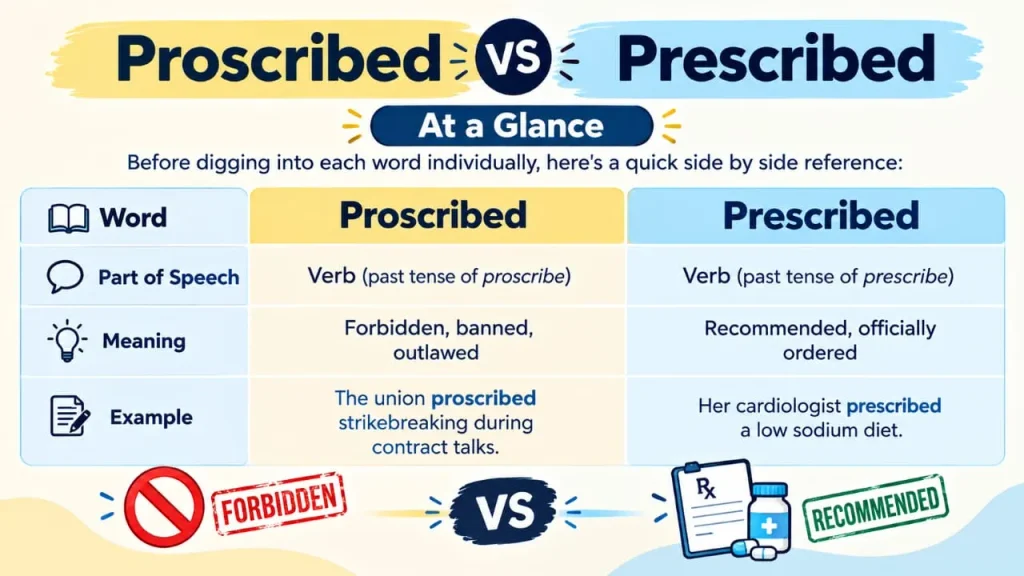
Before digging into each word individually, here’s a quick side by side reference:
| Word | Part of Speech | Meaning | Example |
| Proscribed | Verb (past tense of proscribe) | Forbidden, banned, outlawed | The union proscribed strikebreaking during contract talks. |
| Prescribed | Verb (past tense of prescribe) | Recommended, officially ordered | Her cardiologist prescribed a low sodium diet. |
Synonyms and Antonyms
A quick way to sharpen the distinction is to look at each word’s antonym and synonym set side by side:
| Word | Synonyms | Antonyms |
| Proscribed | banned, outlawed, prohibited, barred | permitted, sanctioned, allowed |
| Prescribed | ordered, advised, mandated, recommended | discouraged, prohibited, disallowed |
Notice something odd: prohibited shows up as a synonym for proscribed and as an antonym for prescribed. That overlap is a good sign you’re thinking about these words correctly; they really do sit at opposite ends of the same idea.
What Does “Proscribed” Mean?
Proscribed means officially forbidden, banned, or outlawed, usually because something is considered harmful, dangerous, or against established rules. It’s a strong word, and it usually shows up in formal, authoritative contexts rather than casual conversation.
The related noun is proscription (a ban), and the adjective is proscriptive (having the effect of banning something).
A few examples of how it plays out in real writing:
- “The company’s new code of conduct explicitly proscribes accepting gifts from vendors over $50.”
- Under the UK’s Terrorism Act 2000, the government maintains a public list of organizations that are formally proscribed, meaning membership or support of them becomes a criminal offense.
- “The group was formally proscribed under anti terrorism legislation last year.”
- “Our HR handbook proscribes using personal social media accounts to discuss client work.”
Common contexts for proscribed: government and regulatory announcements, legal filings, compliance policies, workplace codes of conduct, and academic research guidelines that restrict certain methods or practices. If you’re reading a news article about a banned organization or a company policy listing prohibited behavior, proscribed is doing the heavy lifting.
What Does “Prescribed” Mean?
Prescribed means officially recommended, ordered, or set down as a required or suggested course of action. Most people know it from the doctor’s office, but its reach extends well beyond medicine; anywhere rules or guidance are “set down,” prescribed is likely the right word.
The related noun is prescription, and the adjective is prescriptive (laying down rules to be followed).
A handful of examples worth studying:
- “The physician prescribed a two week course of antibiotics and told her to finish every pill.”
- Regulatory bodies like the FDA prescribe strict labeling requirements for prescription medications, down to font size and warning placement.
- “The syllabus prescribes three required readings before the midterm exam.”
- “State law prescribes a 30 day notice period before terminating a commercial lease.”
Common contexts for prescribed: healthcare and pharmacy communication, professional style guides and procedure manuals, academic syllabi and curricula, and legal documents that spell out required steps or formats. Anywhere something is being formally recommended or mandated, not banned, you’re looking at prescribed.
Related reading: if you enjoy untangling near opposite word pairs, our guide to Discreet vs Discrete covers a completely different kind of mix up, one rooted in spelling rather than meaning.
Why Do These Opposite Words Share the Same Roots?
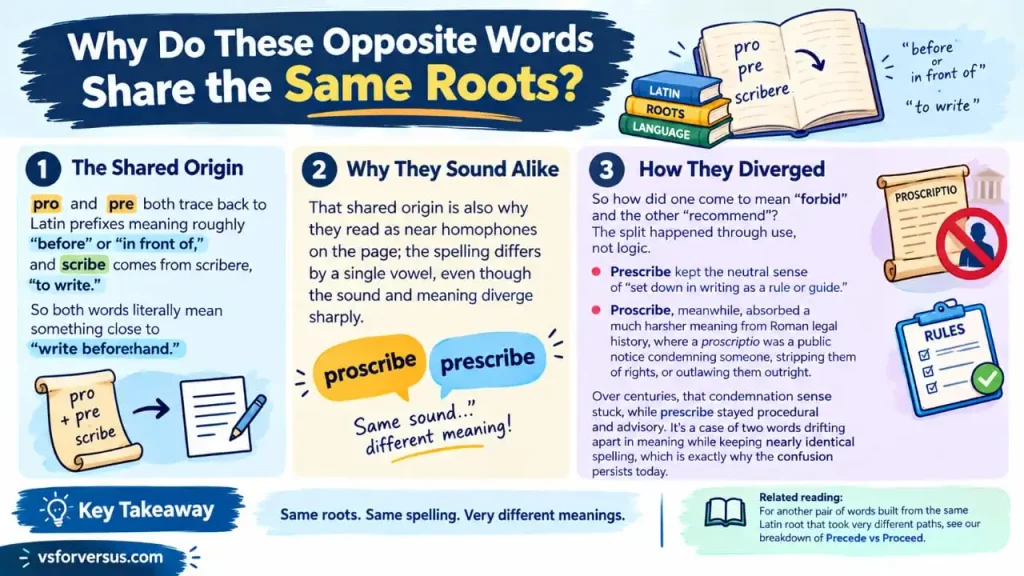
Here’s the part that genuinely surprises people, including native English speakers who’ve used both words for years: pro and pre both trace back to Latin prefixes meaning roughly “before” or “in front of,” and scribe comes from scribere, “to write.” So both words literally mean something close to “write beforehand.”
That shared origin is also why they read as near homophones on the page; the spelling differs by a single vowel, even though the sound and meaning diverge sharply.
So how did one come to mean “forbid” and the other “recommend”? The split happened through use, not logic. Prescribe kept the neutral sense of “set down in writing as a rule or guide.” Proscribe, meanwhile, absorbed a much harsher meaning from Roman legal history, where a proscriptio was a public notice condemning someone, stripping them of rights, or outlawing them outright.
Over centuries, that condemnation sense stuck, while prescribe stayed procedural and advisory. It’s a case of two words drifting apart in meaning while keeping nearly identical spelling, which is exactly why proscribed vs prescribed confusion persists today.
Related reading: for another pair of words built from the same Latin root that took very different paths, see our breakdown of Precede vs Proceed.
Key Differences Between Proscribed vs Prescribed
Once the proscribed vs prescribed distinction clicks, these patterns become second nature:
- Proscribed = forbidden. Prescribed = recommended or required.
- Proscribed is a synonym of banned, outlawed, prohibited; its antonym set includes permitted and sanctioned.
- Prescribed is a synonym of ordered, advised, mandated; its antonym set includes discouraged and prohibited.
- Both words can apply to the same noun; a drug can be prescribed by a doctor for treatment and proscribed for recreational or unsupervised use. Context, not the noun itself, tells you which meaning applies.
- Proscribed tends to appear in legal, regulatory, and policy language; prescribed tends to appear in medical, procedural, and academic language.
- Neither word is casual; both signal formal, authoritative instruction, just in opposite directions.
Memory Trick: How to Remember Proscribed vs Prescribed
The fastest way to lock in the proscribed vs prescribed difference is to anchor each word to a more familiar relative; a simple mnemonic does most of the work.
Proscribe shares its “pro ” with prohibit. Remember that proscribe and prohibit start the same way and mean almost the same thing: forbid, and you’ll stop confusing it with its opposite.
Prescribe shares its root with prescription, and a prescription is something a doctor writes for you, not against you. Picture a prescription pad every time you see the word, and the “recommended, not banned” meaning sticks.
If spelling still trips you up in the moment, there’s a simple backup: proscribed has an O, like the word no, and proscribed effectively means no. Prescribed has an E, closer to yes, and prescribed effectively means yes, please do this.
Common Mistakes with Proscribed vs Prescribed
Even skilled writers slip here, especially under deadline pressure or in fields like healthcare and law, where the two words appear side by side constantly. Here are the most common errors, corrected:
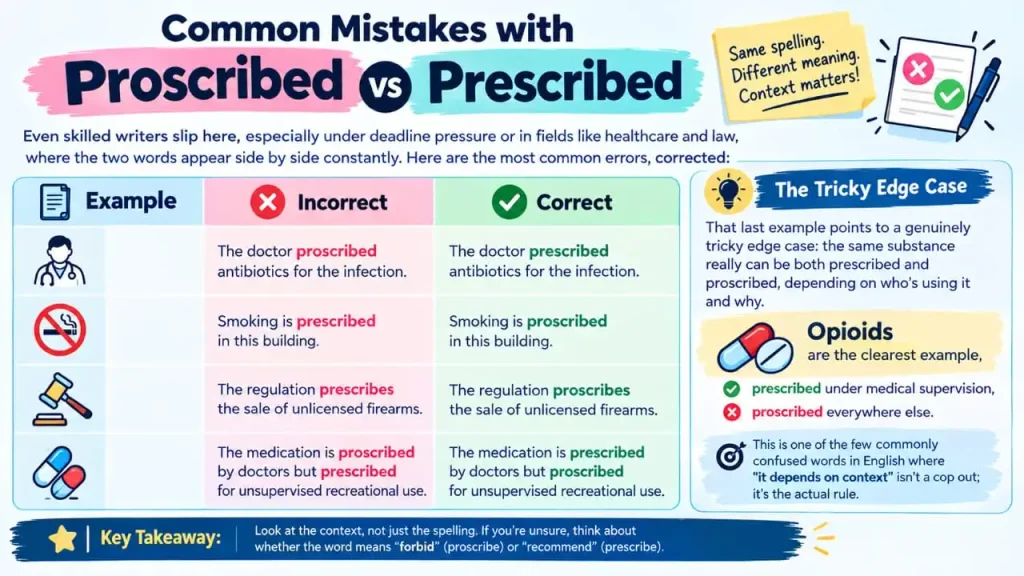
| ❌ Incorrect | ✅ Correct |
| The doctor proscribed antibiotics for the infection. | The doctor prescribed antibiotics for the infection. |
| Smoking is prescribed in this building. | Smoking is proscribed in this building. |
| The regulation prescribes the sale of unlicensed firearms. | The regulation proscribes the sale of unlicensed firearms. |
| The medication is proscribed by doctors but prescribed for unsupervised recreational use. | The medication is prescribed by doctors but proscribed for unsupervised recreational use. |
That last example points to a genuinely tricky edge case: the same substance really can be both prescribed and proscribed, depending on who’s using it and why. Opioids are the clearest example, prescribed under medical supervision, proscribed everywhere else. This is one of the few commonly confused words in English where “it depends on context” isn’t a cop out; it’s the actual rule.
Quick Quiz: Test Your Knowledge
- The office dress code ___ jeans on client visit days. (proscribes/prescribes)
- The pharmacist filled the dosage ___ by the doctor. (proscribed / prescribed)
- Several governments have ___ the chemical from use in food packaging. (proscribed / prescribed)
- True or false: A drug can never be both prescribed and proscribed.
- Which word is more likely to appear in a legal ban on an organization, proscribed or prescribed?
(Answers: 1. proscribes, 2. prescribed, 3. proscribed, 4. False, 5. Proscribed)
Frequently Asked Questions
What does proscribed mean?
Proscribed means officially forbidden, banned, or outlawed, usually in a legal, regulatory, or policy context.
What does prescribed mean?
Prescribed means officially recommended, ordered, or set down as a required course of action, most commonly in medical, academic, or procedural writing.
Is proscribed the opposite of prescribed?
Yes. Despite looking almost identical, proscribed and prescribed carry nearly opposite meanings, one forbids, the other recommends or requires.
Why do proscribed and prescribed mean opposite things if they share the same root?
Both words come from Latin roots meaning “write beforehand,” but their meanings drifted apart over time. Prescribe kept the neutral sense of “set down as a rule,” while proscribe absorbed the harsher Roman legal sense of publicly condemning or outlawing someone.
Can something be both prescribed and proscribed?
Yes. The same substance or activity can be prescribed in one context and proscribed in another; a medication prescribed by a doctor, for example, may be proscribed outside of medical supervision.
Do proscribed and prescribed sound the same?
Not quite. Proscribed uses a long “o” sound (pro SCRIBED), while prescribed uses a short “e” sound (pre SCRIBED). The difference is subtle in fast speech, which is part of why this proscribed vs prescribed mix up happens in listening and note taking, not just writing.
Bottom Line
Proscribed = forbidden, banned, not allowed. Prescribed = recommended, ordered, required. They come from the same Latin roots but drifted into near opposite meanings, so the safest habit is to pause on the O (no) versus E (yes) whenever you write either word. Get that one distinction right, and you’ll never misfire in a medical note, a legal document, or a workplace policy again.
To read more: Principles vs Principals: 5 Shocking Differences You Need to Know

Marcus is a former product manager turned comparison writer who spent eight years testing tools and gadgets before quitting to write full-time. He specializes in breaking down tech and software matchups into plain-English verdicts, with a soft spot for buying guides nobody else wants to write.