
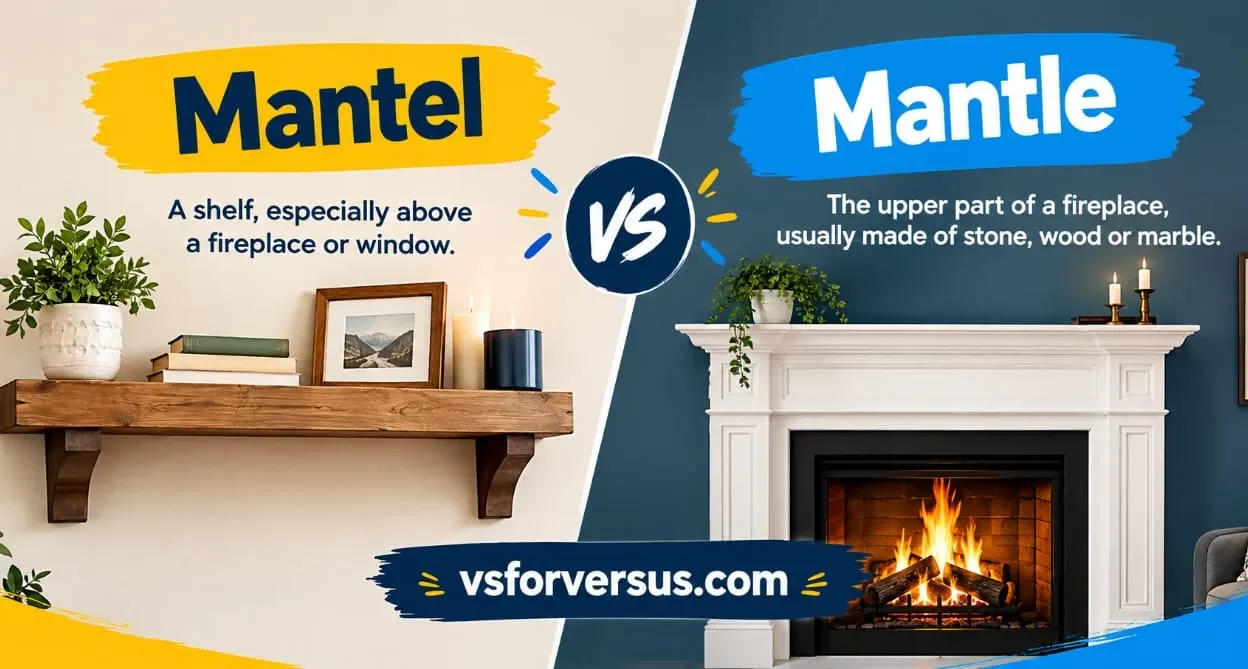
Mantel vs Mantle these two words show how a single missing letter can completely change a word’s meaning, tripping up even careful writers. Though they sound identical when spoken, they refer to entirely different things.
Mantel specifically refers to the shelf or structure above a fireplace, often used to display photos, decorations, or a clock; think of the classic “mantel piece” in a living room. Mantle, on the other hand, has multiple meanings: it can refer to a cloak or covering, a position of responsibility passed on to someone (“taking on the mantle of leadership”), or even the layer of the Earth between the crust and core in geology.
This wide range of meanings makes “mantle” far more versatile than “mantel.” In this article, we’ll explore both words in detail, their origins, correct usage, and clear examples to help you use each one accurately.
Quick Answer
Mantel vs mantle are homophones; they sound identical but mean different things. A mantel is the shelf or structure above a fireplace. A mantle is a cloak, a covering (like a mantle of snow), the layer of the Earth beneath the crust, or a figurative role, as in “take up the mantle of leadership.” When you’re deciding between mantel vs mantle for anything involving a fireplace, mantel is always the correct choice.
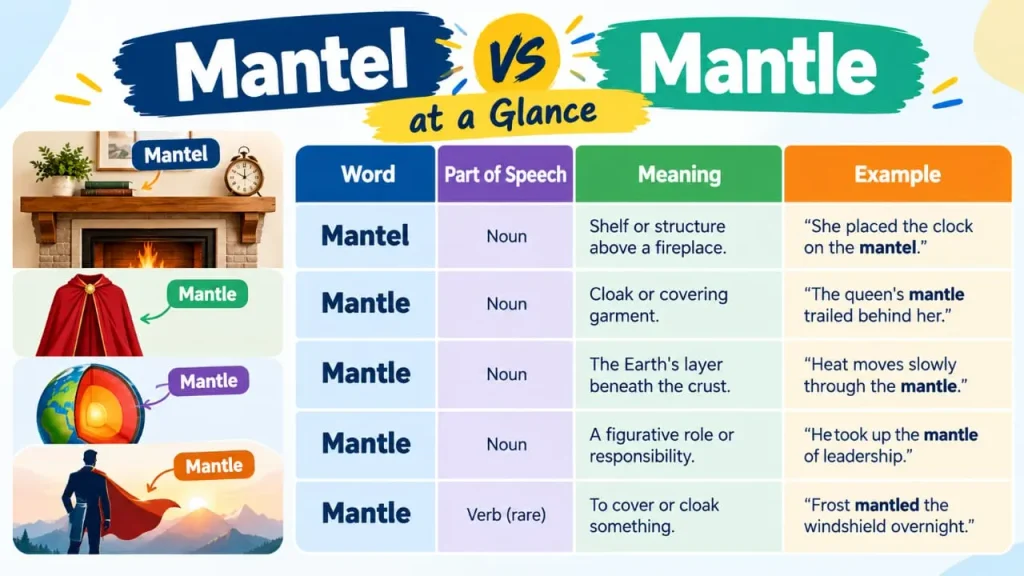
Mantel vs Mantle at a Glance
| Word | Part of Speech | Meaning | Example |
| Mantel | Noun | Shelf or structure above a fireplace | “She placed the clock on the mantel.” |
| Mantle | Noun | Cloak or covering garment | “The queen’s mantle trailed behind her.” |
| Mantle | Noun | The Earth’s layer beneath the crust | “Heat moves slowly through the mantle.” |
| Mantle | Noun | A figurative role or responsibility | “He took up the mantle of leadership.” |
| Mantle | Verb (rare) | To cover or cloak something | “Frost mantled the windshield overnight.” |
What Is a “Mantel”?
A mantel is the architectural shelf, ledge, or framing structure built above and around a fireplace opening. It’s a noun with exactly one meaning in modern English, which makes it easier to lock in once you know it.
Here’s what “mantel” looks like in real writing:
- “We finally hung the stockings on the mantel this weekend.”
- The listing copy read: “Stunning living room featuring a floor to ceiling stone mantel and custom built ins.”
- In her essay on 1920s interior design, she noted that “the carved wood mantel became the visual anchor of the parlor.”
- “Can you grab the picture frame off the mantel before the movers get here?”
Common contexts: You’ll see “mantel” most often in home renovation blogs, real estate listings, interior design copy, and casual conversation about fireplaces. If a sentence involves a shelf, a fireplace, or something you’d display a clock or photos on, mantel is your word.
Historically, mantels served a practical purpose beyond decoration; early versions helped direct smoke up and away from the room, long before modern venting existed. Today the function is almost entirely visual. A mantel anchors the room, gives you a place to hang stockings or lean a mirror, and often becomes the most photographed feature in a real estate listing.
What Does “Mantle” Mean?
Mantle carries more weight, literally and figuratively. It has four related meanings, all tracing back to the idea of something that covers or wraps around something else:
- A loose, sleeveless cloak or covering garment
- A metaphorical covering, like snow or fog
- The layer of the Earth between the crust and the core
- A role, responsibility, or position inherited from someone else
Real world examples of each:
- “The queen’s mantle trailed behind her as she walked into the hall.”
- “By morning, a thin mantle of frost had settled over the garden.”
- “Our geology professor spent the whole lecture explaining how heat moves through the Earth’s mantle.”
- “When the CEO retired, she made it clear who would take up the mantle of the company’s next chapter.”
Common contexts: “Mantle” shows up in geology and science writing, business and leadership writing (“assume the mantle,” “pass the mantle”), literary or historical fiction, and figurative language in speeches and essays.
It also appears in more specialized fields. Biologists use “mantle” to describe the outer tissue layer of a mollusk or the coloring across a bird’s back and wings, and lighting historians use it for the fabric hood that glows over an old gas lamp flame. You won’t need those senses often, but recognizing them helps explain why “mantle” carries so much more range than “mantel” ever will.
Key Differences Between Mantel vs Mantle
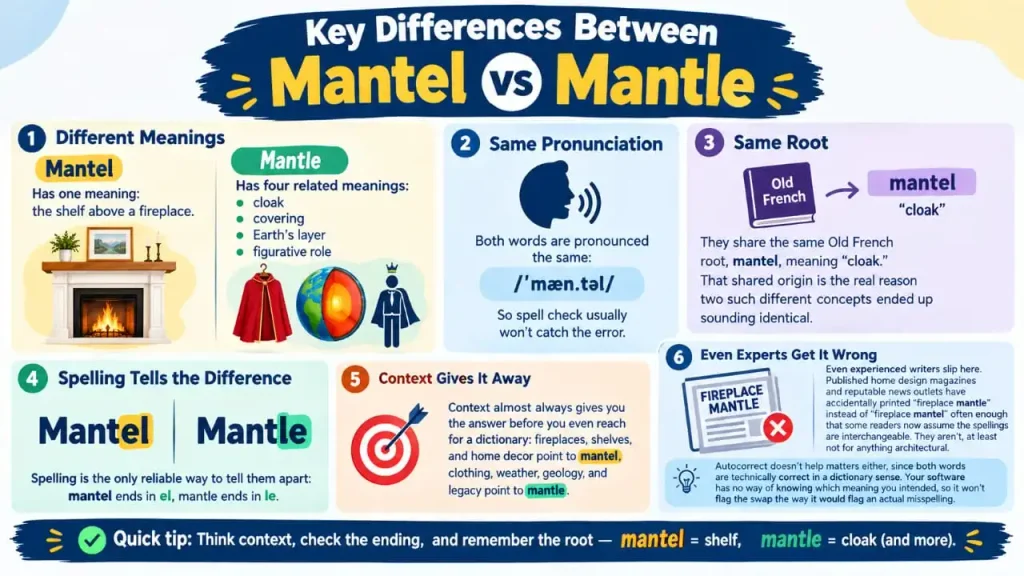
- Mantel has one meaning: the shelf above a fireplace.
- Mantle has four related meanings: cloak, covering, Earth’s layer, and figurative role.
- Both words are pronounced the same, /ˈmæn.təl/, so spell check usually won’t catch the error.
- They share the same Old French root, mantel, meaning “cloak.” That shared origin is the real reason two such different concepts ended up sounding identical.
- Spelling is the only reliable way to tell them apart: mantel ends in el, mantle ends in le.
- Context almost always gives you the answer before you even reach for a dictionary: fireplaces, shelves, and home decor point to mantel; clothing, weather, geology, and legacy point to mantle.
Even experienced writers slip here. Published home design magazines and reputable news outlets have accidentally printed “fireplace mantle” instead of “fireplace mantel” often enough that some readers now assume the spellings are interchangeable.
They aren’t, at least not for anything architectural. Autocorrect doesn’t help matters either, since both words are technically correct in a dictionary sense. Your software has no way of knowing which meaning you intended, so it won’t flag the swap the way it would flag an actual misspelling.
Memory Trick: How to Remember Mantel vs Mantle
Here’s the trick that tends to stick best: think of a manTEL as somewhere you could put a TELevision. The shelf, the TV, the “TEL”, it’s all sitting right there in the word.
If that doesn’t do it for you, try this backup: mantel has only one job (holding up a shelf), so just memorize the ending el alongside it. As for mantle’s le ending, there’s no real etymological reason it “matches” the word’s broader meanings; the two words share a root, after all, but plenty of learners find it easier to remember once they picture mantle as the “bigger,” busier word with the longer list of jobs.
Either trick works. Pick the one that sticks, and the mantel vs. mantle confusion mostly disappears after a week or two of paying attention. Some writers find it helps to physically circle or highlight the word the first few times they write it, until the correct spelling starts to feel automatic rather than something they have to stop and reason through.
Common Mistakes with Mantel vs Mantle
| Context | Incorrect | Correct |
| Home decor | “She put the vase on the mantle.” | “She put the vase on the mantel.” |
| Renovation writing | “The mantlepiece was made of reclaimed oak.” | “The mantelpiece was made of reclaimed oak.” |
| Leadership/business | “He inherited the mantel of leadership from his father.” | “He inherited the mantle of leadership from his father.” |
| Science/geology | “The Earth’s mantel is nearly 3,000 kilometers thick.” | “The Earth’s mantle is nearly 3,000 kilometers thick.” |
| Client email | “We’ll install the new fireplace mantle next Tuesday.” | “We’ll install the new fireplace mantel next Tuesday.” |
That last one is worth noting. Contractors, real estate agents, and interior designers write this word constantly, and a mantel vs. mantle typo in a client facing email or listing can look unpolished even when the rest of the writing is sharp. It’s a small error, but it’s exactly the kind a careful reader, a client, an editor, a hiring manager, tends to notice.
Quick Quiz: Mantel or Mantle?
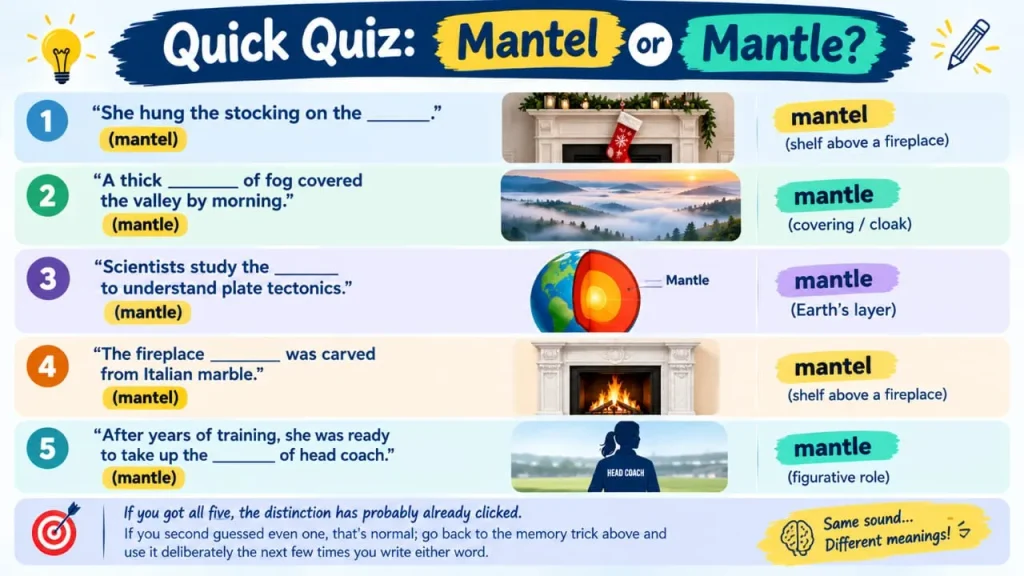
- “She hung the stocking on the ______.” (mantel)
- “A thick ______ of fog covered the valley by morning.” (mantle)
- “Scientists study the ______ to understand plate tectonics.” (mantle)
- “The fireplace ______ was carved from Italian marble.” (mantel)
- “After years of training, she was ready to take up the ______ of head coach.” (mantle)
If you got all five, the distinction has probably already clicked. If you second guessed even one, that’s normal; go back to the memory trick above and use it deliberately the next few times you write either word.
Frequently Asked Questions
Is it “mantel” or “mantle” over a fireplace?
It’s “mantel.” The shelf, ledge, or decorative structure above a fireplace is always spelled M A N T E L, regardless of the material it’s made from; wood, marble, stone, or concrete all follow the same rule.
Is “mantel” American English, and “mantle” British English?
No, and this is a common myth. “Mantel” is the standard spelling for the fireplace shelf across American, British, and Australian English alike. Some UK sources use “mantelpiece” more often than the shorter “mantel,” but that’s a stylistic preference, not a rule that “mantle” is correct elsewhere. When it comes to fireplaces, mantel vs. mantle isn’t a regional issue at all. Mantel wins everywhere.
What does “take up the mantle” mean?
It means to accept a role, responsibility, or legacy passed down from someone else, often after a predecessor retires, steps down, or dies. It’s common in leadership, business succession, and political writing, and it traces back to the idea of literally draping a cloak, the mantle, over the shoulders of a successor.
Are “mantel” and “mantle” pronounced the same?
Yes. Both are pronounced /ˈmæn.təl/, with the stress on the first syllable. That’s exactly why spell check and autocorrect tools frequently swap one for the other without flagging anything.
What is the Earth’s mantle?
The Earth’s mantle is the thick layer of hot, dense rock between the planet’s crust and its core. It makes up the majority of the Earth’s volume and plays a central role in processes like plate tectonics and volcanic activity, the kind of detail that shows up often in geology essays and science journalism, which is one reason “mantle” tends to feel like the more academic sounding of the two words.
Is “mantlepiece” a real word?
Not quite. It’s a common misspelling of “mantelpiece,” which is a synonym for “mantel.” Both are spelled with an el, not an le, even though “mantlepiece” shows up often enough online that spell check tools sometimes let it slide. If you’re describing the shelf above a fireplace, stick with “mantel” or “mantelpiece.”
Final thoughts
Mantel vs mantle is a small spelling trap with an easy fix. Once you know that mantel has just one job, the shelf above a fireplace, and mantle carries everything else (cloaks, coverings, Earth’s layers, inherited roles), the confusion tends to disappear for good.
The manTEL/TELevision trick is there for the moments your brain blanks, but honestly, most people only need to make the mistake once, get gently corrected as Sarah did, and it sticks. That’s really how most of English’s confusing word pairs get mastered: not through memorizing a rule, but through one slightly embarrassing moment that makes the difference impossible to forget.
To read more: Labelled vs Labeled: Which Spelling Is Correct? 5 Essential Rules

Marcus is a former product manager turned comparison writer who spent eight years testing tools and gadgets before quitting to write full-time. He specializes in breaking down tech and software matchups into plain-English verdicts, with a soft spot for buying guides nobody else wants to write.