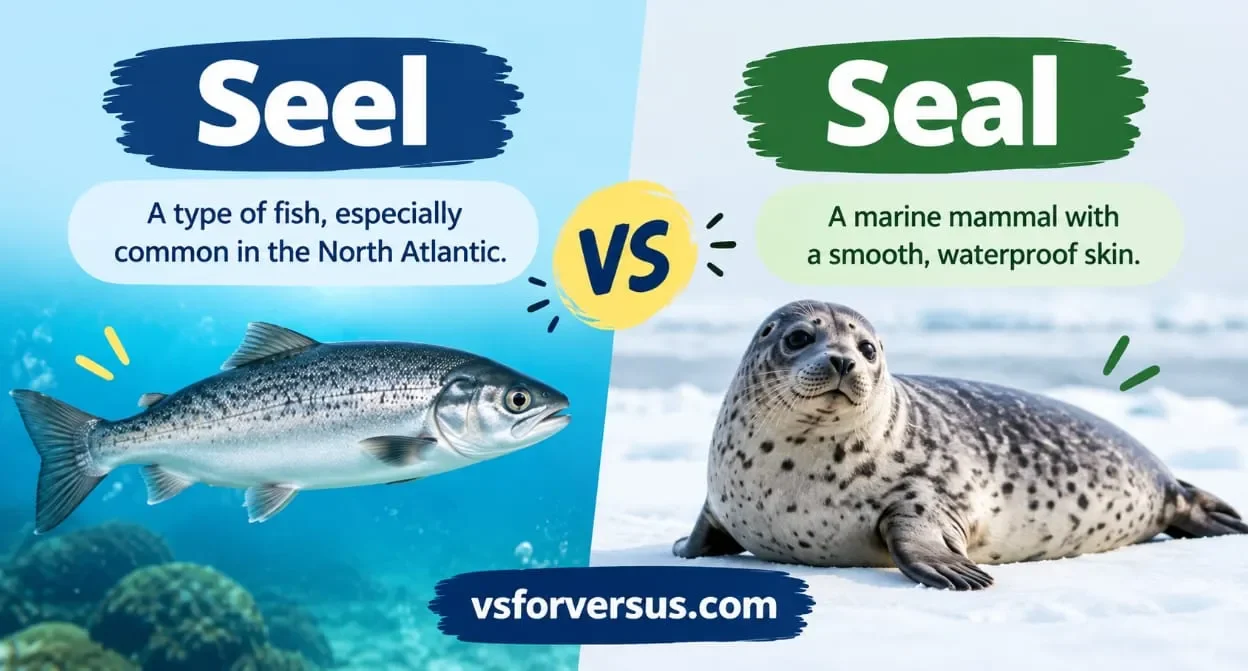
Seel vs Seal Spelling confusion often arises when one word is common and the other is rare, and that’s exactly the case here. Most people have never encountered the first term outside of falconry or old literary texts, while the second appears constantly in everyday language.
Seel is an archaic, rarely used verb that historically meant sewing a hawk’s eyes shut during training, or more broadly, closing or blinding something. Seal, by contrast, is the far more familiar word, referring to an airtight closure, an official stamp or emblem, or even the marine mammal known for basking on rocky shores.
Because “seel” is so uncommon today, many writers mistakenly assume it’s simply a misspelling of “seal.” In this article, we’ll uncover the surprising origin of “seel,” clarify its rare usage, and explain exactly when “seal” is the word you actually need.
Quick Answer
Seal is the word you need almost every time; it names the marine animal, the act of closing something tightly, and an official stamp of approval. Seel is a real but extremely rare word, mostly used in falconry to mean sewing shut a hawk’s eyelids during training. Unless you’re writing about falconry history, always write seal.
Seel vs Seal at a Glance
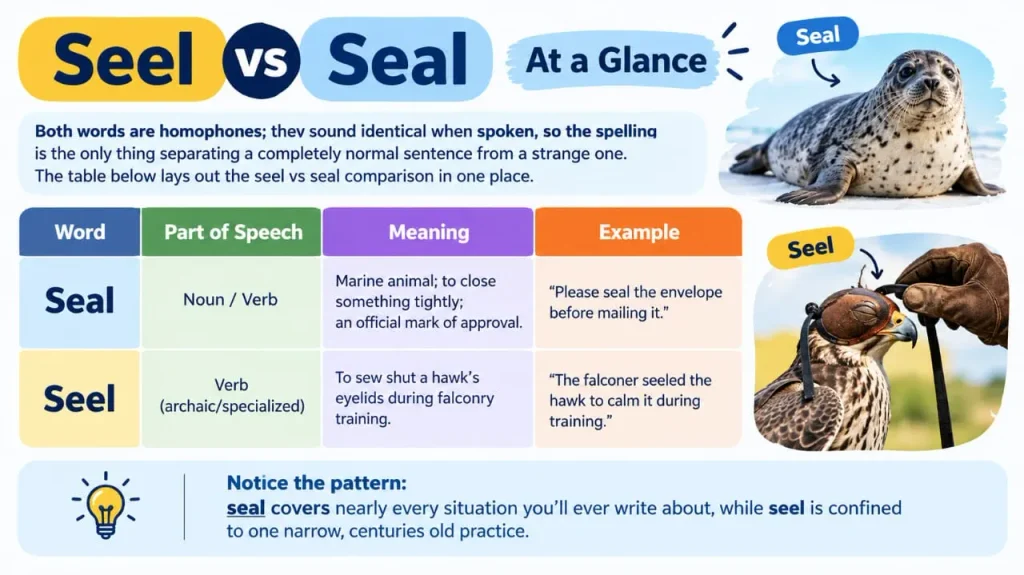
Both words are homophones; they sound identical when spoken, so the spelling is the only thing separating a completely normal sentence from a strange one. The table below lays out the seel vs seal comparison in one place.
| Word | Part of Speech | Meaning | Example |
| Seal | Noun / Verb | Marine animal; to close something tightly; an official mark of approval | “Please seal the envelope before mailing it.” |
| Seel | Verb (archaic/specialized) | To sew shut a hawk’s eyelids during falconry training | “The falconer seeled the hawk to calm it during training.” |
Notice the pattern: seal covers nearly every situation you’ll ever write about, while seel is confined to one narrow, centuries old practice.
What Does “Seal” Mean?
Seal is one of those workhorse English words that shows up everywhere once you start noticing it. As a noun, it can mean the sleek ocean mammal with flippers, an official emblem stamped on a document, or a physical closure, like the rubber gasket on a jar lid, or the wax seal pressed into an old letter to keep it private.
As a verb, it means to close something securely, to make an agreement final, or to prevent something (air, liquid, information) from escaping. Dictionaries like Merriam Webster list all of these senses under a single entry, which is part of why the word feels so flexible in everyday use.
A few real world examples show that range in action:
- “Can you seal the leftovers before you put them in the fridge?”, a text between roommates
- “The two companies sealed the merger after months of negotiation.”, a business news update.
- “We watched a seal sunbathing on the dock all afternoon.”, a vacation post on social media.
- “Please review and seal the attached documents before the closing date.”, a line from a legal correspondence.
- “Your signature seals the agreement, so read the fine print first.”, advice in a workplace memo.
Seal appears constantly in emails (“seal the box before shipping”), in legal and business writing (“the contract is not binding until it’s signed and sealed”), and in casual conversation (“did you seal the deal?”). That range is exactly why it wins the seel vs seal comparison so decisively; it simply does more work.
What Does “Seel” Mean?
Seel is a genuine English word, not a typo, not a misspelling, not a made up variant. Collins Dictionary and other major references list it as a falconry term meaning to sew a hawk’s or falcon’s eyelids partially shut with thread during early training, a practice used to keep the bird calm before it was accustomed to humans.
Older and literary English also used “seel” more broadly, in a figurative sense, to mean “to blind” or “to close up”, the kind of usage you’ll occasionally find in older poetry or drama, where a writer describes sleep or darkness as something that “seels” the eyes shut.
You’ll rarely need this word in ordinary writing, but it does show up in specific places:
- “The trainer seeled the young falcon according to the old method.”, a passage in a book about falconry history.
- “The poem describes grief as something that seels the mourner’s eyes to the world around her.”, literary analysis in an essay.
- “Seeling was a standard part of falconry training centuries ago.”, a line from a historical essay.
If you’re a birder, a falconry enthusiast, or reading older literary texts, you may encounter “seel” legitimately. Everyone else can treat it as a word to recognize, not to use.
Why does this mix up keep happening, though? Part of it is pure phonetics: English speakers hear one sound (/siːl/) and have to guess at the spelling, and “ee” feels just as plausible as “ea” if you’ve never seen the word written down.
Autocorrect doesn’t always help either: some keyboards will “correct” a mistyped seal into seel if you’re typing quickly, especially on mobile, since seel is a recognized dictionary word and your phone has no way of knowing which one you meant. So the seel vs seal mistake isn’t really about not knowing English; it’s about a spelling system that doesn’t always match what your ear hears.
Key Differences Between Seel vs Seal
The seel vs seal distinction breaks down into a few scannable points:
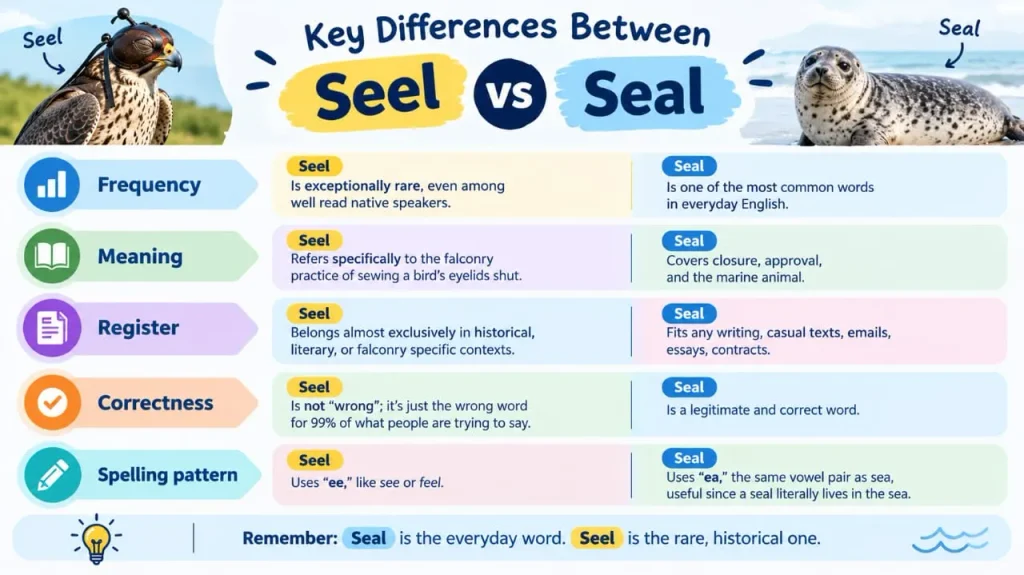
- Frequency: Seal is one of the most common words in everyday English; seel is exceptionally rare, even among well read native speakers.
- Meaning: Seal covers closure, approval, and the marine animal; seel refers specifically to the falconry practice of sewing a bird’s eyelids shut.
- Register: Seal fits any writing, casual texts, emails, essays, contracts. Seel belongs almost exclusively in historical, literary, or falconry specific contexts.
- Correctness: Both words are legitimate. Seel is not “wrong”; it’s just the wrong word for 99% of what people are trying to say.
- Spelling pattern: Seal uses “ea,” the same vowel pair as sea, useful since a seal literally lives in the sea. Seel uses “ee,” like see or feel.
Which Word Fits Which Context?
Here’s a quick reference for specific writing situations, useful when you just need a fast answer without reading the full explanation above.
| Context | Correct Word | Example |
| Closing an envelope or package | Seal | “Seal the envelope before mailing it.” |
| Talking about the ocean animal | Seal | “A seal was resting on the rocks.” |
| Business or contract writing | Seal | “The partnership was officially sealed.” |
| Legal documents and agreements | Seal | “The court sealed the records.” |
| Academic or literary analysis of falconry/archaic texts | Seel | “The essay explains how falconers once seeled young hawks.” |
| Everyday conversation or social media | Seal | “Look at this baby seal video!” |
How to Remember the Difference
The simplest memory trick ties directly to meaning: a seal lives in the sea, and both words share the same “ea.” If you can picture a seal swimming in the sea, the spelling locks into place.
For the rarer word, anchor it visually instead of phonetically: picture a falconer’s hands near a hawk’s eyes; “seel” is about eyes, and that odd, specific image is exactly why it’s memorable enough to not need often. When in doubt, default to seal. It’s right far more often than it’s wrong.
Common Mistakes With Seel vs Seal
Even confident, experienced writers slip on this one occasionally, usually while typing fast, not because they don’t know better. Here’s a quick reference table of the most common errors:
| Incorrect | Correct |
| Please seel the envelope before you mail it. | Please seal the envelope before you mail it. |
| We saw a seel resting on the rocks near the shore. | We saw a seal resting on the rocks near the shore. |
| They finally seeled the deal after weeks of back and forth. | They finally sealed the deal after weeks of back and forth. |
| The product got the company’s seel of approval. | The product got the company’s seal of approval. |
| The lawyer asked us to seel the documents by Friday. | The lawyer asked us to seal the documents by Friday. |
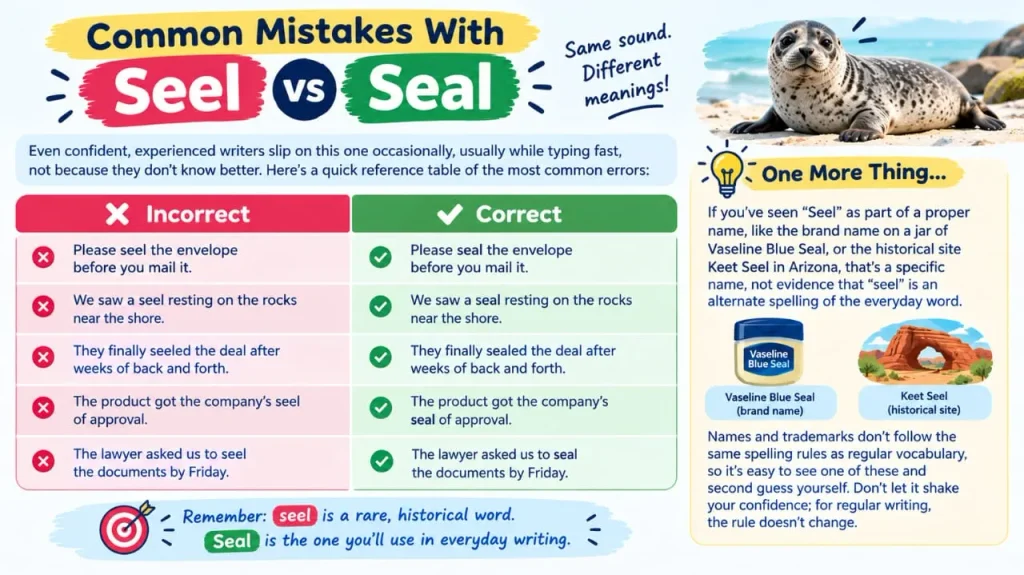
One more thing worth knowing: if you’ve seen “Seel” as part of a proper name, like the brand name on a jar of Vaseline Blue Seal, or the historical site Keet Seel in Arizona, that’s a specific name, not evidence that “seel” is an alternate spelling of the everyday word. Names and trademarks don’t follow the same spelling rules as regular vocabulary, so it’s easy to see one of these and second guess yourself. Don’t let it shake your confidence; for regular writing, the rule doesn’t change.
Quick Quiz: Test Yourself on Seel vs Seal
Try these before checking the answers below.
- Please ___ the envelope before mailing it. (seal/seel)
- The falconer ___ the young hawk as part of its training. (seal/seel)
- We watched a ___ swim gracefully near the boat. (seal/seel)
- Careful buyers always ___ a deal with a written contract, not just a handshake. (seal/seel)
- True or False: “Seel” is simply a misspelling of “seal.”
Answers: 1. seal, 2. seel, 3. seal, 4. seal, 5. False; seel is a real, rare word with its own meaning.
FAQ About Seel and Seal
Is “seel” a real word?
Yes. It’s a legitimate, if rarely used, English verb tied to falconry, where it means sewing shut a hawk’s eyelids during training.
Is “seal” the correct spelling for the animal?
Yes, always. The marine mammal is spelled seal, never seel, in every standard variety of English.
Is it “seal the deal” or “seel the deal”?
It’s “seal the deal.” This common idiom means to finalize an agreement, and it always uses the “ea” spelling.
Why does autocorrect change “seal” to “seel” (or the other way around)?
Both are real dictionary words, so autocorrect can’t always tell which one you meant. Fast typing and phonetic guessing are the two biggest reasons this swap happens, especially on mobile keyboards.
What does “seel” mean in falconry?
It refers to the historical practice of sewing a hawk’s or falcon’s eyelids partly shut to keep the bird calm before it grew used to being handled by humans.
Are seel vs seal pronounced the same?
Yes. They’re homophones, identical in sound, different in spelling and meaning, which is exactly why the written form matters so much here.
Conclusion:
There’s a genuinely easy rule once you strip away the confusion: seal is the everyday word for the animal, the closure, and the approval stamp, while seel is a rare, specialized term almost no one needs outside falconry history. When you’re unsure, default to seal; it’s correct in nearly every sentence you’ll ever write, from a quick text to a formal contract.
If you take away just one habit from this guide, let it be this: whenever your fingers type “seel” out of habit or autocorrect nudges you toward it, pause for a second and picture the animal swimming in the sea. That one small mental check is usually all it takes to catch the slip before it reaches an email, an essay, or a signed document, and it’s a far more reliable habit than trying to memorize a rule under pressure.
To read more: Seel vs Seal: The Ultimate Guide to 5 Key Differences and Which Is Correct

Marcus is a former product manager turned comparison writer who spent eight years testing tools and gadgets before quitting to write full-time. He specializes in breaking down tech and software matchups into plain-English verdicts, with a soft spot for buying guides nobody else wants to write.