
Seal vs Seel is a rare word pair, and the confusion comes from an unusual place: one of the two words is far more familiar than the other. Because “seel” looks like a typo of a common word, many writers assume it isn’t real at all.
Seal is the everyday word, meaning to close something tightly, as in “seal the envelope,” and it also names an official stamp or the marine mammal found along coastlines. Seel, on the other hand, is an archaic verb that originally meant to stitch a hawk’s eyelids shut during training, and it later came to mean to blind or close the eyes.
In this guide, you’ll learn the origins of both words, their correct usage, common mistakes to avoid, and clear examples that make the right choice easy every time.
Quick Answer:
For seal vs seel, seal is correct in almost every sentence: as a verb it means to close something securely or to make a deal final, and as a noun it names an official stamp or the marine animal. Seel is a separate, rare and archaic verb meaning to sew a hawk’s eyelids shut in falconry. Both words are pronounced /siːl/, so the spelling must follow the meaning, not the sound.
Seal vs Seel at a Glance
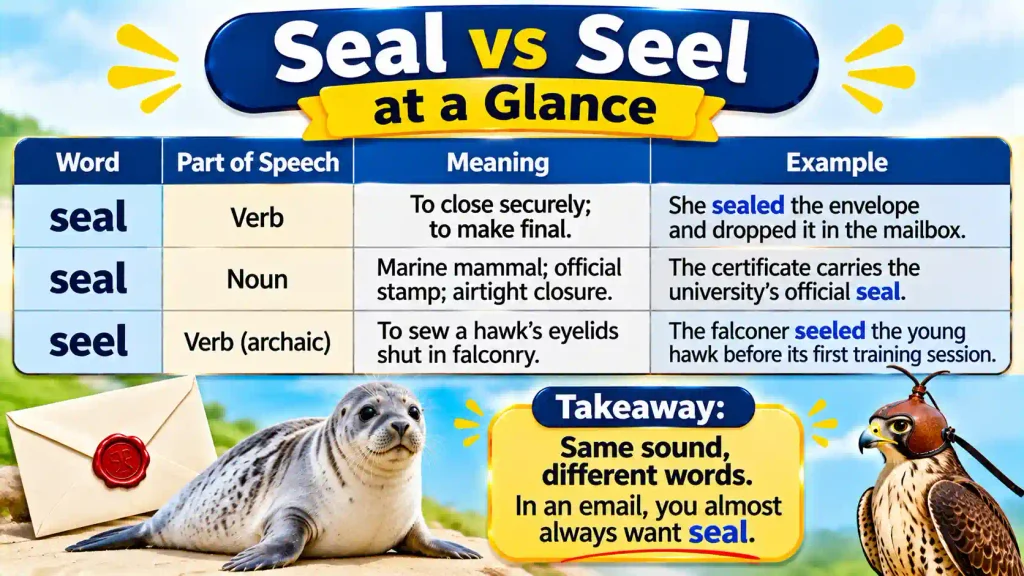
| Word | Part of Speech | Meaning | Example |
| seal | Verb | To close securely; to make final | She sealed the envelope and dropped it in the mailbox. |
| seal | Noun | Marine mammal; official stamp; airtight closure | The certificate carries the university’s official seal. |
| seel | Verb (archaic) | To sew a hawk’s eyelids shut in falconry | The falconer seeled the young hawk before its first training session. |
Same sound, different words. In an email, you almost always want seal.
What Does “Seal” Mean?
The seal definition covers two parts of speech and several meanings, which explains why the word turns up everywhere. As a verb, it means to close something so nothing gets in or out, or to make something final. As a noun, it can be a marine mammal, an official mark on a document, or a closure that keeps air and liquid out.
Here is seal in real sentences:
- Can you seal the box with packing tape before the courier arrives?
- The plumber sealed the gap around the sink, and the leak stopped.
- Just sealed the deal on our first apartment!
- We spotted a seal sunning itself on the rocks at low tide.
Where you’ll meet it: packaging and mail (to seal an envelope), contracts and business writing, nature writing, and official paperwork, where a notary’s seal confirms a document.
In professional writing: Legal and business documents use the word precisely. A contract can be signed and sealed, a sensitive court file can be placed under seal, and a company can invite sealed bids. Packaging teams rely on it too, as in a tamper evident seal on food and medicine, where one wrong letter on a label becomes a quality control problem. In that kind of writing, seal vs seel is a precision issue, not a style choice.
Common phrases: The seal the deal meaning is simple: to make an agreement final. A seal of approval is a formal endorsement, to seal someone’s fate is to decide their outcome, and to seal off an area is to block access. Written in capitals, SEAL names the US Navy’s Sea, Air, and Land team.
Word forms: seal, seals, sealed, sealing.
What Does “Seel” Mean?
The seel falconry meaning is physical. Falconers once passed fine thread through the eyelids of a newly caught hawk to keep it calm while training began, and seel was the verb for that practice. Dictionaries also record an older sense: to close or blind the eyes. It is a transitive verb, so it always acts on something. You seel a hawk.
The examples sound historical because the word itself is:
- The old manual explains how a falconer would seel a newly caught hawk.
- A caption in the museum’s falconry display notes that hawks were once seeled for their first weeks of training.
- The historian’s footnote adds, “Seeled is correct here, not a typo.”
- The editor left seeling untouched in the Renaissance passage.
Where you’ll meet it: historical falconry manuals, older literature, literary analysis, and dictionaries of archaic English words. Its forms are seel, seels, seeled, and seeling.
A note for editors and students: if a source quotes an old text, keep its spelling and add a short footnote explaining the word. Accurate quoting matters more than modernizing, and a one line note stops readers from assuming you made a mistake.
Is Seel a Real Word?
Yes. Seel is a genuine dictionary word, but it is rare and archaic, not a spelling variant of seal. In modern emails, essays, and reports, it almost never fits.
Seel in Shakespeare
In Act 3, Scene 2 of Macbeth, the title character calls on night to blind the day: “Come, seeling night, scarf up the tender eye of pitiful day.” The falconry image becomes poetry, with night closing the day’s eye the way a falconer closes a hawk’s. If you find seeling in an edition like that, leave it alone, because the spelling is deliberate. Once you know where seel lives, you’ll recognize it on sight.
Seal vs Seel: Key Differences
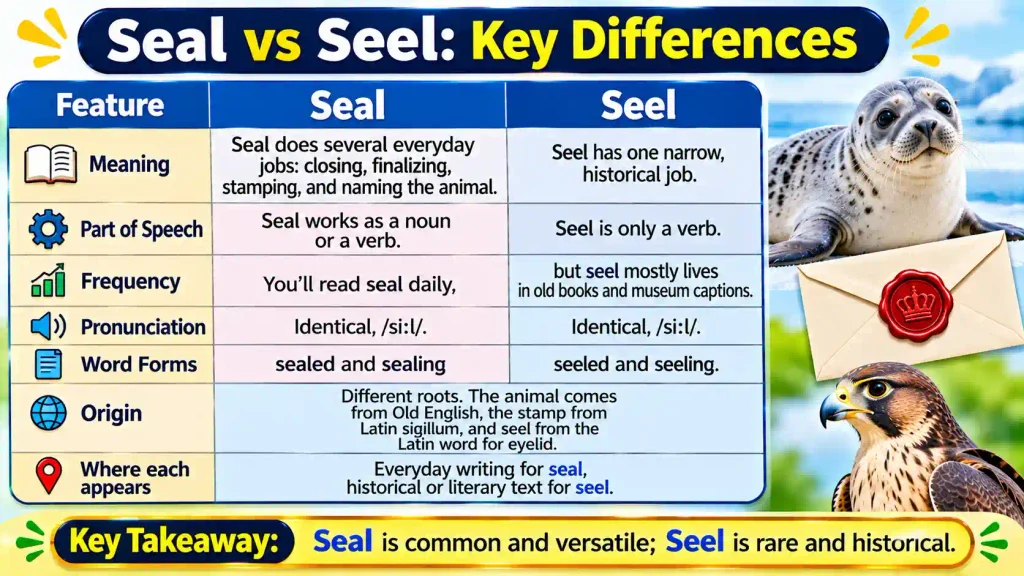
- Meaning: Seal does several everyday jobs: closing, finalizing, stamping, and naming the animal. Seel has one narrow, historical job.
- Part of speech: Seal works as a noun or a verb, while seel is only a verb.
- Frequency: You’ll read seal daily, but seel mostly lives in old books and museum captions.
- Pronunciation: Identical, /siːl/.
- Word forms: sealed and sealing versus seeled and seeling.
- Origin: Different roots. The animal comes from Old English, the stamp from Latin sigillum, and seel from the Latin word for eyelid.
- Where each appears: everyday writing for seal, historical or literary text for seel.
Why the Mix Up Happens
The two words are homophones: they sound the same and are spelled differently. Your ear can’t tell you which spelling to use, so you reach for whichever looks familiar, or whichever you typed fastest.
Then comes the spellcheck blind spot. Because seel is a real word, many spellcheckers let it through. What looks like a misspelling is really the correct spelling of the wrong word, and a basic spellchecker can’t tell the difference. That’s why seal vs seel trips up careful writers too. Even seasoned editors can miss it, since the eye reads for sense, and a real word in the wrong place passes at a glance.
It shows up in three places:
- Emails and business writing. A message reading “Happy to seel the deal on Thursday” goes out at 4:55 p.m., and nobody rereads it.
- Student essays and exams. Writers under time pressure spell by sound, and “seel” feels as plausible as “seal.”
- Older or specialist texts. A reader meets seel in a falconry book or a Shakespeare play and wonders whether it’s a misprint. It isn’t.
Social media adds speed to the mix. A caption typed on a phone, a rushed group chat message, or a one line reply to a client leaves almost no time for proofreading, and autocomplete can accept a real word in the wrong place. The fix is a search, not slower typing.
How to Remember Seal vs Seel
Two quick tricks, one for each word.
The eyes trick. Seel has two e’s, like two closed eyes, and its one real job is closing a hawk’s eyes. The verb even traces back to the Latin word for eyelid. If you aren’t writing about hawks, you don’t want the two eyed spelling.
The sea trick. Seal starts with sea, and the animal spends much of its life there. Seal and deal also share the same ea, which helps with the idiom.
If you tutor English learners, have them say both words aloud, then write only one beside a picture of a sealed envelope. A concrete image sticks better than a recited rule.
Add one habit before you hit send: search your draft for “seel.” Unless you’re discussing falconry or Shakespeare, change every one to seal. The same ea/ee swap trips people up on heal and heel, steal and steel, and peal and peel, so the check is worth making routine.
Common Mistakes With Seal vs Seel
| Wrong | Right | Why |
| Thanks for the call, I think we can seel the deal this week. | Thanks for the call, I think we can seal the deal this week. | The idiom is spelled with ea. |
| Please seel the envelope before the courier arrives. | Please seal the envelope before the courier arrives. | Closing something is seal. |
| The jar’s tamper seel was broken. | The jar’s tamper seal was broken. | A closure is a seal. |
| We saw a seel sunbathing near the pier. | We saw a seal sunbathing near the pier. | The animal is a seal. |
| The agreement was seeled on Monday. | The agreement was sealed on Monday. | Seeled is a real form, but of a different word. |
| The treaty was meant to seel peace between the two nations. | The treaty was meant to seal peace between the two nations. | Figurative use, the same word as seal the deal. |
| Please seel off the area until maintenance arrives. | Please seal off the area until maintenance arrives. | To block access is seal off. |
| Changing “seeling night” to “sealing night” in a Macbeth quote. | Leave “seeling” as printed. | The spelling is Shakespeare’s, and deliberate. |

Every wrong sentence above reads fine until you stop and check the meaning.
Quick Quiz
Try these before you read the answers.
- Fill in the blank: “Please ___ the envelope.” Answer: seal. Closing an envelope is the everyday verb.
- Fill in the blank: “We spotted a ___ on the rocks.” Answer: seal. The marine animal always takes this spelling.
- What’s wrong with “The two companies seeled the agreement”? Answer: Seel is a real word but means something else. Write sealed. The sentence is about finalizing an agreement.
- A falconry manual says the falconer would ___ the hawk’s eyes. Answer: seel. Falconry is the one place the old verb still lives.
- In “Come, seeling night,” is seeling closest in meaning to blinding, building, or hiding? Answer: blinding. Night closes the day’s eye, just as a falconer closes a hawk’s.
Seal vs Seel FAQ
Is seel a real word?
Yes, though rarely. Dictionaries list seel as an archaic verb tied to falconry, so you’ll meet it in historical texts rather than in modern emails or essays. If a writer uses it today to mean “close an envelope,” that’s a mistake, because the modern word for that job is seal.
What does seel mean?
Mainly to sew a hawk’s eyelids shut during early training. Older texts also use it for closing or blinding the eyes, as in the “seeling night” of Macbeth. It is a transitive verb, so it needs an object: you seel a bird, never just “seel.”
Is it “seal the deal” or “seel the deal”?
It’s “seal the deal.” Anyone stuck on seal vs seel for this idiom can stop there: seal means to make an agreement final, and “seel the deal” doesn’t exist.
Are seal and seel pronounced the same?
Both are /siːl/. They are homophones, so your ear can’t choose the spelling. The meaning has to, and the context on the page tells you which word the writer intended.
What is the past tense of seel?
Seeled, with seeling as the ing form. For seal, use sealed and sealing. A sentence like “they seeled the contract” mixes the two words.
Did Shakespeare use the word seel?
He did. “Come, seeling night” appears in Act 3, Scene 2 of Macbeth, where the word describes night blinding the day, a poetic twist on the falconry practice.
Keep Going: More Confusing Word Pairs
Now that seal vs seel is settled, the same sound versus spelling check works on other pairs: sea vs see, heal vs heel, steal vs steel, and peal vs peel. Browse our guide to homophones and our list of commonly misspelled words for more.
Final Thought
The whole lesson comes down to one habit: match the spelling to the meaning, not the sound. Seal covers nearly everything you will write, from envelopes and contracts to animals and agreements. Seel is a rare, archaic falconry verb that belongs in historical and literary text. Before you hit send, search your draft for “seel” and change it to seal, unless you are quoting Shakespeare or writing about hawks. If you proofread other people’s work, add “seel” to your search list next to other real word typos like form and from.
To read more: Reoccur vs Recur: What’s the Shocking Difference?2026

Elena covers lifestyle and consumer comparisons — everything from mattresses to meal kits — drawing on a background in market research. She’s known for digging past marketing copy to find the one detail that actually decides a purchase, and for admitting when two options are basically a coin flip.