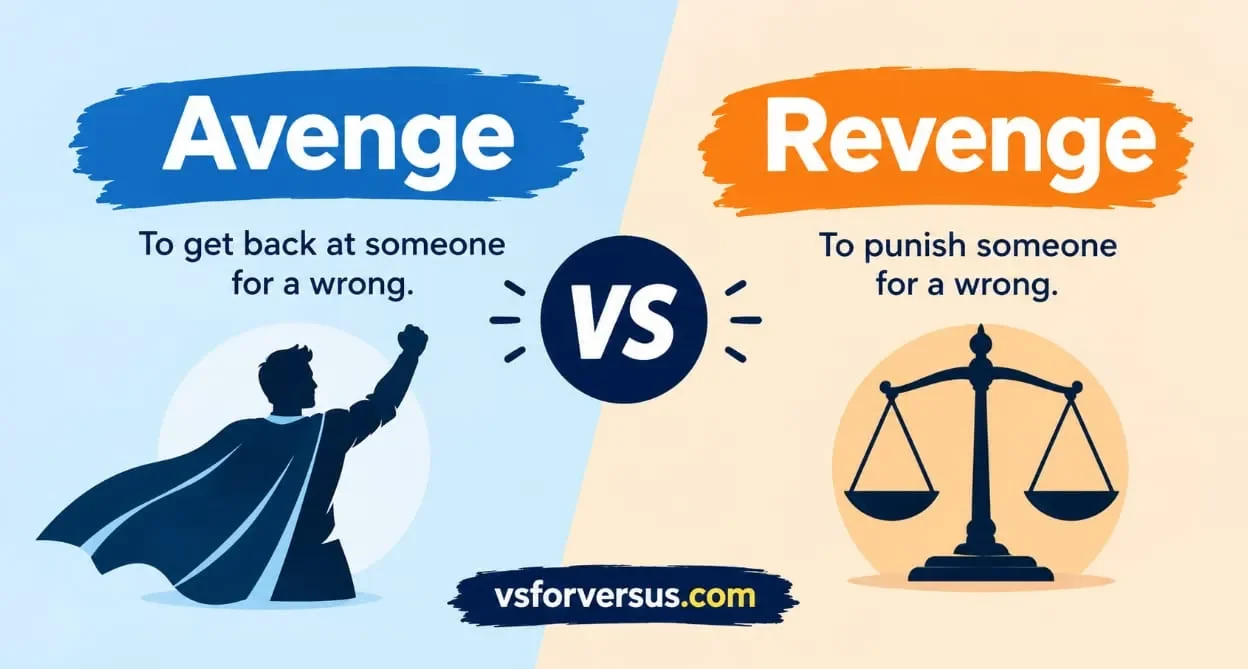
Avenge vs Revenge these two words share the same Latin root and nearly identical spelling, yet they carry a subtle but important difference in tone and intent. Both involve responding to a wrong, but the motivation behind each word sets them worlds apart.
Avenge typically carries a sense of justice or moral righteousness, often used when someone seeks retribution on behalf of another person or a greater cause, as in “he vowed to avenge his father’s death.” Revenge, on the other hand, is usually driven by personal anger or a desire for payback, often seen as selfish or emotionally charged, as in “she wanted revenge for the betrayal.”
This distinction matters in storytelling, legal contexts, and everyday conversation, where tone can completely shift a sentence’s meaning. In this article, we’ll break down the origins of both words, their correct usage, and clear examples to help you use them precisely.
Quick Answer
Avenge is a verb that means to take payback for a wrong done to someone else: She avenged her brother. Revenge is usually a noun that names the payback itself: He took revenge on his rival. The simplest avenge vs revenge rule is this: you avenge the person who was wronged, and you take revenge on the person who did the wrong.
Why This Pair Trips People Up
Three things work against you. The words share an Old French ancestry and the same venge ending, so they feel like cousins. Both describe getting even for a wrong. And revenge can technically act as a verb, which makes the usual advice (“one is a verb, one is a noun”) feel incomplete. A writer who spots “take revenge” in a sentence can reasonably wonder whether the rule is wrong. It isn’t, as the next sections show.
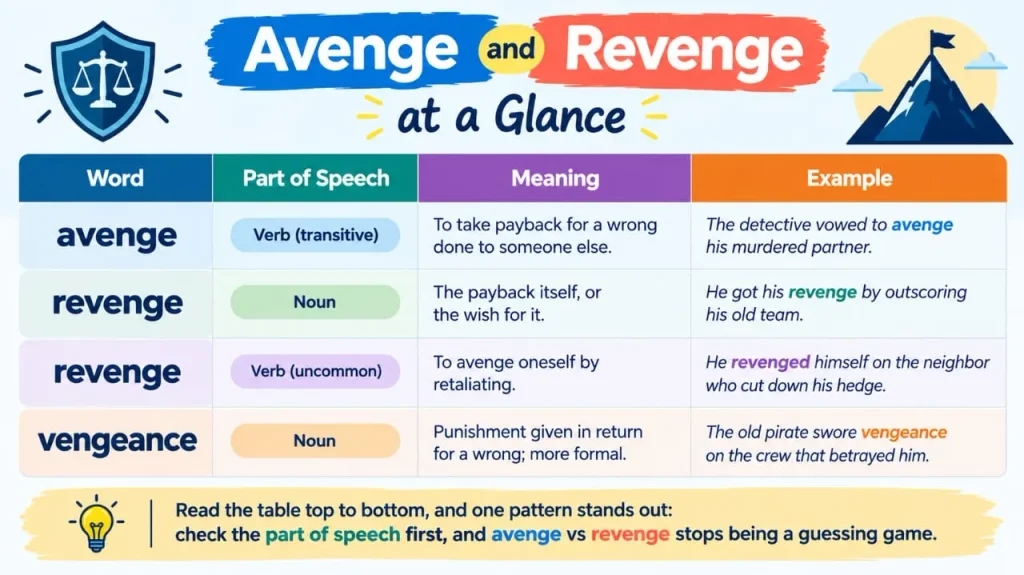
Avenge vs Revenge at a Glance
| Word | Part of Speech | Meaning | Example |
| avenge | Verb (transitive) | To take payback for a wrong done to someone else | The detective vowed to avenge his murdered partner. |
| revenge | Noun | The payback itself, or the wish for it | He got his revenge by outscoring his old team. |
| revenge | Verb (uncommon) | To avenge oneself by retaliating | He revenged himself on the neighbor who cut down his hedge. |
| vengeance | Noun | Punishment given in return for a wrong; more formal | The old pirate swore vengeance on the crew that betrayed him. |
Read the table top to bottom, and one pattern stands out: check the part of speech first, and avenge vs revenge stops being a guessing game.
What Does Avenge Mean?
Avenge is a transitive word, so it needs a direct object: usually the person who was wronged, or the wrong itself. To avenge someone is to punish whoever harmed them, and to avenge an insult or a death is to answer it. The word family is small: avenge, avenges, avenged, avenging, plus avenger for the person doing it. Avenge is never a noun, so nobody “takes an avenge.”
Real writing tends to look like this:
- The Hawks avenged last season’s playoff loss with a 3–0 sweep on Saturday.
- She avenged the ruined wedding with a one star review that went viral.
- In Act 4, Laertes storms back to Denmark to avenge his father’s death.
- Her brother wanted to avenge the insult, but their mother talked him out of it.
Sports reports, literary essays, news features, and fantasy fiction are where avenge lives. It carries a slightly dramatic, formal flavor, which can sound heavy in an everyday email. In a workplace message, “I want to avenge the missed deadline” would read as a joke. For ordinary frustration, choose a plainer phrase like “make up for.”
What Does Revenge Mean?
Revenge is usually a noun. It names the payback, or the desire for payback. The typical collocations are take revenge, seek revenge, get revenge, plot revenge, and sweet revenge, followed by on or against the person and for the wrong.
- He plotted revenge for months after his old partner walked off with the client list.
- After the bath, the cat got her revenge by shredding the couch cushion.
- My sister’s revenge for the spoiler was hiding the remote for a week.
- Police said the vandalism looked like revenge, not random mischief.
Revenge turns up everywhere: crime reporting, film and game titles, workplace gossip, and the occasional dramatic text to a friend. Because it is the everyday word, it often gets pressed into service as a verb by mistake. In formal business or legal writing, retaliation is usually the safer choice, since revenge signals a personal grudge rather than a documented action.
The “Take Revenge” Trap
Learners often ask whether revenge is a verb in “time to take revenge.” It is not. Take is the verb, and revenge is its object, so revenge is still a noun. A quick test: swap in another noun. “Time to take a break” has exactly the same structure, and so do seek revenge, get revenge, and plot revenge. In each one, a different verb does the work, and revenge simply names the thing.
Can Revenge Be a Verb?
Yes, but it is uncommon. Merriam Webster, for one, lists revenge oneself on as an idiom, and that reflexive pattern is where the verb mostly survives: “He revenged himself on his rival.” Outside it, “revenge someone” is rare, and some usage guides treat it as an error. In modern writing, reach for avenge or take revenge on instead.
Key Differences Between Avenge vs Revenge
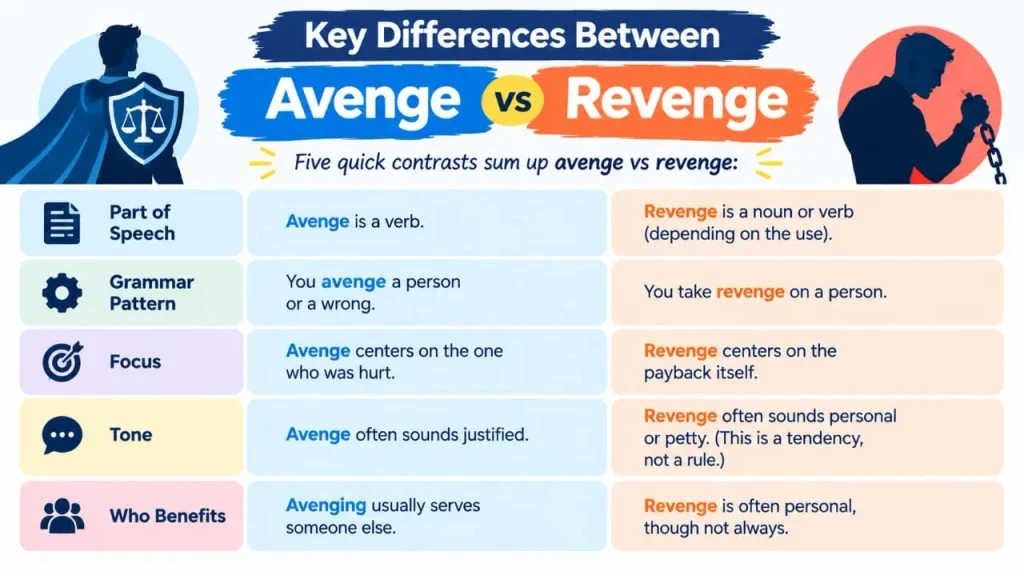
Five quick contrasts sum up avenge vs revenge:
- Part of speech: Avenge is a verb.
- Grammar pattern: You avenge a person or a wrong. You take revenge on a person.
- Focus: Avenge centers on the one who was hurt. Revenge centers on the payback itself.
- Tone: Avenge often sounds justified. Revenge often sounds personal or petty. This is a tendency, not a rule.
- Who benefits: Avenging usually serves someone else. Revenge is often personal, though not always.
Why You’ll See Three Different Rules Online
Search for avenge vs revenge, and you will find three explanations that do not always agree. That is why this pair feels so slippery.
| Rule you’ll see | What it says | Where it works | Where it breaks |
| Part of speech | Avenge is a verb, revenge a noun | Most everyday sentences | Fails once revenge is used as a verb |
| Who benefits | Avenge is for others, revenge for yourself | Family and friend examples | Fails with “avenge himself” |
| Motive | Avenge means justice, revenge means resentment | Moral or literary framing | Subjective, and some writers use avenge for plain score settling |
Start with part of speech, the most reliable test. Then use the other two rules to fine tune tone once the grammar is settled. If a sentence needs a verb, avenge is the safe choice. If you want to hint that the act was personal or petty, rewrite it with the noun instead: “She took revenge on the landlord.”
Prepositions and Reflexives: On, For, and Against
Prepositions cause a lot of the trouble, so these patterns are worth learning.
- Avenge needs no preposition for the wronged party or the wrong: avenge his brother, avenge the insult.
- To name the wrongdoer, add on: She avenged her brother on his attackers.
- Reflexive: avenge oneself on works: “He avenged himself on the rival who sabotaged him.”
- Passive: be avenged, as in “Her death will be avenged.”
- The noun revenge takes on or against the wrongdoer and for the wrong: “revenge on the landlord for the leaked emails.”
Avenge, Vengeance, and Retaliation
Vengeance is a noun, and it sits at a more formal, literary register: “She swore vengeance.” Retaliation is the neutral, journalistic word: “Officials warned of retaliation.” Retribution means deserved punishment, and payback is the casual option. Hunting for a synonym? For revenge, try payback or retribution.
How to Remember the Difference?
Four tools can help, especially if you are learning English.
- The action trick: Avenge is the action you take to get revenge.
- The object test: If the hurt person comes right after the word, use avenge. If on and the wrongdoer follows, use revenge.
- The tone check: If the point is justice for someone else, avenge carries that feel. If it is a personal grudge, revenge does.
- The one liner: Avenge the wronged, take revenge on the wrongdoer.
When you’re stuck on avenge vs revenge, the object test is the fastest of the four. Like, this is a verb and noun pair, so checking the part of speech first gets you most of the way there.
Common Mistakes with Avenge vs Revenge
Even experienced writers slip here. Headlines written against a deadline are an easy place for it: “Rovers revenge Tuesday’s defeat” reads fast and is still wrong. Cover letters and essays are no safer, since writers reach for a weighty sounding verb and grab the wrong one. Most avenge vs revenge errors fall into the five patterns below, and each has a quick fix.
| ❌ Incorrect | ✅ Correct | Why |
| Rovers revenge Tuesday’s defeat. | Rovers avenge Tuesday’s defeat. | Avenge is the standard verb. |
| She took her avenge on him. | She took her revenge on him. | Avenge is never a noun. |
| They want to avenge on their boss. | They want to take revenge on their boss. | Avenge takes the wronged party, not the wrongdoer after on. |
| I will revenge you. | I will avenge you. | Avenge is the standard verb for the wronged person. |
| He plotted his avenge. | He plotted his revenge. | A noun is needed after his. |
Quick Quiz: Avenge or Revenge?
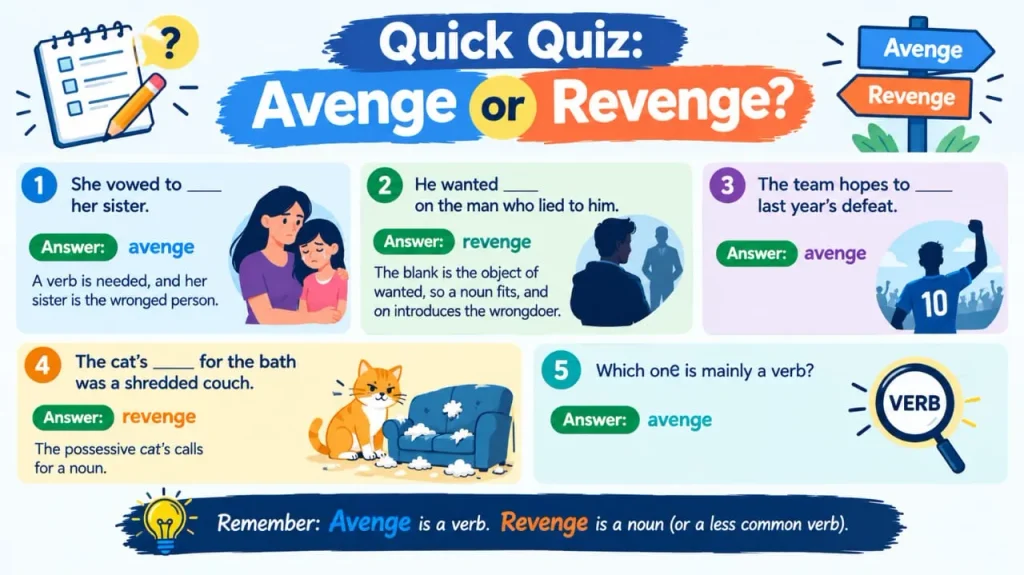
- She vowed to ____ her sister. Answer: avenge. A verb is needed, and her sister is the wronged person.
- He wanted ____ on the man who lied to him. Answer: revenge. The blank is the object of wanted, so a noun fits, and on introduces the wrongdoer.
- The team hopes to ____ last year’s defeat. Answer: avenge.
- The cat’s ____ for the bath was a shredded couch. Answer: revenge. The possessive cat’s calls for a noun.
- Which one is mainly a verb? Answer: avenge.
Frequently Asked Questions
What is the difference between avenge vs revenge?
Avenge is a verb meaning to take payback for a wrong done to someone else. Revenge is usually a noun meaning the payback itself. You avenge a person, but you take revenge on the wrongdoer.
Is revenge a verb or a noun?
Revenge is mostly a noun, as in “take revenge.” It can occasionally be a verb, usually in the reflexive pattern “revenge oneself on,” but that use is uncommon. In everyday writing, avenge is the standard verb.
Can you say “revenge someone”?
Saying “revenge someone” is uncommon, and some usage guides treat it as an error. To act on behalf of the person who was wronged, write “avenge your brother.” To name the person who did the wrong, write “take revenge on the attacker.”
Is it “avenge on” or “avenge for”?
Use “avenge on” to name the wrongdoer, as in “She avenged her brother on his attackers.” Avenge usually takes the wronged person or the wrong directly. With the noun, “revenge for” introduces the wrong, as in “revenge for the leaked emails.”
Can you avenge yourself?
Yes. Avenge works reflexively: “He avenged himself on the rival who sabotaged him.” The matching noun pattern is “take revenge on.” The verb revenge also appears reflexively, as in “revenge oneself on,” but that is the less common option.
Avenge vs revenge: which one do I use in a sentence?
To choose between avenge and revenge, check the part of speech first. If the sentence needs a verb, use avenge. If it needs a noun, use revenge. Then run the object test: the wronged person right after the word means avenge, and on plus the wrongdoer means revenge.
Final Thoughts
The short version of avenge vs revenge is this: avenge is the verb, revenge is the noun, and the object test settles most cases. When you want to act for someone who was hurt, avenge them. When you want to name the payback, or aim it at the wrongdoer, take revenge on them. Keep the one liner handy: avenge the wronged, take revenge on the wrongdoer.
Write three sentences of your own and run the object test on each; the words stick fast.
To read more: Awaiting vs Waiting: 7 Surprising Mistakes You Must Avoid (2026)

Marcus is a former product manager turned comparison writer who spent eight years testing tools and gadgets before quitting to write full-time. He specializes in breaking down tech and software matchups into plain-English verdicts, with a soft spot for buying guides nobody else wants to write.