
Awaiting vs Waiting these two words feel almost identical in everyday speech, yet a closer look reveals differences in grammar, tone, and how they connect to the thing being expected. Both describe being in a state of expectation, but they don’t always fit the same sentence structure.
Waiting is the more common, flexible form, usually followed by a preposition such as “for,” as in “she is waiting for the bus,” and works naturally in casual and formal contexts alike. Awaiting, on the other hand, is a more formal verb that takes a direct object without any preposition, as in “the team is awaiting the final results.” Because of this, “awaiting for” is considered incorrect, a slip that appears surprisingly often in emails and reports.
In this article, we’ll break down the grammar behind both words, show when each one sounds best, and share clear examples to help you use them with confidence.
Quick Answer:
Awaiting is the present participle of the formal verb await. It takes its object directly, with no preposition: “We are awaiting your reply.” Waiting is the present participle of the everyday verb wait. It usually needs “for” before its object: “We are waiting for your reply.”
So awaiting vs waiting is a question of grammar and tone, not meaning. Never write “awaiting for.” If you are unsure, “waiting for” is the safe choice in almost any situation.
Awaiting vs Waiting at a Glance
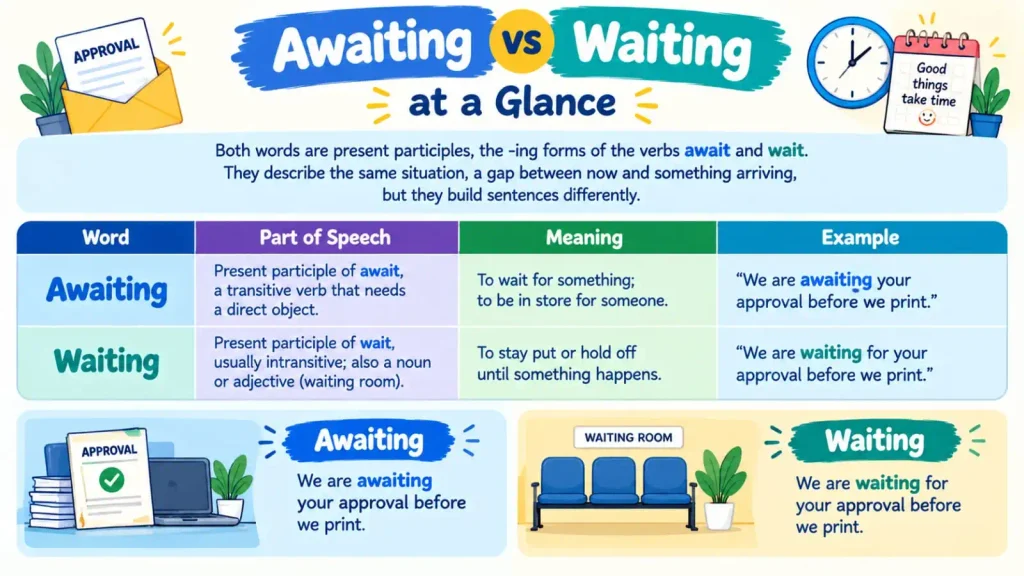
Both words are present participles, the -ing forms of the verbs await and wait. They describe the same situation, a gap between now and something arriving, but they build sentences differently.
| Word | Part of Speech | Meaning | Example |
| Awaiting | Present participle of await, a transitive verb that needs a direct object | To wait for something; to be in store for someone | We are awaiting your approval before we print. |
| Waiting | Present participle of wait, usually intransitive; also a noun or adjective (waiting room) | To stay put or hold off until something happens | We are waiting for your approval before we print. |
What Does “Waiting” Mean?
Waiting is the simpler of the two: you stay where you are, or hold off on acting, until something happens or someone shows up. It’s the everyday default, and it’s flexible. It can stand alone (I’m waiting), take “for” plus a noun, or lead into an infinitive or a time phrase.
- I’m waiting for the 8:15 train, and it’s already late.
- We’re waiting to hear back from the landlord about the lease.
- She waited until everyone had left before opening the envelope.
- I’ve been waiting all afternoon, so please just send it.
You’ll find waiting in conversation, texts, dialogue, and casual or neutral emails. A related form, waiting on, is common in everyday American speech (“still waiting on the report”); our guide to waiting on vs waiting for covers it.
What Does “Awaiting” Mean?
Await has two closely linked senses. The first is to wait for something, in a more formal register. The second is to be in store for someone, as in “A surprise awaits you.” In both senses, the verb is transitive, so whatever is being waited for comes directly after it, with no “for.” Awaiting, as the present participle of await, inherits that requirement, which is why carrying the “for” habit over from waiting is such a common error.
- We’re awaiting your confirmation and will book the venue the moment it arrives.
- The defendant is awaiting trial.
- Your order is awaiting shipment.
- A stack of unopened mail was awaiting her on the hall table.
You’ll see awaiting in formal emails, official notices, legal and news writing, and status labels such as “awaiting payment” or “awaiting approval.” Status labels sometimes use pending instead; our guide to pending vs awaiting covers that choice.
Key Differences Between Awaiting vs Waiting
If you remember one thing about awaiting vs waiting, make it the first point below: the grammar differs even though the meaning barely does.
- Grammar: await takes a direct object. Wait takes “for,” “to + verb,” or “until,” or nothing at all.
- Completeness: “I’m waiting” is a full sentence. “I’m awaiting” leaves the reader hanging.
- Register: awaiting reads as formal and written; waiting is neutral and everyday.
- Infinitives: “waiting to hear” is standard. “Awaiting to hear” is not standard English.
- People: “waiting for her” is normal. “Awaiting her” is possible but formal or literary.
- Frequency: in speech, waiting wins by a wide margin.

Do You Say “Awaiting For”?
No. Awaiting already contains the idea of “waiting for,” so its object follows directly: awaiting your reply, not awaiting for your reply. Save the preposition for waiting: waiting for your reply.
The error is easy to make because “waiting for” is one of the most familiar phrases in English. Writers hear it so often that the preposition tags along even after they switch to the more formal verb.
Awaiting and Waiting With Things as the Subject
Things can do the waiting too: a pile of mail, a surprise, a to do list. When that happens, await puts the person on the receiving end right after the verb: “Forty unread messages are awaiting me.” Wait needs the preposition: “Forty unread messages are waiting for me.” Both are fine, and both follow the same rule in disguise. With await, “me” is the direct object; with wait, “me” comes after “for.”
The same logic explains stock lines such as “A surprise awaits you” and “Two packages were awaiting her outside the door.” Wait works here too (a surprise is waiting for you). The difference is structure and tone, not whether a thing can be the subject.
Awaiting vs Waiting in Real Writing
The same split shows up wherever people write. A Slack message might say, “Still waiting for legal to sign off, but it should be today.” A news report would more likely say, “Several bills remain awaiting a vote in the Senate.” On social media, a frustrated shopper posts, “Day four of waiting for my package, and tracking still says ‘awaiting carrier pickup.'” And a client email? “Hi Maria, we’re awaiting the signed contract and will start work as soon as it arrives.”
The pattern is consistent: casual, human voices reach for waiting, and official voices (the tracking system, the reporter, the account manager) reach for awaiting.
Which Sounds Right Where?
Underneath awaiting vs waiting is a simple choice between formal and informal English. Think of it as a ladder:
- “I await your reply.” Ceremonial; to many ears it sounds old-fashioned.
- “I am awaiting your reply.” Formal and common in business English.
- “I’m waiting for your reply.” Neutral, natural, and safe.
Some pairings are fixed collocations. Awaiting confirmation, awaiting approval, awaiting payment, and awaiting shipment are standard wording in business and customer service writing. Compare “we’re awaiting confirmation” with “we’re waiting for confirmation”: same meaning, different temperature.
| Context | Best Choice | Example |
| Email to a client | Awaiting | We’re awaiting your sign-off before we send the final files. |
| Text to a friend | Waiting | I’m waiting outside. No rush. |
| Order or ticket status | Awaiting | Awaiting payment |
| Legal or news report | Awaiting | Both men are awaiting trial. |
| Healthcare | Awaiting | The patient is awaiting test results. |
| Academic publishing | Awaiting | The manuscript is awaiting peer review. |
One small point on labels: “Awaiting response” is fine as a short status, but in a full sentence add “your”: “We are awaiting your response.”
How to Remember the Difference
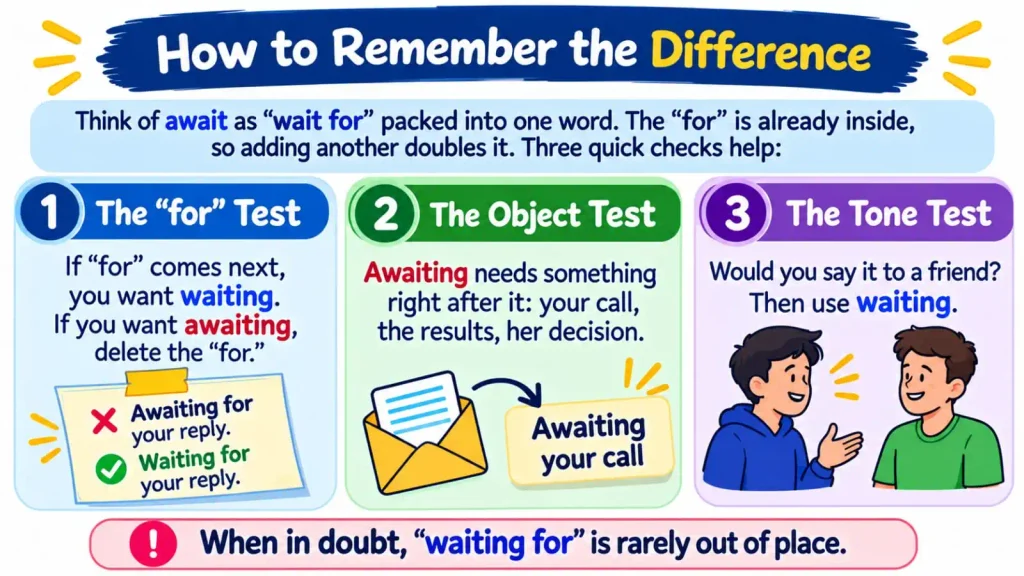
The easiest way to keep awaiting vs waiting straight is to think of await as “wait for” packed into one word. The “for” is already inside, so adding another doubles it. (That is a memory aid, not a claim about the word’s history.) Three quick checks help:
- The “for” test. If “for” comes next, you want waiting. If you want awaiting, delete the “for.”
- The object test. Awaiting needs something right after it: your call, the results, her decision.
- The tone test. Would you say it to a friend? Then use waiting.
When in doubt, “waiting for” is rarely out of place.
Common Mistakes: Wrong vs Correct
Most errors with awaiting vs waiting fall into a handful of patterns, and the first one trips up even experienced writers. It usually happens during editing: someone upgrades “waiting for your reply” to “awaiting” to sound more professional, and the old “for” survives the swap. A good habit: whenever you promote waiting to awaiting, look at the very next word and delete any “for.”
- ✗ We are awaiting for your approval. → ✓ We are awaiting your approval. (Or: We are waiting for your approval.)
- ✗ I’m waiting your reply. → ✓ I’m waiting for your reply.
- ✗ Sorry, I’m still awaiting. → ✓ Sorry, I’m still waiting. (Or: I’m still awaiting your call.)
- ✗ I’m awaiting to hear from the committee. → ✓ I’m waiting to hear from the committee.
- ✗ We’re awaiting at the station. → ✓ We’re waiting at the station.
One last example is correct but stiff: “I’m awaiting you at the café” is grammatical, yet it sounds like a period drama. In a text to a friend, “I’m waiting for you at the café” is what people actually write. For related slips, see our guide to transitive and intransitive verbs.
Quick Quiz: Test Yourself
Here are five questions to check your grip on these two words. Try each one before reading the answer.
- I’m ___ for your reply. Answer: waiting. “For” can’t follow awaiting.
- We are ___ your confirmation. Answer: awaiting. The object follows directly; waiting would need “for.”
- Which is correct: (A) I’m awaiting to hear back, or (B) I’m waiting to hear back? Answer: B. Standard English uses a to-infinitive after waiting.
- Two packages were ___ her outside the door. Answer: awaiting. The person comes right after the verb.
- In a text to a friend, which is most natural: (A) I’m awaiting you at the café, (B) I’m waiting for you at the café, or (C) I await you at the café? Answer: B. The others are grammatical but stiff.
FAQ
Is it “awaiting” or “waiting” in an email?
Both are correct. “Awaiting your reply” is the more formal choice, and “waiting for your reply” sounds warmer. Use awaiting with a client or an official, and waiting with a colleague or friend.
Is “awaiting for” correct English?
No. Write “awaiting your reply” or “waiting for your reply,” but never “awaiting for your reply.”
Is awaiting more formal than waiting?
Yes. Awaiting is more common in written, official, and business English, while waiting dominates everyday speech.
What is the difference between await and wait?
The awaiting vs waiting split mirrors the verbs underneath. Await is transitive, takes a direct object, and is the more formal of the two. Wait usually takes “for” or stands alone.
Can I say “waiting your reply” without “for”?
No. Write “waiting for your reply,” or switch to “awaiting your reply.”
Is “awaiting response” professional?
Yes, as a short label or status. In a full sentence, add “your”: “We are awaiting your response.”
Final Thoughts
Awaiting vs waiting comes down to one small preposition and one honest question about tone. Drop the “for” after awaiting, keep it after waiting when an object follows, and ask whether the sentence sounds like something you’d say out loud. If it doesn’t, switch words. And when you’re unsure, “waiting for” will rarely let you down.
Related guides: waiting on vs waiting for · pending vs awaiting · expect vs anticipate vs await · look forward to hearing from you gerund vs present participle
To read more: Anime vs Manga: 5 Crucial Differences Every Fan Should Know

Marcus is a former product manager turned comparison writer who spent eight years testing tools and gadgets before quitting to write full-time. He specializes in breaking down tech and software matchups into plain-English verdicts, with a soft spot for buying guides nobody else wants to write.