
Language learners and even native speakers often confuse the words “migrate” vs “immigrate,” yet these terms carry distinct meanings rooted in perspective and direction. Both words describe the act of moving from one place to another, but the context in which they are used makes all the difference.
“Migrate” is a broader term, often used for movement between locations, whether by people, animals, or birds, without specifying a permanent destination.
“Immigrate,” on the other hand, specifically refers to people entering and setting in a new country from abroad, usually with the intention of staying long term. Understanding this subtle distinction not only improves your vocabulary but also helps you communicate more precisely in both everyday conversations and formal writing, especially when discussing travel, relocation, or global human movement.
Quick Answer
Migrate means to move from one place to another, often temporarily or without a fixed direction (used for animals, general populations, or even data). Immigrate means to move permanently into a new country to live there, usually through a formal process.
When comparing migrate vs immigrate, the simplest rule is this: migrate describes general movement, while immigrate describes permanent entry into a country.
Migrate vs Immigrate at a Glance
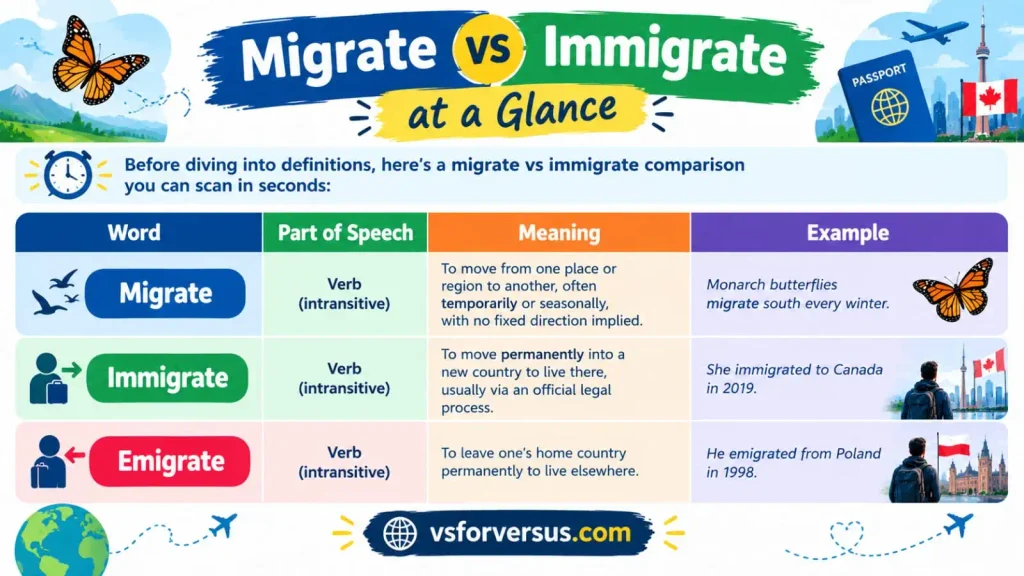
Before diving into definitions, here’s a migrate vs immigrate comparison you can scan in seconds:
| Word | Part of Speech | Meaning | Example |
| Migrate | Verb (intransitive) | To move from one place or region to another, often temporarily or seasonally, with no fixed direction implied | Monarch butterflies migrate south every winter. |
| Immigrate | Verb (intransitive) | To move permanently into a new country to live there, usually via an official legal process | She immigrated to Canada in 2019. |
| Emigrate | Verb (intransitive) | To leave one’s home country permanently to live elsewhere | He emigrated from Poland in 1998. |
What Does “Migrate” Mean?
Migrate is an intransitive verb of movement. It describes relocation from one place to another without specifying a fixed destination or permanence. The move can be seasonal, temporary, one time, or even metaphorical, which is why the word shows up everywhere from nature documentaries to IT departments.
Examples:
- Every autumn, thousands of geese migrate south along the same route their parents flew.
- Our IT team plans to migrate all customer data to the new cloud platform by Friday.
- Rural workers often migrate to the capital during harvest season looking for temporary work.
- Archaeologists believe early humans migrated across the land bridge thousands of years ago.
Common contexts: nature and animal migration writing, seasonal labor and cross border movement, tech and business (data migration is now one of the world’s most common uses), and general historical or academic writing about population shifts.
What Does “Immigrate” Mean?
Immigrate is also intransitive, but it describes a specific kind of movement: entering a new country with the intention of living there permanently. It’s almost always paired with the preposition “to,” and it carries a sense of formality visas, applications, and legal status usually sit close behind this word.
Examples:
- My uncle immigrated to Canada in the early 1990s and never looked back.
- She immigrated to the U.S. under a skilled worker visa after years on a waiting list.
- In her thesis, she examines how families who immigrated during the 1980s adapted to new school systems.
- The report found that most people who immigrated last year cited job opportunities as their primary reason.
Common contexts: immigration law and paperwork, personal and family history writing, journalism, and academic work discussing human immigration and demographic change.
Key Differences Between Migrate and Immigrate
Once you see the pattern, migrate vs immigrate becomes much easier to spot:
- Direction: Migrate has no fixed direction; immigrate always means moving into a country.
- Permanence: Migrate is often temporary or cyclical; immigrate implies a permanent move.
- Preposition: Migrate has no required preposition (“migrate to/from/between”); immigrate is almost always “immigrate to.”
- Legal implication: Migrate is neutral and doesn’t imply a formal process; immigrate implies legal immigration status, paperwork, or a visa process.
- Verb category: Immigrate and emigrate are classified as directional verbs; migrate is not.
- Subject: Migrate applies to animals, people, populations, and even data; immigrate applies only to people.
Preposition Cheat Sheet
Since preposition mix ups are one of the most common mistakes with this word pair, here’s a quick reference:
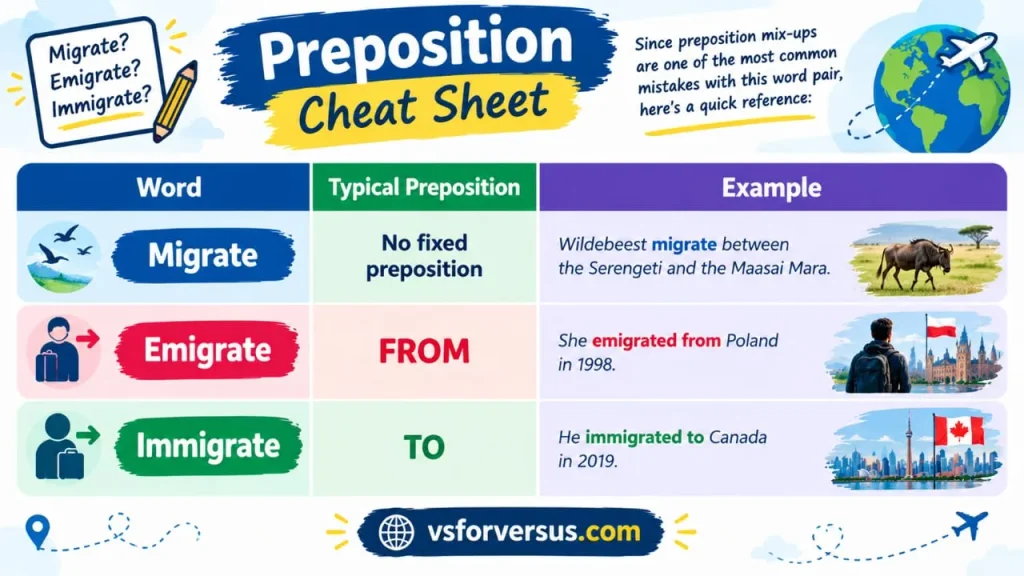
| Word | Typical Preposition | Example |
| Migrate | No fixed preposition | Wildebeest migrate between the Serengeti and the Maasai Mara. |
| Emigrate | FROM | She emigrated from Poland in 1998. |
| Immigrate | TO | He immigrated to Canada in 2019. |
Memory Trick How to Never Mix Them Up Again?
Here’s where even experienced writers slip: because both words start with a similar sound and describe movement, spellcheck won’t catch the difference, and neither will a fast read through. The fix isn’t memorizing a definition. It’s building a mental shortcut.
Try this: “IM” is for IN, IMmigrate means moving IN to a new country to stay. Migrate, on the other hand, has no built in direction; it just means “move,” plain and simple.
If you’re studying emigrate too, borrow a trick English teachers have used for decades: Emigrate FROM, Immigrate TO, think Exit versus In.
There’s a tidy etymological reason this works, as well. Both words trace back to the Latin root migrare, meaning “to move.” The prefixes do the real work: im (a form of in) means “into,” while e means “out of.” That’s exactly why immigrate points inward and emigrate points outward. Migrate keeps neither prefix, which is why it stays direction neutral.
Common Mistakes with Migrate vs Immigrate
Because this pair hinges on such a small shift in meaning, mistakes show up even in polished writing. Here are the ones we see most often:
| ❌ Wrong | ✅ Correct | Why |
| “She migrated to the U.S. to become a citizen.” | “She immigrated to the U.S. to become a citizen.” | Citizenship implies a permanent, legal move — that’s immigrate. |
| “The birds immigrated south for the winter.” | “The birds migrated south for the winter.” | Seasonal, non-permanent movement is migrate, not immigrate. |
| “He immigrated from France last spring.” | “He emigrated from France last spring.” | Immigrate pairs with “to,” not “from.” |
| “Our whole team migrated into the London office permanently, and everyone’s applying for visas.” | “Our whole team immigrated to the UK to work out of the London office, and everyone’s applying for visas.” | A permanent, legal relocation of people calls for immigrate. |
Quick Quiz Test Yourself
Try to answer each question before checking the answer key at the end. This tests whether the migrate vs immigrate distinction has actually clicked, not just whether you can recognize the words.
- Every winter, arctic terns ______ thousands of miles. (migrate/immigrate)
- My grandparents ______ to Canada from Italy in 1962. (migrated/immigrated)
- The company decided to ______ its data to a new server. (migrate/immigrate)
- True or False: “Immigrate” always implies permanence.
- Which word naturally pairs with the preposition “to” migrate or immigrate?
Answer key (no peeking until you’ve tried all five)
- Migrate — seasonal, no fixed direction implied.
- Immigrated — permanent settlement in a new country.
- Migrate — data has no “citizenship,” so no legal/permanent implication applies.
- True — immigrate always implies a permanent move.
- Immigrate — “immigrate to” is the standard pairing.
FAQ Migrate vs Immigrate
What is the difference between migrate and immigrate?
Migrate describes general movement from one place to another, often temporary or without a fixed direction. Immigrate specifically means moving permanently into a new country to live there. The core migrate vs immigrate distinction comes down to permanence and direction.
Do you say “migrated” or “immigrated” in the past tense, and does it matter?
Both are correct past tense forms, but which one to use depends on meaning, not grammar. If the movement was seasonal or undirected, use “migrated.” If someone permanently settled in a new country, “immigrated” is accurate.
Can you use “migrate” for a person, or only animals?
Yes, “migrate” works for people too, and it simply implies the movement isn’t necessarily permanent or tied to one country. Workers who relocate seasonally migrate; someone settling permanently in a new country immigrates.
Is it “immigrate to” or “immigrate into” a country?
“Immigrate to” is the standard, natural phrasing. “Immigrate into” isn’t technically wrong, but it sounds unnatural and is rarely used in formal or native writing.
Is it wrong or informal to say someone “migrated” to a country instead of “immigrated”?
It’s not wrong, but it can sound imprecise. Saying someone “migrated” to a country leaves out whether the move was permanent or legal, while “immigrated” makes that clear. In formal writing legal documents, academic papers, or news reporting “immigrated” is almost always the more accurate choice for a permanent relocation.
What’s the difference between “migrated” and simply “moved” or “relocated”?
“Moved” and “relocated” are neutral, everyday synonyms that don’t specify whether a border was crossed or whether the move was permanent. “Migrated” carries a slightly more technical, biological, or demographic tone and is often used for larger patterns of movement rather than a single person’s move across town.
What’s the difference between migrate, emigrate, and immigrate?
All three describe movement, just from different vantage points. Emigrate focuses on leaving a country, immigrate focuses on entering one, and migrate is the neutral term that specifies neither direction nor permanence, which is also what separates immigration from migration as broader concepts.
Why do people confuse migrate and immigrate so often?
The words look alike, sound alike, and both involve movement, so the difference feels subtle even though the meaning shift is significant. Once you anchor the migrate vs immigrate distinction to permanence and direction rather than spelling, the confusion tends to disappear, even for native speakers.
Conclusions
At the end of the day, migrate vs immigrate comes down to two simple questions: is the movement permanent, and is it into a country? If the answer to both is yes, reach for immigrate. If the movement is temporary, seasonal, or doesn’t specify a direction, migrate is your word.
The grad school applicant from our opening story didn’t need a grammar lecture, just this one distinction, and it changed how her entire story was read.
To read more: “Invision vs Envision: The Shocking Truth About Which Spelling Is Correct in 2026”

Marcus is a former product manager turned comparison writer who spent eight years testing tools and gadgets before quitting to write full-time. He specializes in breaking down tech and software matchups into plain-English verdicts, with a soft spot for buying guides nobody else wants to write.