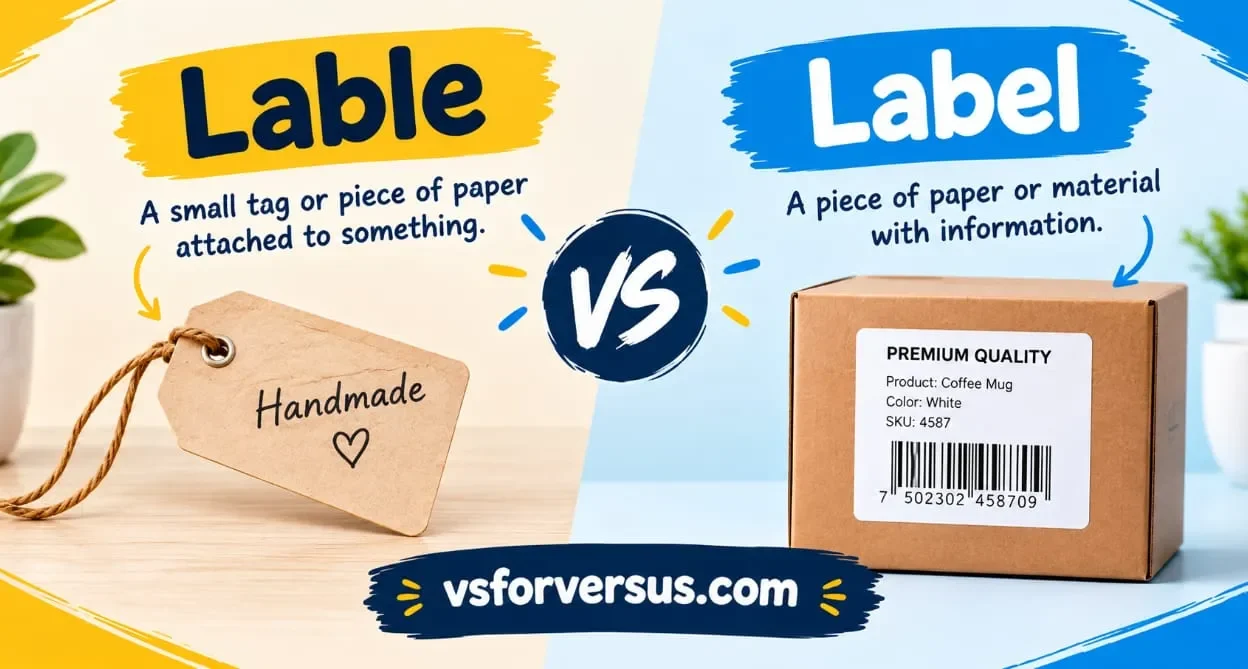
Label vs Label unlike most word pairs on this list, this one isn’t really a battle between two correct words, but rather a common spelling slip that trips up even confident writers. Label is the correct and only standard spelling in English, referring to a small piece of paper, fabric, or material attached to an item to identify it, describe its contents, or provide instructions; think of a price label or a warning label.
Lable, on the other hand, is simply an incorrect spelling, often the result of a typo or a mix up with similar looking words. There’s no dictionary, style guide, or grammar rule that recognizes “lable” as valid. Yet this mistake shows up surprisingly often, especially among fast typists and non native English speakers. In this article, we’ll clear up this common confusion, explain the correct spelling rule behind “label,” and share tips to help you avoid this mistake for good.
Quick Answer
The correct spelling is “label,” vs “lable” is not a real word in any dialect of English; it’s simply a common misspelling. This lable vs label mix up usually happens because “label” sounds like it should rhyme with words ending in ” able,” when it’s actually spelled with ” el” at the end, the same way “table” and “cable” are. Label can work as either a noun, referring to a tag that identifies something, or a verb, meaning to attach that tag or assign something to a category.
Lable vs Label at a Glance
Before going further, here’s the short version in table form. This is the kind of comparison worth bookmarking if you write labels, tags, or product copy regularly.
| Word | Part of Speech | Meaning | Example |
| Label | Noun | A tag or marker that identifies or describes something | “Check the label before you toss that shirt in the dryer.” |
| Label | Verb | To attach a tag, or to categorize something or someone | “Can you label these folders before Monday’s meeting?” |
| Lable | — | Not a real word; a common misspelling of “label” | “Read the lable” → “Read the label” |
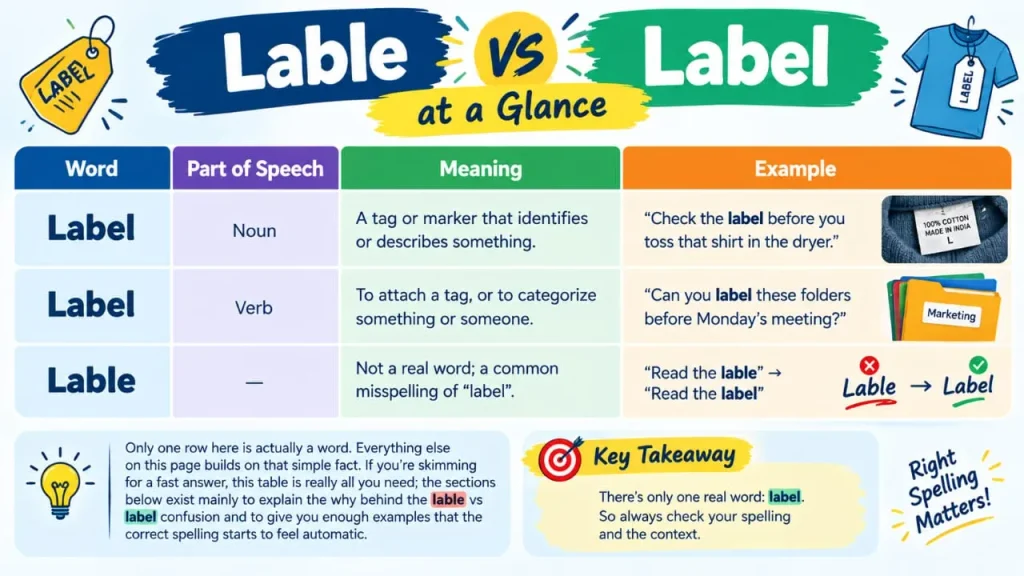
Only one row here is actually a word. Everything else on this page builds on that simple fact. If you’re skimming for a fast answer, this table is really all you need; the sections below exist mainly to explain the why behind the lable vs label confusion and to give you enough examples that the correct spelling starts to feel automatic.
What Does “Label” Mean?
As a noun, a label is a piece of material (paper, fabric, plastic) attached to something to identify it or give information about it. It can also refer, more figuratively, to a name or category assigned to a person, idea, or group, and in the fashion or music industry, it refers to a brand or company.
As a verb, to label something means to attach that kind of tag to it, or to describe or categorize something, sometimes in a way that feels reductive, like labeling a coworker as “difficult” after one bad meeting.
Here’s how it shows up in real, everyday writing:
- Packaging and product copy: “The nutrition label lists everything, right down to the sodium content.”
- Workplace email: “Hey team, please label your expense receipts by project code before submitting them.”
- Shipping and logistics: “Make sure the shipping label is visible on the outside of the box; the courier won’t scan a hidden one.”
- Casual/social: “I hate when people label you after one bad day. We’re all more than our worst moment.”
These examples matter because the lable vs label question rarely comes up in a vacuum. It shows up when someone is actually writing an email, a caption, or a product description and pauses mid sentence to double check the spelling.
The word also carries a slightly heavier meaning in some contexts. In HR or academic writing, “labeling” someone often implies an unfair or oversimplified judgment: “It’s easy to label a quiet student as disengaged when they might just process differently.” In music and fashion, a “label” is a company: “She’s been signed to an independent label since 2019.” (If you’re also unsure how “label” differs from a similar word, see our Label vs Tag comparison.) Recognizing these different shades of meaning matters just as much as spelling the word correctly, since the noun and verb forms show up constantly across professional, academic, and casual writing.
What Does “Lable” Mean?
Nothing. “Lable” isn’t a recognized word in American English, British English, or any other established variety of the language. It has no dictionary entry, no accepted informal use, and no historical spelling that would make it valid.
So why does it show up so often? The most likely explanation is phonetic: “label” is pronounced in a way that can feel like it should end in ” able,” matching words like “capable” or “comfortable.” Your ear hears something close to “lay bul,” and your fingers, moving on autopilot, sometimes reorder the last two letters. It’s a typing slip more than a knowledge gap; plenty of people who can define the word perfectly still type “lable” when they’re moving fast.
- Incorrect: “Don’t lable me based on one mistake.”
- Correct: “Don’t label me based on one mistake.”
- Incorrect: “Can you lable this file before you send it over?”
- Correct: “Can you label this file before you send it over?”
If you’ve typed “lable” in a Google Doc or Word file, you’ve probably already seen the red squiggly line underneath it. Nearly every spell checker flags it instantly, which is one reason this mistake tends to get caught before it reaches a final draft (though clearly not always, as my friend’s skincare labels prove).
This exact lable vs label mix up shows up constantly in online writing communities, where people often ask flat out, “What does lable mean?” rather than asking which spelling is correct. That phrasing makes sense: if you encounter “lable” in someone else’s writing, your first instinct isn’t to question your own spelling; it’s to wonder whether you’re missing some word you don’t recognize. You’re not. It’s simply “label,” typed too quickly.
Key Differences Between Lable vs Label
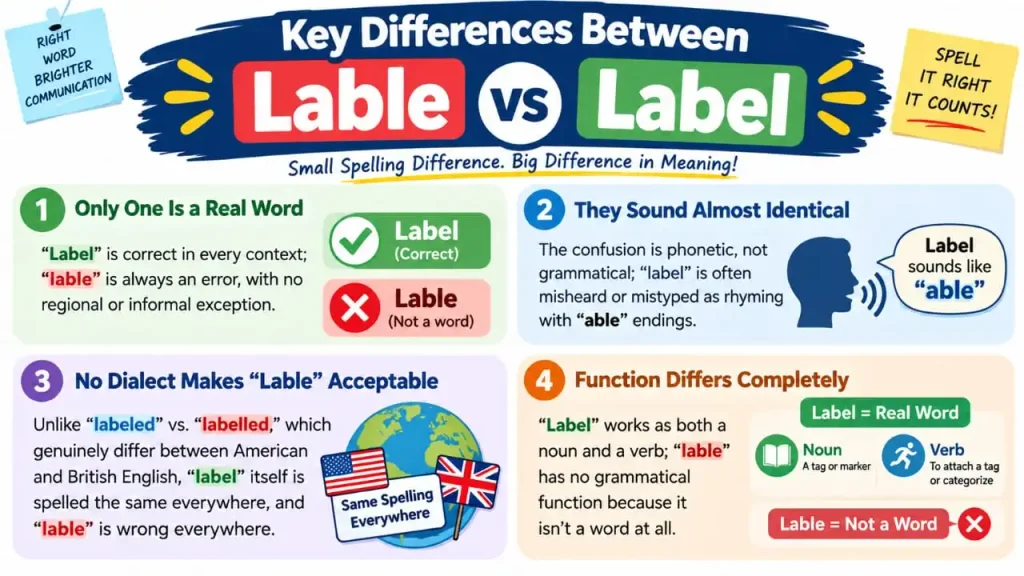
Now that you’ve seen both words defined, here’s the lable vs label difference boiled down to the essentials:
- Only one is a real word. “Label” is correct in every context; “lable” is always an error, with no regional or informal exception.
- They sound almost identical. The confusion is phonetic, not grammatical; “label” is often misheard or mistyped as rhyming with ” able” endings.
- No dialect makes “lable” acceptable. Unlike “labeled” vs. “labelled,” which genuinely differ between American and British English, “label” itself is spelled the same everywhere, and “lable” is wrong everywhere.
- Function differs completely. “Label” works as both a noun and a verb; “lable” has no grammatical function because it isn’t a word at all.
Memory Trick: How to Never Misspell “Label” Again
Here’s the simplest way to lock this in: label ends like table, not like ” able.” Both “label” and “table” end in ” el,” not ” le.” Since most people already know how to spell “table” without thinking twice, pairing the two words gives your brain a stable anchor.
If you want a slightly deeper fix, it helps to recognize that this is the same type of error as swapping letters in “library” (typed as “libary”) or “receive” (typed as “recieve”), two more entries on our Commonly Misspelled Words list. Your brain knows the correct order, but under time pressure, your hands sometimes rearrange letters that sound adjacent. Once you notice you’re prone to this pattern, proofreading for it becomes much faster, because you’re not questioning your vocabulary; you’re just double checking your typing.
This kind of pairing (matching a tricky word to a familiar one that already ends the same way) is a common classroom technique for exactly this reason: it gives you something to check against instantly, without needing to look anything up.
Common Mistakes with “Label” (and How to Fix Them)
| Incorrect | Correct |
| Please lable the invoice before you file it. | Please label the invoice before you file it. |
| The lable on the medicine bottle was smudged. | The label on the medicine bottle was smudged. |
| She felt unfairly labled as “not a team player.” | She felt unfairly labeled as “not a team player.” |
| Double check that the shipping lable matches the order number. | Double check that the shipping label matches the order number. |
The error shows up most often when people are typing quickly under a deadline: finishing an email before a meeting, uploading a product listing before a sale ends, or filling out a shipping form at the last minute. Slowing down for a single extra second before hitting send is usually enough to catch it, especially once you’ve trained yourself to notice the ” able” pull.
A quick note on “labeled” vs “labelled”: this is a separate, legitimate spelling difference, not a mistake (see our full Labeled vs Labelled guide for every tense and form). American English uses “labeled” (one “l”), while British and Australian English use “labelled” (two “l”s). Both are correct in their own dialect. “Lable,” on the other hand, isn’t correct anywhere, in any dialect, in any form.
Quick Quiz: Lable vs Label?
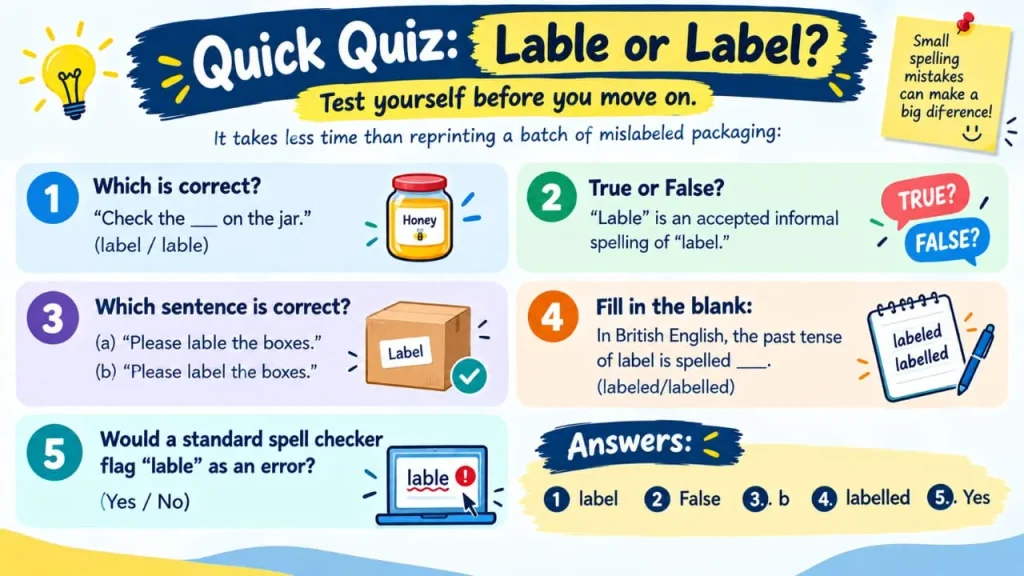
Test yourself before you move on. It takes less time than reprinting a batch of mislabeled packaging:
- Which is correct? “Check the ___ on the jar.” (label / lable)
- True or False: “Lable” is an accepted informal spelling of “label.”
- Which sentence is correct? (a) “Please lable the boxes.” (b) “Please label the boxes.”
- Fill in the blank: In British English, the past tense of label is spelled ___. (labeled/labelled)
- Would a standard spell checker flag “lable” as an error? (Yes / No)
(Answers: 1. label, 2. False, 3. b, 4. labelled, 5. Yes)
Frequently Asked Questions
Is “lable” a word?
No. “Lable” is not a recognized word in any dialect of English. It’s simply a common misspelling of “label,” and no dictionary lists it as a valid alternative.
Why do people spell label as lable?
Because of how the word sounds. “Label” can feel like it should rhyme with ” able” endings, so the last two letters get transposed while typing. It’s a fast typing slip, not a sign that someone doesn’t know the word.
Is it labeled or labelled?
Both are correct, just in different dialects. “Labeled” is standard American English, while “labelled” is standard British and Australian English. Neither one relates to the “lable” misspelling; that’s wrong in both dialects.
What is the correct spelling of label in the UK?
“Label” itself is spelled identically in UK and US English. The only dialect difference shows up in verb forms like “labeled” versus “labelled.”
Will spell check catch “lable”?
Yes. Since “lable” isn’t a real word, virtually every spell checker and grammar tool, from Word to Google Docs to browser extensions, will flag it automatically.
What is a synonym for label?
It depends on the meaning. As a noun referring to a physical tag, synonyms include “tag” or “ticket.” As a verb meaning to categorize, synonyms include “classify” or “categorize.”
Is the lable vs label debate really about grammar?
Not quite. Despite how it’s often framed, this isn’t a grammar rule or a usage nuance; it’s purely a spelling issue. “Label” has one correct spelling, and “lable” is simply incorrect, regardless of tense, dialect, or context.
The Bottom Line
The lable vs label question has a simple, permanent answer: label is correct, and lable is not a word in any context. The mix up is common enough that even experienced writers catch themselves making it when they’re typing quickly, which is exactly why a quick mental check (“label ends like table”) is worth keeping in your back pocket.
Next time you’re writing a product description, an email, or a shipping form, that one second pause will save you the reprint my friend never wanted to pay for. For more word pairs like this one, browse our Commonly Confused Words hub.
To read more: Hangar vs Hanger: What’s the Shocking Difference? 2026

Marcus is a former product manager turned comparison writer who spent eight years testing tools and gadgets before quitting to write full-time. He specializes in breaking down tech and software matchups into plain-English verdicts, with a soft spot for buying guides nobody else wants to write.