Principles vs Principals this homophone pair is one of the most commonly mixed up word pairs in English, tripping up students and professionals alike, largely because spellcheckers often fail to catch the error. Despite sounding identical, these words come from entirely different roots and serve completely different purposes.
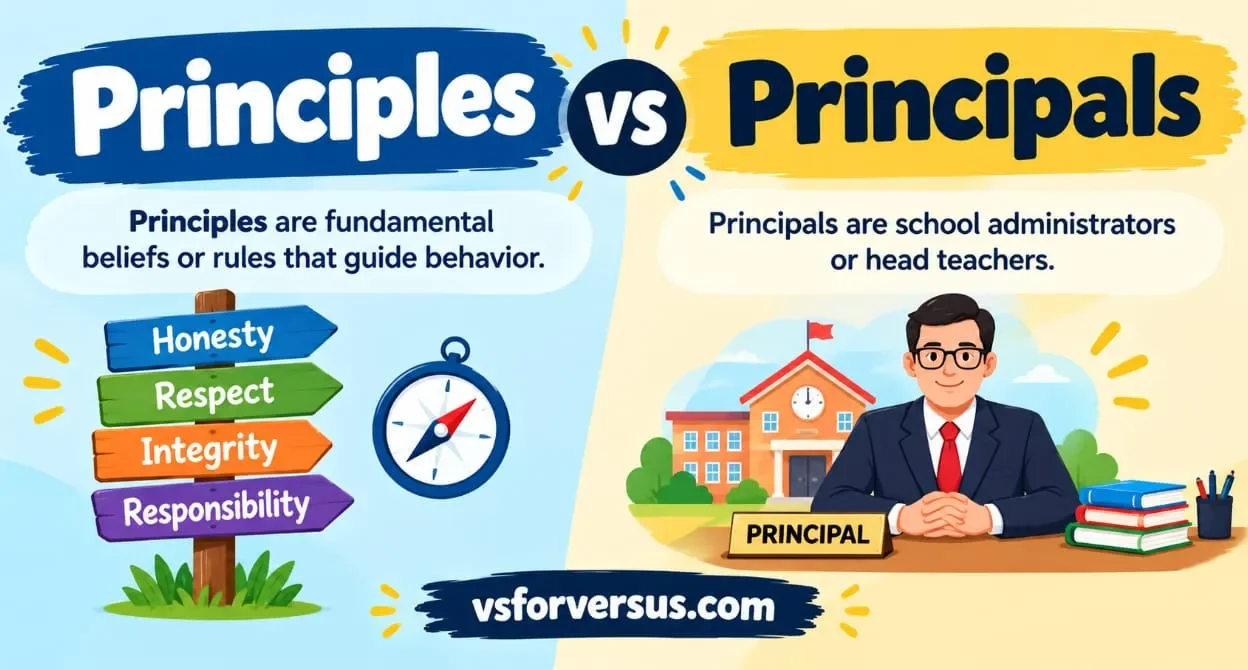
Principles refer to fundamental truths, core beliefs, or guiding rules that shape behavior and decision making, such as moral principles or scientific principles. Principals, on the other hand, typically refer to the head of a school, the most important person in an organization, or even the original sum of money in a financial context, as in loan principal. A single misplaced letter can completely change the meaning of a sentence, making this distinction especially important in academic, professional, and financial writing.
In this article, we’ll unpack the origins of both words, clarify their correct usage, and provide clear examples to help you never confuse them again.
Quick Answer
Principle is always a noun that means a fundamental rule, law, or belief, as in “honesty is a core principle.” Principal can be a noun meaning a person in charge, such as a school administrator or company partner, or an adjective meaning “main” or “most important.” Both words are pronounced identically, which is the root cause of the confusion between principles vs. principals in everyday writing.
Principles vs Principals: Comparison Table
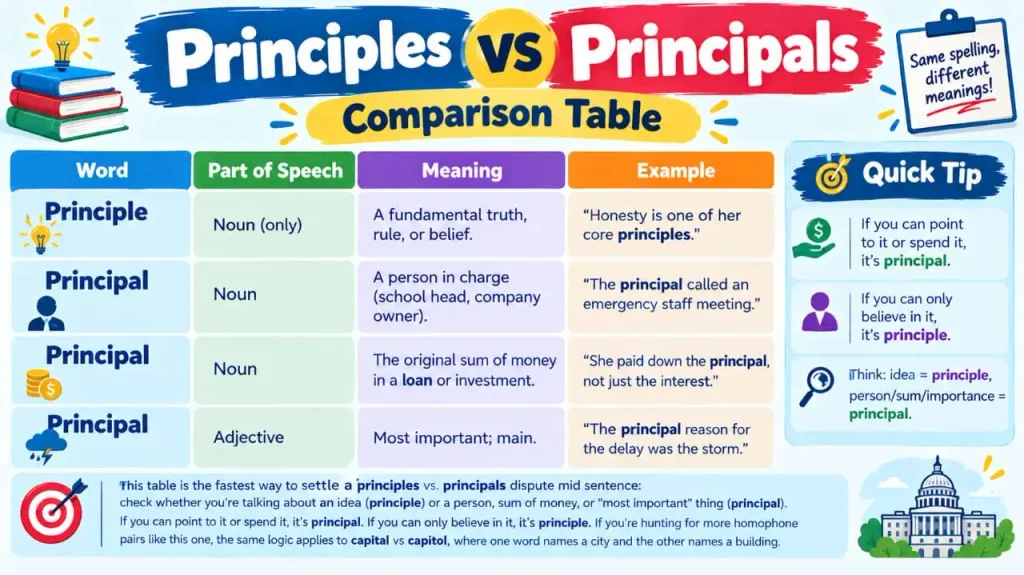
| Word | Part of Speech | Meaning | Example |
| Principle | Noun (only) | A fundamental truth, rule, or belief | “Honesty is one of her core principles.” |
| Principal | Noun | A person in charge (school head, company owner) | “The principal called an emergency staff meeting.” |
| Principal | Noun | The original sum of money in a loan or investment | “She paid down the principal, not just the interest.” |
| Principal | Adjective | Most important; main | “The principal reason for the delay was the storm.” |
This table is the fastest way to settle a principles vs. principals dispute mid sentence: check whether you’re talking about an idea (principle) or a person, sum of money, or “most important” thing (principal). If you can point to it or spend it, it’s principal.
If you can only believe in it, it’s principle. If you’re hunting for more homophone pairs like this one, the same logic applies to capital vs capitol, where one word names a city and the other names a building.
“Principle”: Definition, Examples, and Contexts
Principle only ever functions as a noun. It refers to a rule, law, moral standard, or foundational truth, something you believe in, or something that governs how a system works. Legal writing leans on it constantly too: a contract might reference “the principle of good faith,” or a judge might explain a ruling by citing “a long standing legal principle.”
- “The principles of good customer service start with listening before responding.”
- “He turned down the extra commission on principle; it felt like a conflict of interest.”
- “We covered Newton’s principles of motion in this week’s physics unit.”
- “Our team operates on one core principle: ship small, ship often.”
You’ll run into principle most often in three settings. In academic and essay writing, it shows up whenever a discussion turns to ethics, laws, or scientific theory. In workplace communication, people invoke it to describe personal values, often in a resume line like “guided by strong principles of integrity.”
And in everyday conversation, it surfaces in the fixed phrase “as a matter of principle,” used when someone’s decision is driven by belief rather than convenience. One pattern worth memorizing: principle tends to travel with words like fundamental, guiding, moral, and core, a useful signal when proofreading.
“Principal”: Definition, Examples, and Contexts
Principal does double duty as both a noun and an adjective, which is part of what makes principles vs. principals such a persistent point of confusion; one word simply has more jobs than the other.
- “The principal sent a note home about the new pickup procedure.”
- “After five years, the loan’s principal had dropped below half of what we originally borrowed.”
- “The principal concern from the client was timeline, not budget.”
- “She recently made partner at the law firm after eight years as an associate.”
- “Closing costs on the house were separate from the principal we financed.”
Three everyday contexts account for nearly all uses of principal. In education, it’s the job title students learn first, the person who runs a school. In finance and real estate, it names the original amount borrowed or invested, kept separate from interest, fees, or returns, which is why mortgage statements always list “principal” and “interest” as two different line items.
And in business or the performing arts, it marks a lead role: a principal at a consulting firm, a principal dancer, a principal investigator on a research grant. A quick substitution test helps: if you can swap in “main” or “chief” and the sentence still makes sense, you almost certainly want principal.
Key Differences at a Glance
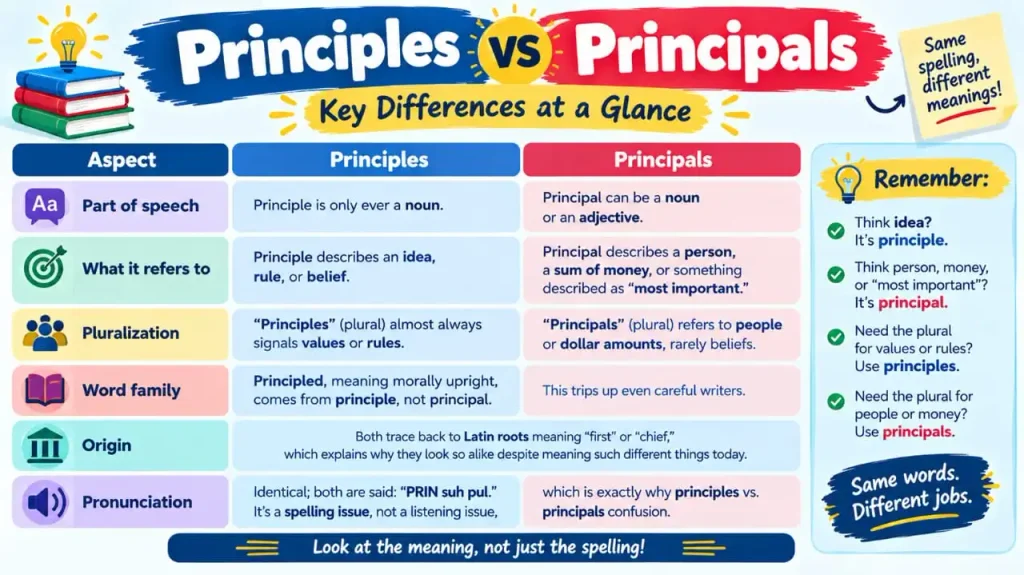
- Part of speech: Principle is only ever a noun. Principal can be a noun or an adjective.
- What it refers to: Principle describes an idea, rule, or belief. Principal describes a person, a sum of money, or something described as “most important.”
- Pluralization: “Principles” (plural) almost always signals values or rules. “Principals” (plural) refers to people or dollar amounts, rarely beliefs.
- Word family: Principled, meaning morally upright, comes from principle, not principal. This trips up even careful writers.
- Origin: Both trace back to Latin roots meaning “first” or “chief,” which explains why they look so alike despite meaning such different things today.
- Pronunciation: Identical; both are said: “PRIN suh pul.” It’s a spelling issue, not a listening issue, which is exactly why principles vs. principals confusion survives even among fluent, well educated speakers.
Memory Trick: How to Remember the Difference?
The classic mnemonic is this: the principal is your pal. Both words end in ” pal,” and a principal is almost always a person: a school administrator, a business partner, a lead performer.
Here’s an honest caveat worth mentioning. Plenty of people notice this mnemonic doesn’t always feel true. The school principal wasn’t necessarily anyone’s friend, often quite the opposite, if you were the one sent to their office. Fair enough. The trick isn’t claiming the principal is likable; it’s simply a spelling anchor. Person equals pal equals principal, regardless of how you actually felt about them growing up.
If that version doesn’t stick, try the backup mnemonic: principle, like rule, ends in ” le.” Both words describe a standard you follow, and both share that ending. Between the two, most learners find at least one that lands, which makes the principles vs principals distinction far easier to recall under pressure. The same kind of memory trick works well for council vs counsel, another pair that trips people up because the words sound alike but serve completely different roles in a sentence.
Common Mistakes Between Principles vs Principals
Even experienced writers slip here. It tends to happen more in formal writing than in casual texting, likely because professional and academic contexts use both words far more frequently, and because spellcheck can’t catch this error, since both spellings are real words.
| ❌ Wrong | ✅ Correct |
| “He refused the deal on principal.” | “He refused the deal on principle.” |
| “The school principle gave a speech at graduation.” | “The school principal gave a speech at graduation.” |
| “It works on the simple principal that heat rises.” | “It works on the simple principle that heat rises.” |
| “She’s known as a woman of strong principals.” | “She’s known as a woman of strong principles.” |
| “The company’s principle investor pulled funding.” | “The company’s principal investor pulled funding.” |
A clear pattern runs through all five errors: the writer means rule, belief, or “most important,” but reaches for the wrong spelling out of habit, likely because principal is the more visually familiar word, appearing on school signs, job titles, and loan paperwork. Reading a sentence back and asking, “Am I describing a person or money, or an idea?” resolves nearly every case in seconds.
Quick Quiz: Test Yourself
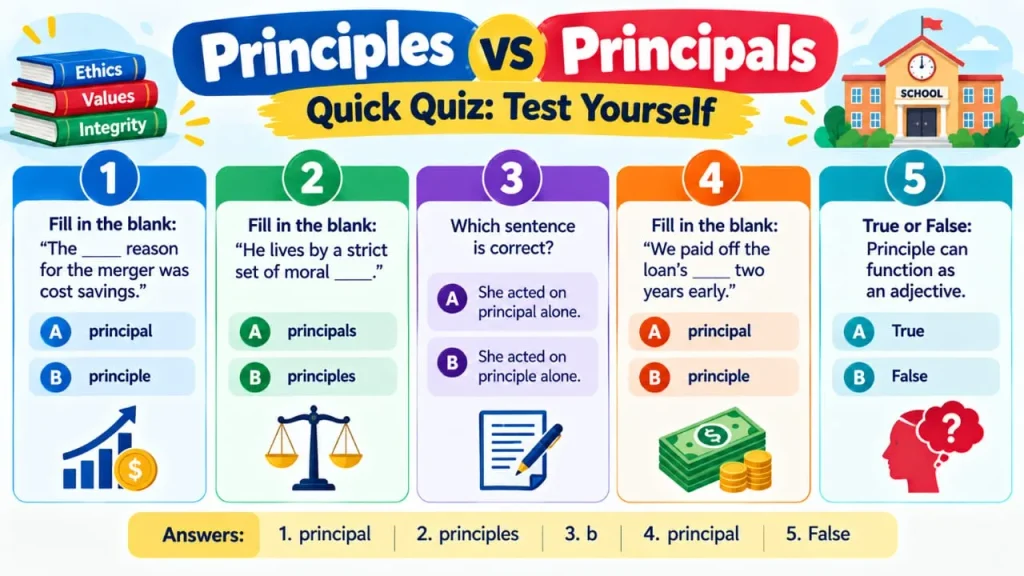
- Fill in the blank: “The ___ reason for the merger was cost savings.” (principal/principle)
- Fill in the blank: “He lives by a strict set of moral ___.” (principals/principles)
- Which sentence is correct? a) “She acted on principal alone.” b) “She acted on principle alone.”
- Fill in the blank: “We paid off the loan’s ___ two years early.” (principal/principle)
- True or False: Principle can function as an adjective.
(Answers: 1. principal, 2. principles, 3. b, 4. principal, 5. False)
Frequently Asked Questions
What is the difference between principal and principles?
Principal refers to a person in charge, an amount of money, or something described as “main” or “most important.” Principles, the plural of principle, refers to rules, beliefs, or fundamental truths. The core principles vs principals distinction always comes down to person or money versus idea.
Is it “school principal” or “school principle”?
It’s always “school principal.” The person who runs a school is described using the noun form of principal, never principle, regardless of dialect or region.
How do you remember principal vs. principle?
The most common mnemonic is “the principal is your pal,” since both words end in ” pal” and principal usually refers to a person. A backup option is “principle, like rule, ends in le.”
What does “principal” mean in finance?
In finance, principal refers to the original amount of money borrowed or invested, separate from interest or returns. For example: “The principal on the loan was $15,000 before interest.”
Is “principled” related to principal or principle?
Principled comes from principle, not principal. Someone described as “principled” acts according to strict moral rules or values, not a job title or a sum of money.
Can “principal” be an adjective?
Yes. As an adjective, principal means “main” or “most important,” as in “the principal cause of the delay was weather.” Principle, by contrast, is only ever a noun; it has no adjective form of its own.
Bottom Line
Getting principles vs principals right isn’t about memorizing dry grammar rules; it’s about pausing for one extra second to ask whether you mean an idea or a person. If homophones like this one trip you up, it’s worth reviewing related pairs such as affect vs effect and capital vs capitol, since the same one second check works for all of them.
To read more:Pickup vs Pick Up: What’s the Difference? (+ Free Mnemonic Trick) 2026

Marcus is a former product manager turned comparison writer who spent eight years testing tools and gadgets before quitting to write full-time. He specializes in breaking down tech and software matchups into plain-English verdicts, with a soft spot for buying guides nobody else wants to write.