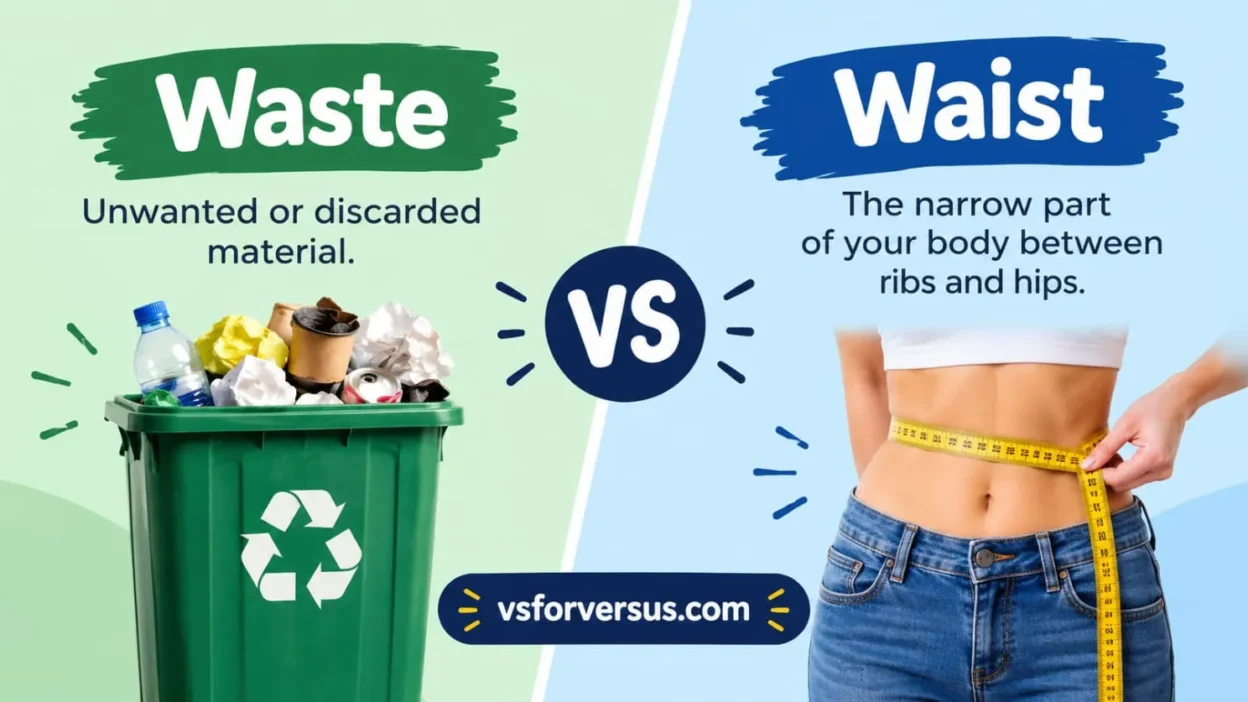
Waste vs Waist this homophone pair is a classic example of how two words can sound completely identical yet belong to entirely different categories of meaning. Because they’re pronounced the same way, spellcheckers rarely catch the mistake, making this one of the sneakiest errors in everyday writing.
Waist is strictly a noun, referring to the narrow part of the body between the ribs and hips, or the matching part of a garment, as in “she wore a belt around her waist.” Waste, on the other hand, is far more versatile; it can function as a verb meaning to use something carelessly, a noun referring to unwanted material, or even an adjective describing something discarded or barren, such as “food waste” or “wasted time.”
Since both words are pronounced /weɪst/, the confusion is purely visual, not grammatical. In this article, we’ll explore the origins of both words, break down their correct usage, and share clear examples to help you avoid this common mix up for good.
Quick Answer
Waist is a noun for the narrow part of the body between the lowest ribs and the hips, while waste means to use something carelessly, or refers to unwanted leftover material. Both words are pronounced /weɪst/, which is exactly why waste vs waist trips up so many writers. A reliable test: if “midsection” fits the sentence, write waist; if “squander” or “trash” fits, write waste.
Waste vs Waist at a Glance
| Word | Part of Speech | Meaning | Example |
| waist | Noun | The narrow part of the body between the ribs and hips, or the matching part of a garment | “These jeans fit perfectly except in the waist.” |
| waste | Verb | To use carelessly or without need; to weaken gradually (“waste away”) | “I wasted an hour hunting for my charger.” |
| waste | Noun | Unwanted material; careless use of resources | “Our cafeteria cut food waste by a third.” |
| waste | Adjective | Unused, discarded, or barren | “Waste heat from the servers now warms the lobby.” |
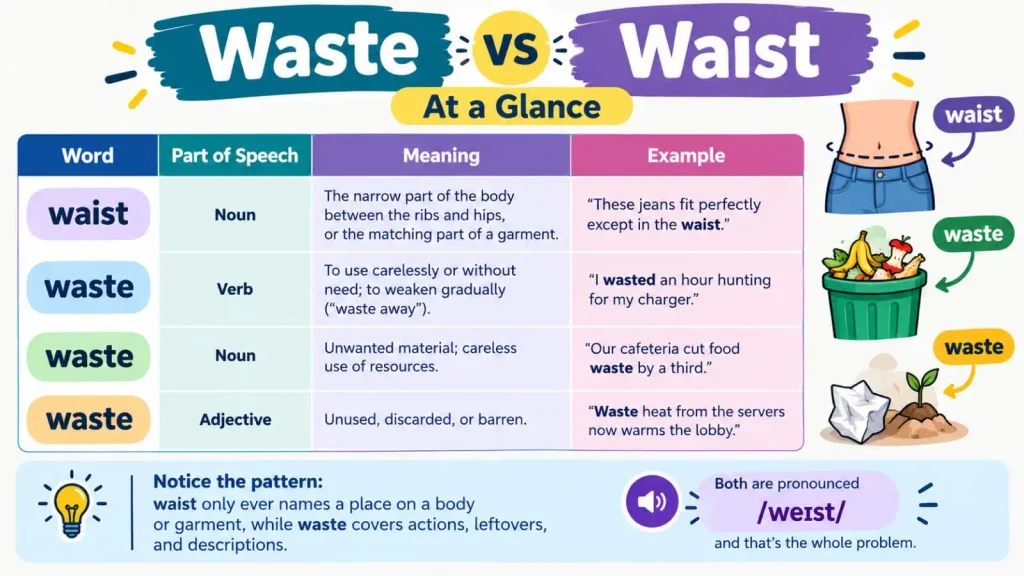
Notice the pattern: waist only ever names a place on a body or garment, while waste covers actions, leftovers, and descriptions. Both are pronounced /weɪst/, and that’s the whole problem.
What Does “Waste” Mean?
Waste is the flexible one. As a verb, it means to use something carelessly, and it can also mean to weaken slowly, as in “waste away.” The noun covers both that careless use and the unwanted material left behind. The adjective describes things that are discarded, unused, or barren, as in “wasteland.”
Here are four ways you’ll see it in real life:
- “Please don’t waste your lunch break on that report; it isn’t due until Friday.” (verb)
- “Our team spent weeks on a feature nobody asked for, which was a waste of everyone’s time.” (noun)
- “The restaurant sends its kitchen waste to a local composting farm.” (noun)
- “After the mill closed, the lot sat as waste ground for a decade.” (adjective)
You’ll meet waste most often around time and money (a waste of time, a waste of money), the environment and business (food waste, waste management), and compound words such as wasteland, wastebasket, and wastewater. It also lives in a few classic sayings, including “haste makes waste” and “waste not, want not.”
What Does “Waist” Mean?
Waist is simpler. It’s a noun, full stop, naming the narrow part of the torso between the lowest ribs and the hips. It can also name the matching part of a garment. Four examples in context:
- “I need a belt; these trousers are loose in the waist.”
- “She tied her jacket around her waist and kept walking.”
- “The river was waist deep by the time we reached the other bank.”
- “Please measure your waist before ordering, since sizing runs small.”
Expect waist in shopping and sizing, fitness, and tailoring. It also builds compound words: waistline, waistband, and waistcoat (the British term for a vest). When describing clothing, English uses the adjective “waisted,” as in “high waisted jeans.”
Key Differences Between Waste vs Waist
Here’s the waste vs waist comparison in scannable form:
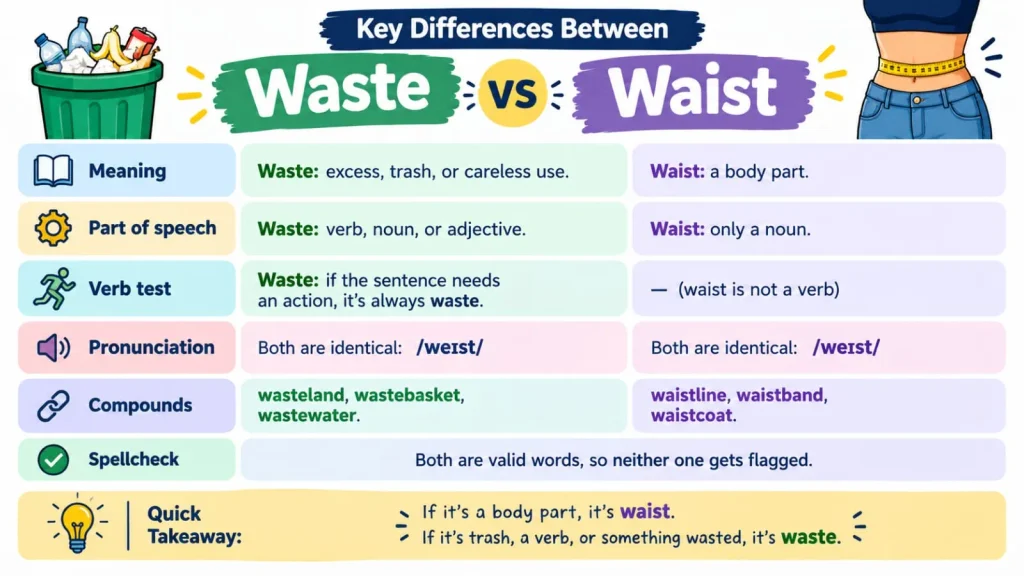
- Meaning: waist is a body part; waste is excess, trash, or careless use.
- Part of speech: waist is only a noun; waste can be a verb, noun, or adjective.
- Verb test: if the sentence needs an action, it’s always waste.
- Pronunciation: identical, /weɪst/.
- Compounds: waistline, waistband, and waistcoat versus wasteland, wastebasket, and wastewater.
- Spellcheck: both are valid words, so neither one gets flagged.
How to Remember Which Is Which?
Three mnemonics make waste vs waist easy to settle. Try all of them and keep whichever sticks.
The swap test. Replace the word with “midsection.” If the sentence still works, write waist. If “squander” or “trash” fits instead, write waste. “That meeting was a midsection of time” makes no sense, so waste is the answer.
“I have a waist.” The letter “i” in waist reminds you that a waist belongs to you. Between these two words, no “i” means waste.
“E for excess.” Waste ends in “e,” the letter excess begins with, and waste is exactly that: more than anyone needed.
The first trick is the most reliable because it checks meaning, not spelling. The other two are quick backups when you’re typing fast. Want to keep this handy? Screenshot the comparison table above, or copy the swap test into your notes app.
Why Even Native Speakers Mix These Up
English has a great many homophones, words that sound alike but are spelled differently, and waste and waist are a textbook pair. When you write quickly, you tend to spell by sound: your mind hears /weɪst/ and your fingers pick a spelling, often the one that feels most familiar. It explains why someone who writes about fitness all week may type “waist” in an email about a wasted budget, and why someone in logistics may do the reverse.
This is also good news for learners of English. If you’ve ever felt that the spelling system is unfair, you’re in good company. Native speakers stumble over the same pairs, so the mistake says nothing about your ability, only about how many spellings English attaches to a single sound.
Where These Words Show Up: Work, School, and Social Media
At work. Operations and sustainability teams write about waste constantly, while retail and apparel teams write about waist measurements. A line like “We cut packaging waste by 18% this quarter” belongs in a sustainability update, while “Available in waist sizes 28 to 40” belongs on a product page. When teams swap topics, the wrong spelling can follow, exactly the mistake that tripped up Priya’s proposal.
At school. Essays on environmental policy are full of waste, in phrases like waste disposal, hazardous waste, and nuclear waste. A health paper might use waist in “waist to hip ratio,” where only the body part makes sense.
On social media. Captions are written fast and rarely proofread. “Wasted a whole Sunday on this spreadsheet” is correct, and so is “Can’t wait to wear my new high waisted jeans.” Swap either spelling and the sentence falls apart.
Phrases Worth Memorizing
Collocations, words that regularly travel together, are one of the fastest ways to lock in the right spelling. Learn these as chunks:
- Waste: a waste of time, a waste of money, go to waste, lay waste to, waste away, waste management
- Waist: waist deep, waist high, waist measurement, waistline, waistband
When a phrase is stored as a single chunk in your memory, the spelling comes with it, and you stop choosing between two spellings every time. Reading them aloud a few times is an easy way to start.
Common Mistakes: Wrong vs Correct
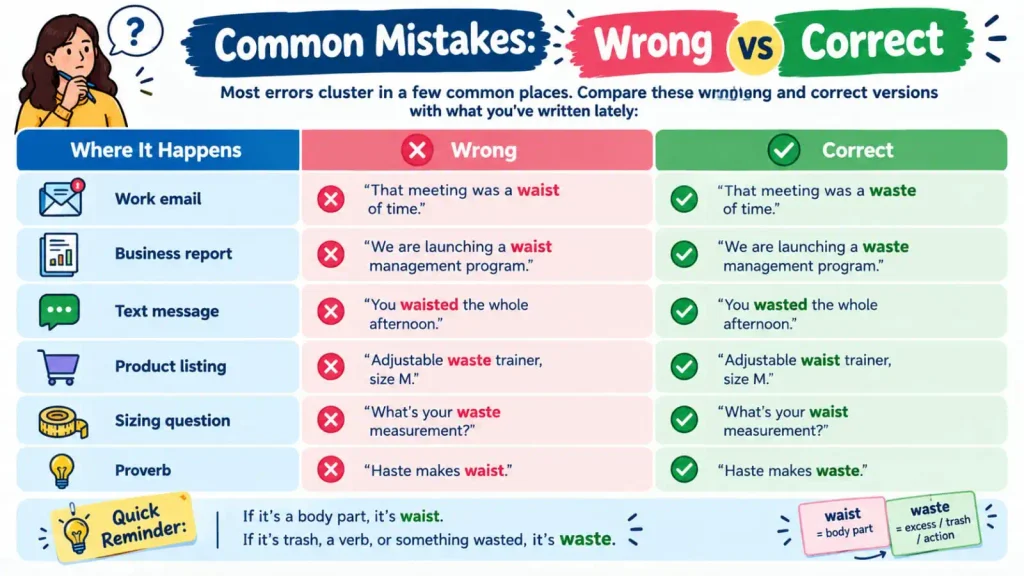
Most errors cluster in a few common places. Compare these wrong and correct versions with what you’ve written lately:
| Where It Happens | Wrong | Correct |
| Work email | “That meeting was a waist of time.” | “That meeting was a waste of time.” |
| Business report | “We are launching a waist management program.” | “We are launching a waste management program.” |
| Text message | “You waisted the whole afternoon.” | “You wasted the whole afternoon.” |
| Product listing | “Adjustable waste trainer, size M.” | “Adjustable waist trainer, size M.” |
| Sizing question | “What’s your waste measurement?” | “What’s your waist measurement?” |
| Proverb | “Haste makes waist.” | “Haste makes waste.” |
Wasted vs Waisted: The Past Tense Trap
The text message example above deserves its own note, because the past tense form is easy to mistype. The past tense of waste is wasted: “You wasted the afternoon.” Waisted is a different word entirely, an adjective meaning “having a waist of a certain kind,” as in “high waisted jeans” or “a fitted, waisted coat.” It is never a verb form.
One more wrinkle: in casual speech, “wasted” can also mean very drunk. That’s a separate, informal sense, but the spelling still comes from waste, never waist.
Quick Quiz: Test Yourself
Fill in each blank to test your waste vs waist instincts, then check the answer underneath. Four or five correct means you have this pair under control.
- Don’t ___ your energy arguing about it.
- Answer: waste. It’s a verb, so waste is the only option.
- The tailor measured her ___ twice.
- Answer: waist. It names the body part.
- Which is correct: “high waisted jeans” or “high wasted jeans”?
- Answer: High waisted. The word describes a garment’s waist.
- Our goal this quarter is to cut food ___.
- Answer: waste. Here it’s a noun meaning unwanted material.
- Which is correct: “You waisted the afternoon” or “You wasted the afternoon”?
- Answer: Wasted. Waisted is never the past tense of waste.
A Note for English Learners
If English isn’t your first language, focus on parts of speech first. Whenever you need a verb, waste is your only option, so you can ignore waist completely. You only have to stop and think when the word is a noun, and then the swap test settles it. Writing a few sentences of your own with each word is a good way to build the habit.
Frequently Asked Questions
What is the difference between waste vs waist?
Waist is the part of the body between the ribs and hips. Waste is unwanted material or the careless use of something.
Is it “waste of time” or “waist of time”?
It’s “waste of time.” Here, waste is a noun meaning careless use, and waist never fits.
Are waste vs waist homophones?
Yes. Both are pronounced /weɪst/, which is why waste vs waist is a spelling problem, not a meaning problem; the definitions never overlap.
Is waist a noun or a verb?
Only a noun. Waste can be a verb, a noun, or an adjective.
Is “waisted” a word?
Yes, as an adjective in phrases like “high waisted.” It is not the past tense of waste; that form is “wasted.”
What is the easiest way to remember which to use?
Use the swap test: if “midsection” fits the sentence, write waist. Otherwise, write waste.
The Bottom Line
Next time waste vs waist comes up in your writing, remember the short version: if the word names a body part or a garment’s middle, it’s waist; for everything else, including time, money, trash, and the past tense “wasted,” it’s waste. Bookmark this page for the moment a draft makes you hesitate.
To read more: Wear vs Ware: 5 Amazing Differences You Must Know

Marcus is a former product manager turned comparison writer who spent eight years testing tools and gadgets before quitting to write full-time. He specializes in breaking down tech and software matchups into plain-English verdicts, with a soft spot for buying guides nobody else wants to write.