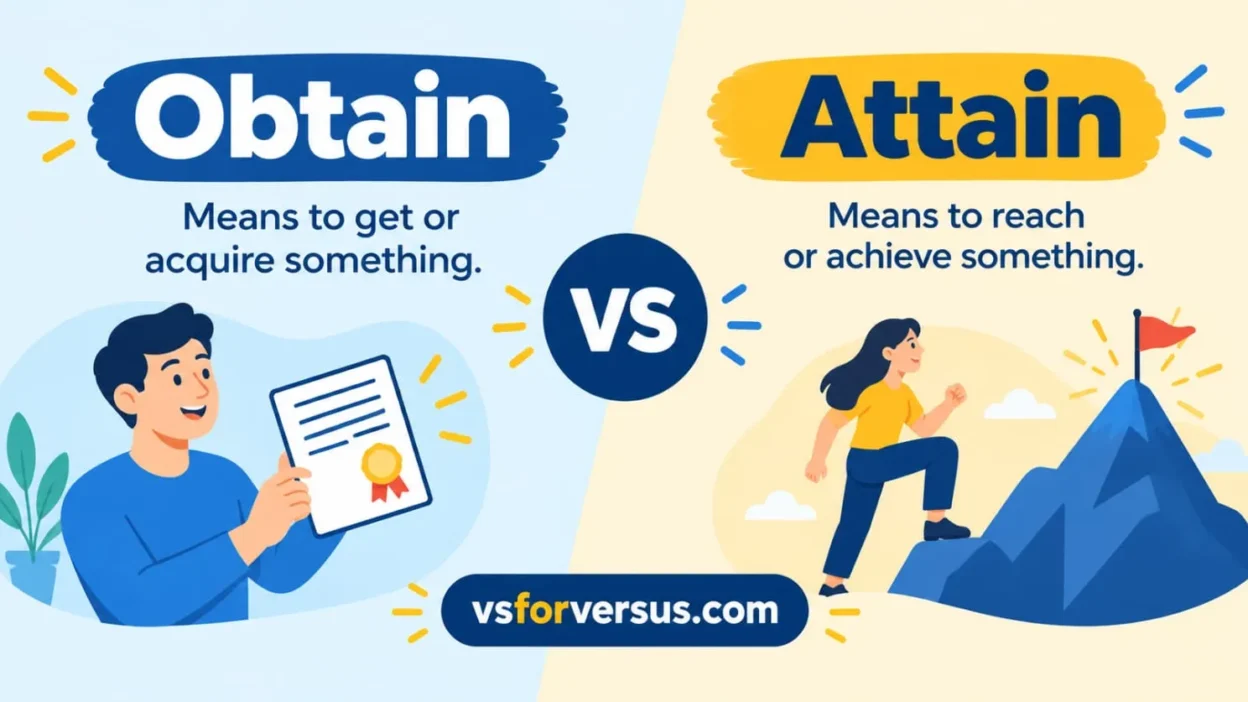
Obtain vs Attain are both related to the idea of “getting” or “achieving” something, but they differ in context and effort. Obtain means to get or acquire something in a fairly simple way, such as a document, permission, or information, without necessarily implying struggle or hard work. For example, “I obtained a copy of the report.”
Attain, on the other hand, means to reach or achieve something difficult, such as a goal, a level, or an achievement, usually through effort, dedication, and time. It’s often used for long term success, as in “She attained her dream job after years of hard work.”
Quick Answer
Obtain means to get or acquire something, usually something tangible, through effort or a process, as in “obtain a permit.” Attain means to achieve or reach something, usually a goal, skill, or status, through sustained effort, as in “attain fluency.”
When the thing you’re describing is a goal or achievement, attain fits; when it’s a possession, document, or something acquired through a procedure, obtain fits. The two overlap only when something functions as both a goal and a physical object, such as a trophy or a diploma.
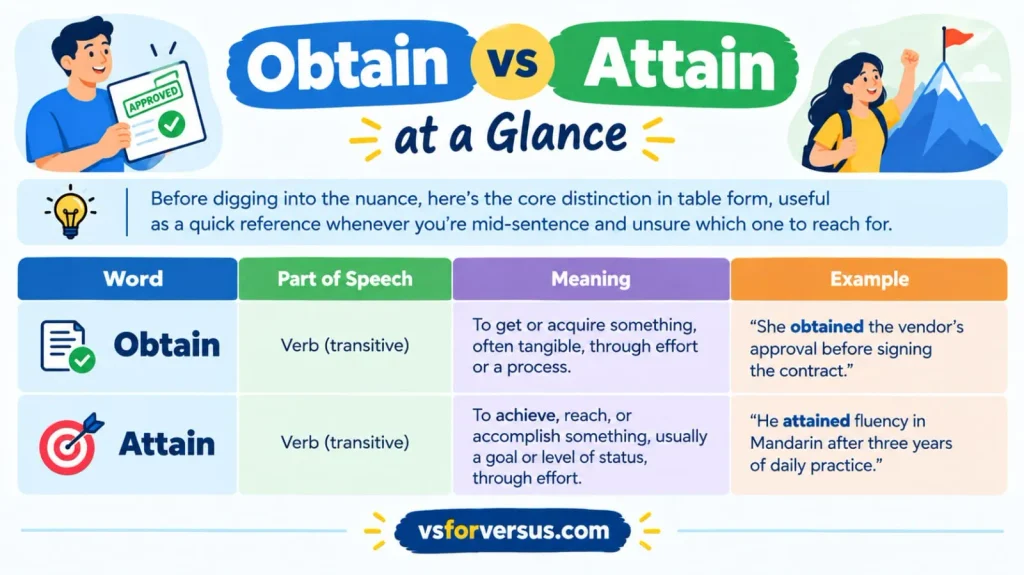
Obtain vs Attain at a Glance
Before digging into the nuance, here’s the core distinction in table form, useful as a quick reference whenever you’re mid sentence and unsure which one to reach for.
| Word | Part of Speech | Meaning | Example |
| Obtain | Verb (transitive) | To get or acquire something, often tangible, through effort or a process | She obtained the vendor’s approval before signing the contract. |
| Attain | Verb (transitive) | To achieve, reach, or accomplish something, usually a goal or level of status, through effort | He attained fluency in Mandarin after three years of daily practice. |
What Does “Obtain” Mean?
Obtain is a more formal, slightly more procedural cousin of “get.” It shows up whenever something is acquired through a request, a transaction, a search, or an official process, and it applies just as comfortably to physical items as it does to permissions, data, or documentation.
If you can picture handing over a form, waiting in a queue, or clicking “submit,” obtain is usually the safer choice. Common synonyms include acquire, secure, and procure.
Examples in natural, real world writing:
- Business email: “Can you obtain sign off from legal before we send this to the client?”
- Academic writing: “The study obtained its data through anonymous online surveys distributed across three universities.”
- Workplace memo: “All contractors must obtain a security badge from the front desk before entering the building.”
- Personal/social: “Finally obtained tickets to the show after refreshing that page for two hours straight.”
None of these sentences involve a lifelong dream or a personal milestone; they involve paperwork, permission, or possession. That’s the throughline. Obtain is the word you want when the emphasis falls on the getting itself: the process, the request, the handoff.
Common contexts: legal and compliance writing (permits, licenses, approvals), procurement and business communication, academic methodology sections, and everyday requests involving documents or access. See also: license vs licence.
What Does “Attain” Mean?
Attain carries more weight than obtain; it implies that whatever you’re describing didn’t just show up; you worked for it. It’s most at home with goals, milestones, skill levels, and status, and it’s rarely used for objects you can simply hand someone.
Common synonyms include achieve and accomplish; if either could replace the word without changing the meaning, attain belongs there. See also: achieve vs accomplish.
Examples in natural, real world writing:
- Resume/career writing: “Attained a 27% increase in team output within the first two quarters.”
- Personal essay: “It took four failed attempts before I finally attained my pilot’s license; the license itself mattered less than proving I could stick with something that hard.”
- Motivational/self improvement content: “You don’t attain confidence overnight; you build it one uncomfortable conversation at a time.”
- Academic/formal: “Candidates must have attained a minimum GPA of 3.5 to qualify for the honors track.”
That second example is doing double duty: the license is a physical card, but the sentence is really about the achievement behind it. That’s where a lot of obtain vs attain confusion actually starts, and it’s worth its own section below.
Common contexts: resumes and performance reviews, academic and admissions writing, self improvement and coaching content, and any writing centered on goals rather than possessions. Hiring managers and admissions readers tend to notice attain specifically because it signals ownership of the outcome, not just proximity to it.
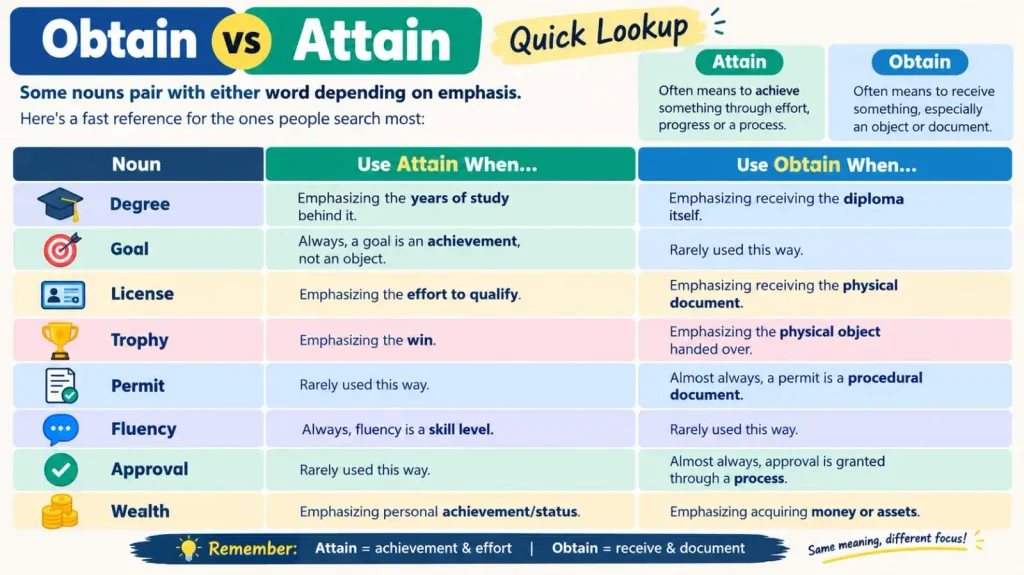
Obtain vs attain a? Quick Lookup
Some nouns pair with either word depending on emphasis. Here’s a fast reference for the ones people search most:
| Noun | Use Attain When… | Use Obtain When… |
| Degree | Emphasizing the years of study behind it | Emphasizing receiving the diploma itself |
| Goal | Always, a goal is an achievement, not an object | Rarely used this way |
| License | Emphasizing the effort to qualify | Emphasizing receiving the physical document |
| Trophy | Emphasizing the win | Emphasizing the physical object handed over |
| Permit | Rarely used this way | Almost always, a permit is a procedural document |
| Fluency | Always, fluency is a skill level | Rarely used this way |
| Approval | Rarely used this way | Almost always, approval is granted through a process |
| Wealth | Emphasizing personal achievement/status | Emphasizing acquiring money or assets |
Key Differences Between Obtain and Attain
Once you’ve seen both words in context, the pattern becomes easier to trust. Here’s the distinction broken down into the pieces that matter most when you’re choosing between them mid sentence.
- Effort type: Obtain implies a process, request, or transaction; attain implies sustained personal effort or growth over time.
- Object type: Obtain typically applies to tangible things, documents, objects, approvals; attain typically applies to intangible things, goals, skills, status, levels.
- Connotation: The mistake is rarely ungrammatical; the two words differ in connotation, with attain reading as more aspirational and obtain reading as more procedural.
- The overlap zone: When something is simultaneously a goal and a physical object, a trophy, a diploma, a certification, either word can work, depending on whether you’re emphasizing the achievement or the item itself.
- A meaning attain doesn’t share: Obtain also has a rarer, more formal sense meaning “to be generally accepted or established,” as in “this custom obtains throughout the region.” Attain has no equivalent usage.
Even experienced writers slip on that overlap zone. It’s common to see a line like “she obtained her black belt” in a martial arts blog written by someone who’s edited copy for years, and it’s not technically wrong, but it undersells the sentence.
“Attained” would have pulled the reader’s attention toward the years of training instead of the belt itself. Knowing the rule doesn’t make the choice automatic; it just makes the choice more deliberate.
Memory Trick: How to Remember Obtain vs Attain?
Here’s the simplest hook, using the first letter of each word against the first letter of what it typically modifies:
- Attain → Achievement (goals, skills, status)
- Obtain → Object (things, documents, permissions)
A second, quick mental test: if you can naturally swap in “achieve,” reach for attain. If you can naturally swap in “acquire” or “get,” reach for obtain. Run that substitution test on any sentence where obtain vs attain has you stuck, and the right word usually surfaces fast.
Common Mistakes with Obtain vs Attain
Most mix ups follow the same pattern: attain gets used for something that’s actually just an object, or obtain gets used for something that’s actually a personal achievement. Seeing the errors side by side makes the pattern click faster than any rule on its own.
| ❌ Incorrect | ✅ Correct | Why |
| “She attained a new laptop from IT.” | “She obtained a new laptop from IT.” | A laptop is a physical item acquired through a request, not a personal achievement. |
| “He obtained his lifelong dream of opening a bakery.” | “He attained his lifelong dream of opening a bakery.” | A “dream” is an achievement, not something handed over. |
| “I need to attain a copy of my transcript.” | “I need to obtain a copy of my transcript.” | A transcript is a document acquired through an office or process. |
| “The team attained a new client contract.” | “The team obtained a new client contract.” | A contract is a document, even though winning it took effort, the emphasis here is on the paperwork itself. |
The fourth pair is genuinely close. Landing a contract still takes plenty of effort, but because a contract is a tangible, signable document, obtain is the more natural fit. Pairs like this are why obtain vs attain trips up confident writers, not just beginners.
Quick Quiz: Obtain or Attain?
Test yourself with these five, then check your instincts against the explanations.
- She trained for two years to ___ her black belt in taekwondo. (attain, the sentence emphasizes the achievement behind the belt)
- You’ll need to ___ a visa before your trip next month. (obtain, a visa is a procedural document)
- He finally ___ the promotion he’d been chasing since 2022. (attain, status/achievement)
- Please ___ written consent from the client before publishing their testimonial. (obtain, formal permission)
- The runner ___ the championship trophy after a photo-finish. (either attain or obtain works; this sits in the overlap zone, depending on whether you’re emphasizing the win or the physical trophy)
Frequently Asked Questions
What is the difference between obtain and attain?
Obtain means to acquire or get something, usually tangible, often through a process or request. Attain means to achieve or reach something, usually a goal or level of status, through sustained effort. That’s the core obtain vs attain distinction.
Can attain and obtain be used interchangeably?
Sometimes. When the thing you’re describing is both a goal and a physical object a trophy, a diploma, a certification either word can work, depending on whether your sentence is emphasizing the achievement or the item itself.
Do you obtain or attain a degree?
Both show up in real writing. “Attain a degree” puts the focus on the years of studying behind it; “obtain a degree” puts the focus on receiving the actual diploma or credential. Neither is incorrect; the choice simply signals what you want the reader to picture first.
Does obtain have another meaning besides “to get”?
Yes, obtain can also mean “to be generally accepted, established, or prevail,” as in “this custom obtains in many cultures.” This usage is far less common, and attain doesn’t share it at all.
Is attain more formal than obtain?
Both outrank “get” in formal writing, but attain carries a stronger sense of personal achievement, which is why it shows up so often in resumes, academic writing, and career narratives.
Why do even fluent English speakers mix up obtain and attain?
Because the words genuinely overlap more than most confusable pairs. Both imply effort, and plenty of things degrees, trophies, licenses can be framed as either an achievement or a possession. The “correct” choice often depends on what you want the sentence to emphasize, not a hard grammatical rule, and that’s what keeps obtain vs attain on the list of persistent mix ups in professional and academic writing.
Is it ever wrong to use obtain instead of attain?
It won’t usually confuse a reader, but it can flatten a sentence that’s meant to highlight effort or achievement. Writing “I obtained my certification” isn’t grammatically incorrect, but it reads as a routine acquisition rather than a milestone; swapping in “attained” restores that sense of accomplishment when it’s actually what you mean.
Final Thought
Getting obtain vs attain right isn’t about memorizing a dry grammar rule; it’s about asking one question before you write the sentence: am I describing something I acquired, or something I earned? Once you know the answer, the right word tends to follow on its own.
Keep that question handy the next time you’re drafting a résumé bullet, a business email, or a personal essay, and this particular mix up will stop costing you a reader’s pause.
To read more: “Obliged vs Obligated: The Shocking Difference? 2026”

Marcus is a former product manager turned comparison writer who spent eight years testing tools and gadgets before quitting to write full-time. He specializes in breaking down tech and software matchups into plain-English verdicts, with a soft spot for buying guides nobody else wants to write.