
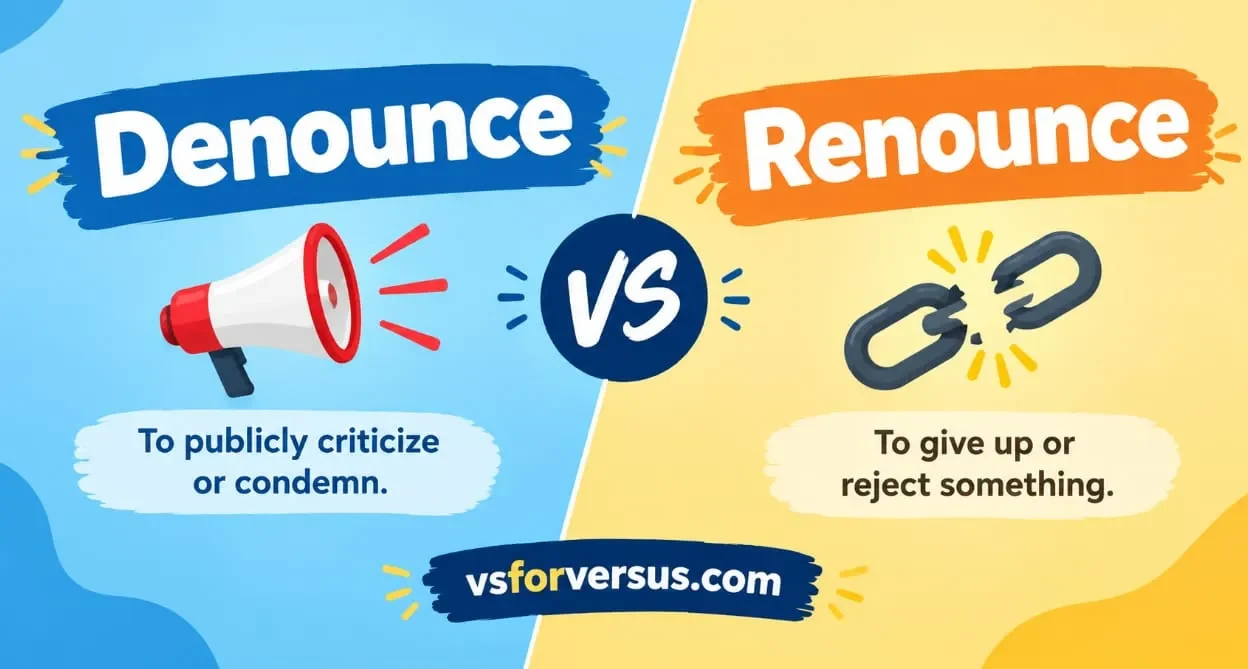
Denounce vs Renounce: At first glance, these two words might look like close cousins since they share the same root and a similar spelling pattern, but their meanings take very different directions. This mix up is common among writers and speakers who assume both words simply mean “to reject something.”
In reality, Denounce means to publicly criticize, condemn, or speak out strongly against a person, action, or belief, often exposing wrongdoing. Renounce, however, means to formally give up, abandon, or reject a right, title, belief, or claim, usually as a personal decision rather than a public accusation.
Understanding this distinction matters, especially in formal writing, legal contexts, and everyday communication. Below, we’ll explore both terms in depth, covering their origins, correct usage, and practical examples to help you use each one with confidence.
Quick Answer
Denounce means to publicly criticize, accuse, or condemn someone or something as wrong; it points outward, at another person, group, or action, as in “The committee denounced the decision as unethical.”
Renounce means to formally give up a belief, right, title, or claim that belongs to the speaker; it points inward, at oneself, as in “She renounced her citizenship after relocating permanently.” A fast way to choose correctly: if the sentence accuses someone else, use denounce; if it gives up something of your own, use renounce.
Denounce vs Renounce at a Glance
Before unpacking the etymology and nuance behind these two words, take a look at the basics side by side.
| Word | Part of Speech | Meaning | Example |
| Denounce | Verb (transitive) | To publicly condemn or accuse someone or something as wrong | “The senator denounced the new policy as discriminatory.” |
| Renounce | Verb (transitive) | To formally give up a right, title, belief, or claim | “He renounced his claim to the family estate.” |
Pronunciation: Denounce is said dih NOUNCE; renounce is said rih NOUNCE. The near identical sound is part of why they’re so easy to swap in speech and in writing.
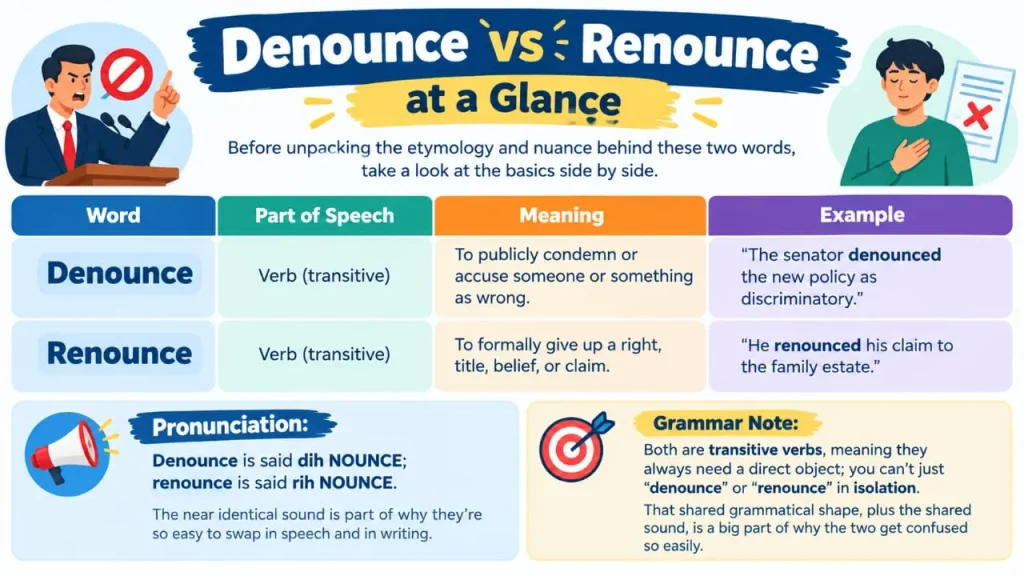
Both are transitive verbs, meaning they always need a direct object; you can’t just “denounce” or “renounce” in isolation. That shared grammatical shape, plus the shared sound, is a big part of why the two get confused so easily.
What Does “Denounce” Mean?
Understanding denounce vs renounce starts with knowing what denounce actually means: to say, publicly and often forcefully, that something is wrong, harmful, or unacceptable. It’s an act of condemnation aimed at someone or something outside yourself: a policy, a person’s behavior, an ideology, or an event.
The word traces back to the Latin denuntiare, meaning “to announce” or “to proclaim officially,” which entered English through Old French with an accusatory edge it has never lost. Today, denounce almost always carries negative, condemnatory weight. Common synonyms include condemn, criticize, decry, and censure.
Here’s how it shows up in real, everyday writing:
- News/political context: “International leaders denounced the airstrikes as a violation of human rights.”
- Workplace email: “In her resignation letter, she denounced the company’s handling of the harassment complaint.”
- Academic essay: “Few contemporaries were willing to publicly denounce the emperor’s policies, fearing exile.”
- Everyday/social media: “He quickly denounced the rumor on Twitter, calling it ‘completely fabricated.'”
You’ll most often see denounce in journalism, human rights reporting, formal complaints, and public statements, anywhere someone needs to go on record against something they believe is wrong.
What Does “Renounce” Mean?
Renounce works differently. Using it correctly means formally giving something up a belief, a title, a right, a claim rather than condemning someone else’s actions. Unlike denounce, renounce is inward facing: you’re not accusing another party; you’re stepping away from something that was, or still is, yours. Common synonyms include relinquish, forswear, and repudiate.
Renounce comes from the Latin renuntiare, “to proclaim back,” borrowed into English via Old French renoncer. Where denounce kept its accusatory sting, renounce evolved toward the quieter, more personal sense of relinquishment.
Real world examples:
- Legal/immigration context: “After two decades abroad, she renounced her citizenship and applied for naturalization elsewhere.”
- Professional context: “He renounced his seat on the board rather than face a conflict of interest inquiry.”
- Academic/historical essay: “The monarch renounced the throne to marry outside the royal family.”
- Personal/belief context: “In his memoir, he describes renouncing the political party he’d supported for thirty years.”
Renounce shows up constantly in legal documents, immigration paperwork, discussions of inheritance and titles, and personal accounts of changing one’s beliefs or affiliations.
Key Differences Between Denounce vs Renounce
Once you see them side by side, the denounce vs renounce pattern becomes clear:
- Direction: Denounce points outward, at someone or something else; renounce points inward, at something the speaker holds or owns.
- Ownership of the object: You denounce things you have no claim to (a regime, an ideology, a rumor). You renounce things that are or were yours (a title, a right, a belief, a citizenship).
- Emotional register: Denounce is accusatory and public; renounce is a formal act of letting go, which can be quiet or ceremonial rather than combative.
- Typical collocations: Denounce pairs naturally with words like violence, regime, statement, and ideology. Renounce pairs with citizenship, claim, rights, throne, and faith.
- They can coexist in one story: A single person can both denounce and renounce in the same breath, “The prince denounced the corruption in his father’s court, then renounced his own claim to the throne.”
Memory Trick: How to Never Mix Them Up Again
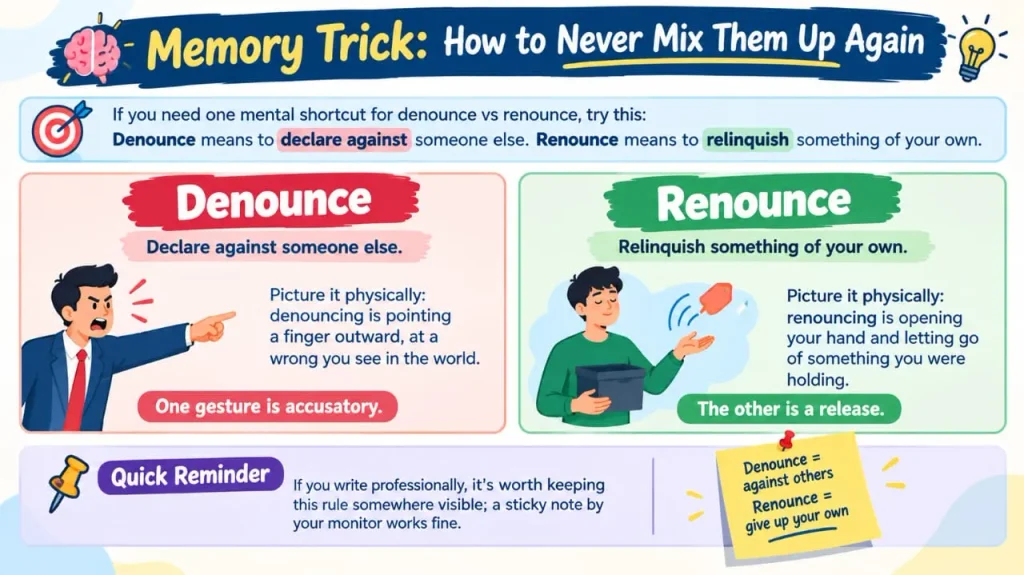
If you need one mental shortcut for denounce vs renounce, try this: Denounce means to declare against someone else. Renounce means to relinquish something of your own.
Picture it physically: denouncing is pointing a finger outward, at a wrong you see in the world. Renouncing is opening your hand and letting go of something you were holding. One gesture is accusatory; the other is a release. If you write professionally, it’s worth keeping this rule somewhere visible; a sticky note by your monitor works fine.
Common Mistakes with Denounce vs Renounce
Even experienced writers trip over denounce vs renounce, especially under deadline pressure, because the words look and sound so similar. Here are real patterns of error, corrected:
| ❌ Incorrect | ✅ Correct |
| “She broke the silence to renounce the verdict.” | “She broke the silence to denounce the verdict.” |
| “He should denounce his affiliation with the group.” | “He should renounce his affiliation with the group.” |
| “The activist renounced the unjust law in a fiery speech.” | “The activist denounced the unjust law in a fiery speech.” |
Notice the pattern: the error almost always happens when the object of the sentence is ambiguous about ownership. Pause and ask yourself, “Is this mine to give up, or someone else’s wrong to call out?” That one question catches most mistakes before they ship. (For more real writing errors like these, see our Common Word Confusions hub.)
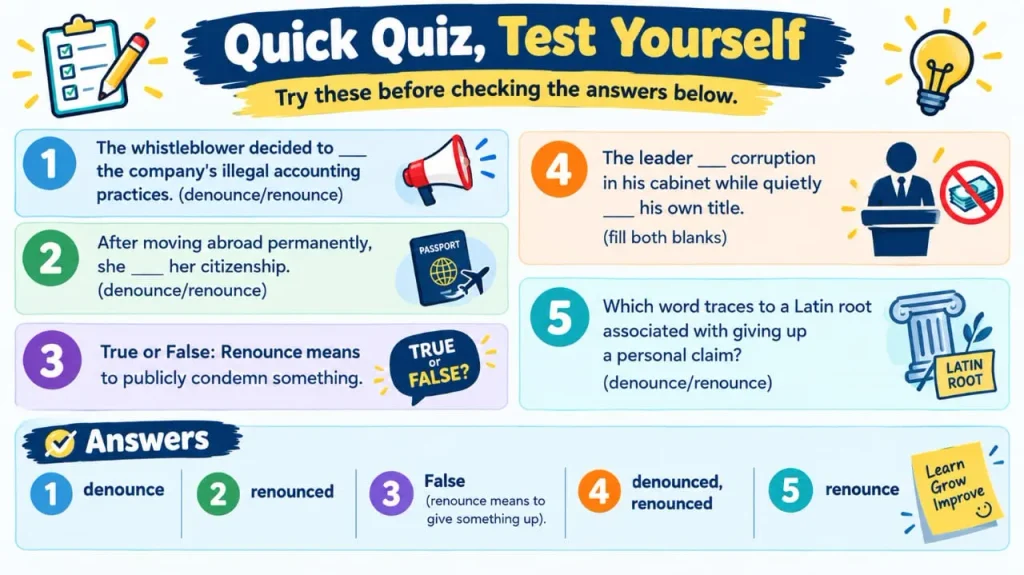
Quick Quiz, Test Yourself
Try these before checking the answers below.
- “The whistleblower decided to ___ the company’s illegal accounting practices.” (denounce/renounce)
- “After moving abroad permanently, she ___ her citizenship.” (denounce/renounce)
- True or False: Renounce means to publicly condemn something.
- “The leader ___ corruption in his cabinet while quietly ___ his own title.” (fill both blanks)
- Which word traces to a Latin root associated with giving up a personal claim? (denounce/renounce)
Answers: 1. denounce, 2. renounced, 3. False (renounce means to give something up), 4. denounced, renounced, 5. renounce
Frequently Asked Questions
What is the difference between denounce and renounce?
Denounce means to publicly condemn or accuse someone or something as wrong; renounce means to formally give up something that belongs to you, like a title, right, or belief. The distinction comes down to whether you’re pointing at someone else’s wrongdoing or letting go of your own claim.
What does it mean to renounce something?
To renounce something means to officially and voluntarily give it up, a citizenship, a right, a religious belief, or a title, usually through a formal statement or declaration.
What does it mean to denounce someone?
To denounce someone means to publicly and openly criticize or accuse them of wrongdoing, often in a formal or high stakes setting like politics, journalism, or a public statement.
Can you denounce and renounce the same thing?
Denounce and renounce can both apply to the same situation, but not to the same object; for example, someone can denounce a corrupt system while renouncing their own role or title within it.
What are the noun forms of denounce and renounce?
The noun form of denounce is denunciation, an act of publicly condemning something. The noun form of renounce is renunciation, the formal act of giving something up.
Why do denounce and renounce sound so similar?
Both words share the Latin root nuntiare, meaning “to announce” or “to proclaim,” which is also the root behind announce and pronounce. That shared root, plus near identical spelling, is exactly why so many people search denounce vs renounce to sort them out.
Final Thoughts
At the end of the day, denounce vs renounce comes down to one simple question: are you condemning something outside yourself, or are you giving up something that belongs to you? Keep that one distinction in mind outward accusation versus inward release, and you’ll never send another email, essay, or public statement with the wrong word in it again.
To read more: Councillor vs Counselor: What’s the Shocking Difference? 2026

Marcus is a former product manager turned comparison writer who spent eight years testing tools and gadgets before quitting to write full-time. He specializes in breaking down tech and software matchups into plain-English verdicts, with a soft spot for buying guides nobody else wants to write.